Tag Archives: christian nationalism

Christian Nationalism in Australia – A Religious View (Part 2)

This post continues from “Christian Nationalism in Australia – A Religious View (Part 1)

Last week I wrote about attending an online conference on Christian Nationalism organised by staff at Eva Burrows College, part of the University of Divinity. It was refreshing to see some public action against Christian Nationalism emanating from a Christian institution, though the tepidness of the proposed opposition was somewhat exasperating.

After the first session, attendees were invited to choose one of a number of break-out sessions. I chose a talk from Reverend Dr Graham Hill, whose presentation was entitled “When Faith is Captured by Fear: Discipleship, Peace and the Challenge of Christian Nationalism in Australia.”

Graham Joseph Hill is an Australian theologian, a former associate professor of the University of Divinity, and currently a mission catalyst for the Uniting Church in New South Wales and the ACT. Hill is the author of 18 theological books, including Kingdom or Empire?: Following Jesus in an Age of Nationalism, Populism and Political Idolotary. No prizes for guessing who that caps fits!
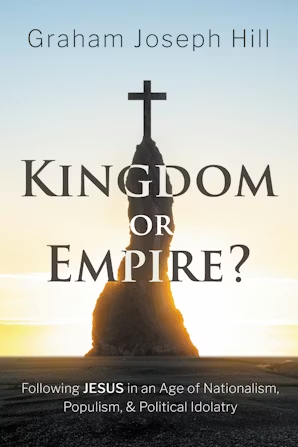
The blurb for Hill’s book says:

“Nationalism and populism promise security, belonging, and power, but at the cost of distorting the gospel. Too often, the cross is wrapped in a flag, and allegiance to Christ is replaced with loyalty to empire.

… Hill exposes the dangers of Christian nationalism while offering a compelling vision of the kingdom of God: a kingdom marked by justice, humility, reconciliation, and love. 

… [He] invites Christians to disentangle faith from partisan agendas and to rediscover the dangerous, beautiful hope of following Jesus in a world that confuses power with truth.”

Graham Hill’s theology is admirable, but his presentation left me feeling that the church’s response is too timid for the scale of the threat.

Nevertheless, I was impressed that, early in his talk, Graham mentioned we could all learn a lot from the sovereignty of First Nations people – a sovereignty that doesn’t seek to dominate others, exploit resources, or to build empires.

Conversely, he reminded us of the close connection between Christian nationalism and its complicity in colonialism. It was Christian nationalism, says Graham that justified British colonialism – the British felt (or at least argued) that they had a “divine mandate” to Christianise the world. (And I would say look at how well that went, but apparently we’re not supposed to expect another “Spanish Inquisition” – which is awkward because history suggests we probably should.)

In Australia, Graham continued, the same ideology was used to legitimate the dispossession of Aboriginal lands, the removal of children and cultural erasure.

Australia, says Graham, is experiencing the “quiet arrival of a loud ideology.” Christian Nationalism is being promoted on Youtube, through imported sermon series, from vocabulary being adopted by congregations and by rhetoric from the pulpit. It’s being discussed in prayer meetings and in pastoral conversations. There are small groups, he says, where “conspiracy and scripture sit side by side.”

The fear that Australia’s imagined “Christian heritage” is being undermined is not always expressed in religious language. The ideology is masked by populist slogans like “Stop the Boats!” and “Jobs and Growth”.

Dr Hill would be too refined to mention this, but the one that comes to mind for me is, “Fuck off, we’re full!”

The message, says Graham, is that, for Christians, the primary danger is no longer sin, but cultural decline. The refugee becomes the invader. Worship becomes a source of anxiety. “The cross is refashioned as a tribal banner.” It is reminiscent, he says, of the German church under Naziism.

Graham concedes that this “rhetoric of national grievance” is beginning to infiltrate Australian churches, and that the wider church community is starting to see the danger.

“History shows the danger to which it leads,” says Graham.

Meanwhile, we heathens have been raising the red flag on Christian Nationalism since the early 2000s and begging the mainstream church to get involved and take care of its own dirty laundry.

Referring to his book, Kingdom or Empire, Graham acknowledges the patriarchal tendencies of the church, but notes that Jesus was not a king. Jesus didn’t rule by fear, domination or violence. In his own time, he was revolutionary and subversive. He offered the promise of liberation from the Roman Empire, but by embracing love, not war, (as the war-mongering MAGA would have said when they were hippies back in the 60s). The Jesus of the New Testament was about love, peace and reconciliation. He was humble and non-violent.

Contrast this with the rhetoric of US Secretary of Defence, Pete Hegseth, this week. Hegseth delivered a prayer at a Pentagon worship service he claimed was inspired by Ezekiel 25:1 but which was, in fact, nearly a verbatim recitation of Samuel L Jackson’s fictional monologue from Pulp Fiction.

Mercifully failing to appear in black face and effecting a Samuel L Jackson impersonation, Hegseth nevertheless repeated his dialogue almost word for word: 

Blessed is he who, in the name of camaraderie and duty, shepherds the lost through the valley of darkness for he is truly his brother’s keeper and the finder of lost children.

And I will strike down upon thee with great vengeance and furious anger those who attempt to capture and destroy my brothers.”

This is a language that is familiar to me. Many years ago during the HIV AIDS crisis, an ecumenical service was organised in Tasmania to pray for those who were afflicted by this, then incurable, disease. A friend who attended a Pentecostal Church was outraged by this plan.

“Surely,” I said, “A loving god would be happy to see his followers put aside their differences and come together to pray for the end to a disease that’s causing so much suffering.”

She was a small, quietly-spoken woman of habitually meek demeanour, but at that moment her eyes blazed and her face grew hard as she spat at me, “He is NOT a loving God – he is a RIGHTEOUS God!” This is the version of God that was being taught to worshippers at the Assemblies of God in the 1980s.

Christians, says Graham, need to resist populism and the “pull of the crowd.” He reminds us that propaganda and conspiracy theories during Jesus’ lifetime led to crowds shifting from calling “Hosanna!” to “Crucify him!”

Christianity is not meant to be forced upon populations, Graham insists. It is not – or should not be – a religion of conquest and domination. In Graham’s understanding of the Bible, the Kingdom of God is meant to “grow like a mustard seed” –  quietly, organically, relationally, and not through force, domination, or conquest. This is the opposite of the spirit of Christian nationalism and populism.

This struck a chord with me as I remembered a conversation I had with my late, fundamentalist Christian brother.

“Why won’t you believe in God and accept Jesus as your Lord and Saviour? What has turned you away from God?”

“You!” I replied truthfully. “I love you, and I know you’re a good person, but your religion is teaching you to hate, to be bigoted and judgemental, to lose your sense of humour, and to rudely impose your religion forcefully on people like me who have no interest in it. As far as I can see it only makes you angry and unhappy. You aren’t modelling a faith I would want any part of.”

At the time, he was working on a project to prove to the Jews that they were wrong.

I said, “I have this vision of Jesus poking his head through the clouds and shouting at your pastor, “Shut up! Shut up! Shut up! You’re not bloody helping!”

So what is the answer to the incipient Christian nationalism seeping through Australian churches? It’s an important question because it’s not just divisive for the country, but for Christianity itself.

I can’t see myself ever believing in God, but Graham’s version of Christianity is one I can respect, while the Christianity of Lyle Shelton and David Pellowe is one I have sworn to oppose with every fibre of my being.

For Graham, within the church, there should be more pastoral guidance, and more important questions about how this ideology is a mismatch for Christian theology. Graham does not propose waging a religious war against Christian nationalists, but to gently persuade them of the error of their ways.

He says that more liberal Christians need to find ways to listen deeply to the concerns of Christian nationalists. Othering them and treating their views with disdain, he says, will only entrench their positions.

I recall American Episcopalian Archbishop Shelby Spong warning that fundamentalism was going to destroy the Christian Church. I agree. And I have said repeatedly that while those of us outside the church can be allies, real change will only come from within the church – which is why I attend these kinds of conferences.

And yes, a Zoom conference is a nice, if belated, start to turn the tide. But the mainstream church needs to be far more proactive and outspoken. It needs a far more energetic approach if it wants to protect its own institutions from these “reconstructionists” who, despite their name, are busy burning down the house.

I guess it’s a start, at least, and Graham does concede that “silence can become complicity.” But, I openly admit, my own approach would be far more bellicose. It’s going to take more than a polite sprinkle of holy water to put out the fire.

Chrys Stevenson

Again, for clarity, please note that any snarkiness about fundamentalism or Christian nationalism in this article comes from me, not from Dr Hill.

See also: Christian Nationalism in Australia: A Religious View (Part One)

Part Three coming soon.
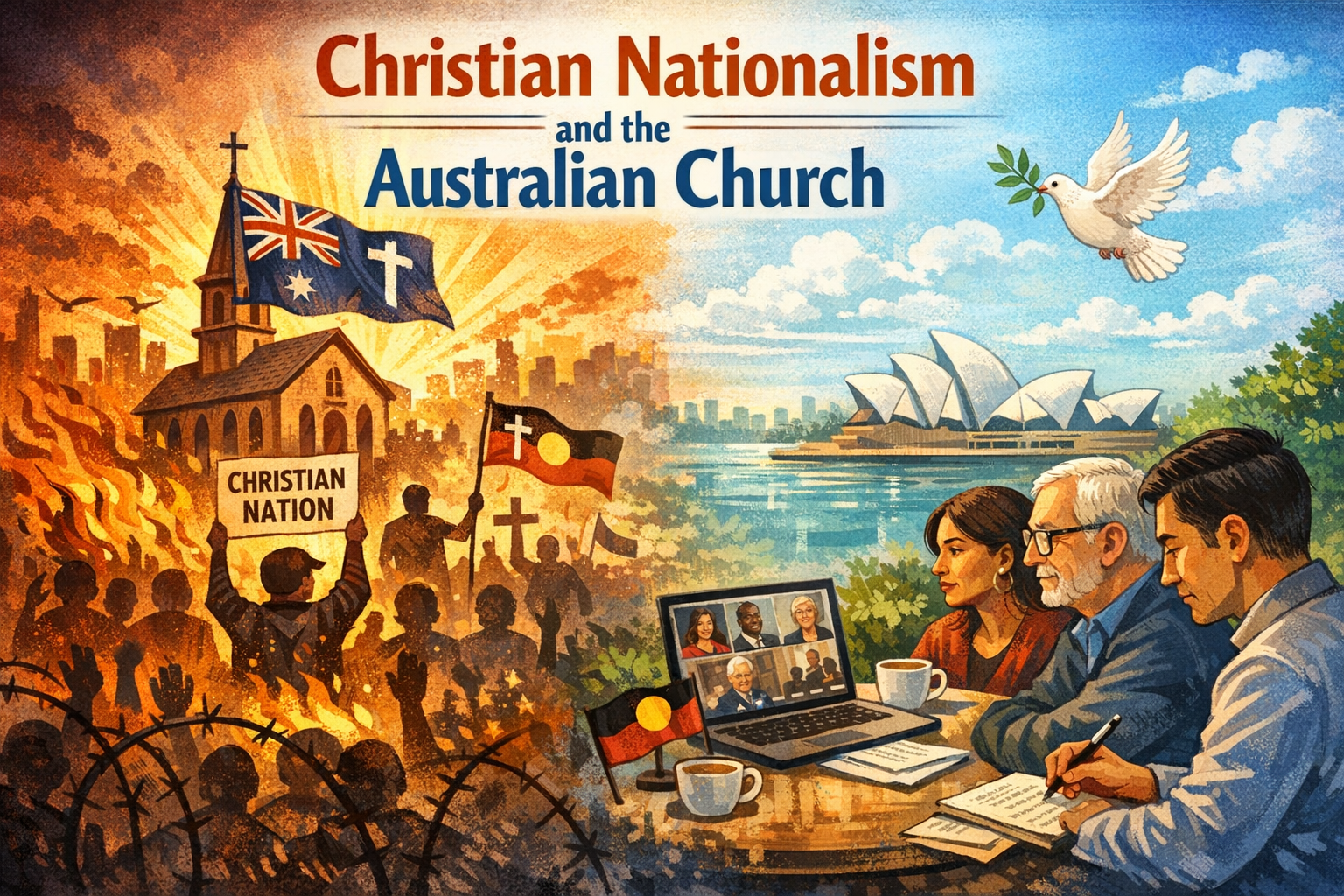
Christian Nationalism in Australia – A Religious View (Part One)

Christian Nationalists are so noisy and obnoxious you can be forgiven for thinking they form the greater part of the Christian Church. This is not true of the USA, where Christian nationalists form a vocal but significant minority group within American Christianity. In Australia, the group is becoming ever more vocal, but is, nevertheless, still an extremist, fringe group.

So, yesterday (10 April 2026), it was a pleasant relief to find myself in a Zoom conference on Christian Nationalism with more than 100 committed Christians, theologians, academics and pastors – none of whom support the idea of a Christian theocracy nor the political machinations of those who embrace the 7 Mountains Movement. 

Christian Nationalism and the Australian Church” was organised by the Salvation Army’s Eva Burrows College and hosted by Reverend Professor Glen O’Brien, a Uniting Church minister and Research Coordinator at Eva Burrows College. He was assisted by Dr Sue Holdsworth, a post-doctoral researcher at Eva Burrows College.

I was impressed that every speaker, without exception, acknowledged this country’s traditional owners, and many noted the Indigenous name of the land from which they were speaking. This is in stark contrast to the noisy Christian voices we heard in opposition to The Voice referendum.

The first speaker was Eleni Poulos, Adjunct Fellow at Macquarie University and a minister of the Uniting Church. Eleni’s deep, calm voice deserves its own radio program (are you listening ABC?).  Eleni has written about the rise of right-wing Christian populism and its impact on Australian politics here.

Eleni noted that the Christian Nationalists’ strategy for shaping public discourse relies on creating fear, then offering themselves as a means of providing protection and a sense of “belonging” to a group which stakes an ownership claim over the nation through the myth of Australia as a “Christian nation”. 

Eleni acknowledges that Christian nationalism is active in Australia but insists it is quite different to what we’re observing in the USA. It is less violent, less political, and a distant concept in the lives of most Australian Christians. 

She notes that the Canberra Declaration which claims Australia’s constitution, culture, laws and values are drawn from our “Judeo-Christian heritage” (in itself, a contentious and problematic term), and that the Australian government “sits on the shoulders of Jesus Christ” – which must be a particularly difficult burden for him to bear! Initiated in 2010, the Canberra Declaration, ostensibly a Christian Nationalist document, has been signed by over 97,000 people.

The associated Daily Declaration is Australia’s largest Christian news site. 

Eleni notes that Dr Augusto Zimmerman, Head of Law and Professor at Sheridan College in Perth and adjunct Professor of Law at the University of Notre Dame, has written a book arguing for the Christian Foundations of the Common Law to be recognised and restored. Not surprisingly it is enthusiastically reviewed by Dr Graham McLennan, another Christian Nationalist, previously of the Australian Christian Lobby and the ever-entertaining Bill Muehlenberg of Culture Watch whose politics are slightly to the right of Attila the Hun. 

Eleni also pointed to The Spirit Behind the Voice: The Religious Dimension of the “Voice” Proposal (2023)a book edited by Gabriël Moens AM and Augusto Zimmerman which, says Eleni, contains, “truly appalling essays against The Voice” including the claim that it might lead to Aboriginal religion becoming the religion of state.

Former national party politician, John Anderson is also a concern for Eleni. His “anti-woke” website has a large readership and if you take a quick gander you’ll see him promoting books like, America’s Cultural Revolution: How the Radical Left Conquered Everything and The Queering of the American Child.

Eleni drew our attention to research by David T Smith, Associate Professor of American Politics and Foreign Policy at the University of Sydney. In 2021, Smith wrote about the “declining policy influence” of the Christian Right in Australia, and its continuous defeats on issues such as same-sex marriage and abortion. This is something I’ve noted previously when documenting the successive failures of Lyle Shelton of the Family First Party (previously Australian Christian Lobby). 

Yet there are subtle reminders of the grip that Christianity has on our secular government. Eleni reminds us that every Australian parliament except for the ACT and most councils open with a Christian prayer – even in constituencies where less than half of the residents are Christian. 

At its heart, says Eleni, Christian Nationalism is about belonging – who belongs, and, of course, who doesn’t. This has a tendency to consider white, western, Christian civilisation as the true citizens of the country with a mandate to “save” the rest of us. The myth of a white, Christian Australia, which most of us abandoned in the 1960s is still, she says, a powerful force. 

A clear danger of this revisionist view of Australian history is that it views Black history as divisive and cultural diversity and the LGBTQ+ community as “existential threats.” It promotes fears about immigration – especially Muslim immigration – and see Christianity as the “social glue” that holds the family, and the nation, together.  

But, Eleni insists, unlike in the USA, Australian Christian Nationalists are not building an agenda for Christian government – at least not yet. 

Christian Nationalism, says Eleni, is not Christianity – it is a distorted view of Christianity which builds walls between people, rather than tearing them down. She refers to it as “culturalized Christianism.” Eleni says that Christian nationalists’ utopian view of a softer and better way of life masks the ideology’s racism, Islamophobia and homophobia. It may result in a better life for white, middle-class, Christians, but woe-betide the rest of us – especially those already at the margins!

So, is Christian Nationalism something we should worry about? Eleni agrees that, although it is not as fully fledged here as it is in the USA, it still poses “a serious minority threat.”

Here, the 7 Mountains Movement is still “embryonic”, although she concedes that it’s been rather more than embryonic in Victoria and Western Australia where evangelical Christian politicians have sought to strong-arm their way into local politics. Still, she says, in her own research, she is “not getting a sense for the desire for a theocracy” but rather just a desire for Christians to have more of an influence over policy. 

In the question time, one attendee noted that Christian nationalism was having an enormous influence in Australian churches and was attracting a big following. Another person noted that the “end times” rhetoric, which claims that Jesus will not return until Christians head all the governments of the world, is not as potent here as it is in the US. 

Another attendee also pushed back saying, “There is more happening at the political level than you think. Although they are quiet behind the scenes, Christian nationalism has got a lot further than is obvious.”

Eleni acknowledged that there is a lot of movement at the Christian nationalist station and, of great interest to me, mentioned the evangelical infiltration of Anzac Day services. 

The seminar made clear that, at least in the opinions of knowledgeable, mainstream Australian Christians, Christian nationalism sits in a liminal space – neither dominant nor dormant. Despite their noisiness online this is an ideology that hovers at the edges of Australian church and public life. Yet the fact that these Christians felt the need to convene an online conference to discuss it suggests that they are looking towards America and are anxious to head off any attempts to theocratise Australia “at the pass.”

It’s encouraging to see so many within the church engaging with this issue with research, serious thought and an integrity that considers, not only the welfare of the Christians and the Church, but also those of other faiths, of no faith, and those who live on the margins of our society. 

Much more was discussed during the day-long seminar, and I will write up my notes over the next week or two.

Chrys Stevenson

For clarity, snarky remarks about Christian nationalists are entirely mine, and not those of the speaker, Eleni Poulos.

See also:

https://theothercheek.com.au/a-look-at-aussie-christian-nationalists/

Christian Dominionism: Follow the Money

This is the text of the speech I gave last weekend at the Secularism Australia Conference. Many thanks to the organisers for asking me to speak on this important subject.

I believe urgent action needs to be taken to head off the Americanisation of Australian politics at the pass. I have spent 12 years following Christian dominionism and Christian nationalism, and the last 3 months undertaking intensive research into the libertarian networks behind these movements.

Issues like prayers in parliament and chaplains in schools and the military are important. I don’t want to take away from the people putting their efforts into these issues. But the matches to light these ‘fires’ are being supplied by foreign networks. If those networks are not challenged we’ll be playing “whack-a-mole” with church/state separation until the second coming of Christ.

I am convinced the only thing that will succeed is for all of those affected by the cancerous political ideology I describe below: atheists, secularists, rationalists, humanists together with feminists, educators, unions, voluntary assisted dying lobbyists, advocates for women’s reproductive choice, LGBTIQ+ groups, environmentalists, climate change activist, medical bodies, and more, to band together and pool our financial and intellectual resources.

As I say below, progressive, wealthy benefactors do exist and we have the potential to be able to fight back if we can get some funding and mount a professional campaign.

This is not my area of expertise. I’ve tried something similar before and failed. I will continue to research and write about this and scream into the abyss and hope someone with vision and energy will hear and take up the challenge. What is needed is a highly professional, strategic, holistic counter-attack. If we don’t fight back, and quickly, Australian democracy is at stake.

Chrys Stevenson

Christian Dominionism: Follow the Money

For all its faults, Australia is a free and democratic country with, generally, sensible attitudes towards religion and one of the best electoral systems in the world. It’s easy to be complacent and imagine this could never change. 

I’ve been researching the rise of Christian dominionism – a very close cousin of Christian nationalism – for the last 12 years. It’s an ideology that teaches that Jesus will not return to earth until his followers have established a global theocracy which will see Old Testament Biblical Law enforced across every nation. 

The dominionists’ plan for achieving Total World Domination is called the Seven Mountains Mandate

Followers of this ideology are encouraged, trained and mentored, to infiltrate and conquer the Seven Mountains of Influence. 

These “mountains” represent: 

  • Government (including law, the military, and our electoral system) 
  • Business (including unions)
  • Education
  • Media and the Arts 
  • Entertainment
  • Religion, and 
  • the Family. 

The Seven Mountains Mandate is a political strategy devised and promoted by a large, but nebulous group, called the New Apostolic Reformation. The NAR’s leaders, revered as “prophets” and “apostles”, aspire, eventually, to sit atop each one of these mountains on every nation on earth – at which point Jesus will return to rapture them to eternal glory in Heaven. 

You may never have heard of the New Apostolic Reformation and that’s just how they like it. But Apostolic networks are among the fastest growing movements in the modern Christian world.

You may be surprised to hear that, according to ChurchWatch Central – an Australian group of concerned pastors, elders and church-goers – the New Apostolic Reformation is associated with over 1000 churches here in Australia. 

The aim of the NAR’s Seven Mountains strategy is for evangelical Christians to infiltrate governments and the public institutions which surround them; quietly building power and influence within those institutions, with the objective of gaining complete control.  

If you look at this as a Christian movement, there is so much about dominionism that just doesn’t make sense. 

Tim Costello from Australia’s Centre for Public Christianity shares my sense of puzzlement about why fundamentalist Christians would embrace a political agenda so totally antithetical to the teachings of Jesus. He says:

“How do you preach Jesus’ love of enemies and defend gun ownership or separate children from parents and place them in cages at the Texan border? 

And how do you reduce the Gospel to securing Supreme Court appointments simply so they will overturn Roe v Wade? 

Why would you suppress telling the truth in schools about US racial history by dismissing it as “woke”? 

According to Reverend Costello:

“You do all that by engaging in a political Christianity that wants to rule.”

Professor Samuel Perry, a leading expert on Christian nationalism, suggests we should look on it as a kind of “impostor Christianity.”  

Russell Moore, formerly a top official with the Southern Baptist Convention and now the editor-in-chief of Christianity Today, says this is Christianity, radicalized to the point that some American pastors cannot preach the Sermon on the Mount, without being heckled for endorsing “woke” liberal talking points.

In order to understand why people who call themselves Christians also oppose government welfare, public schools, gun control and action on climate change, I decided to follow the money.  

What I discovered was an unholy alliance between evangelical Christians affiliated with the New Apostolic Reformation’s Seven Mountains strategy, and a league of ultra-wealthy libertarians who operate a complex, international network of right-wing think-tanks – many of which fall under the umbrella of a group known as the Atlas Network

The ideology expressed in this coalition is called paleolibertarianism – nothing to do with Paleo-Pete. 

Here’s how it works: the Christians took on the libertarians’ economic agenda. In return, the ultra-wealthy libertarians encouraged the politicians who benefit from their donations to endorse the dominionists’ religious agenda. Why? Because the Christians provide the ultra-wealthy with a voting bloc to get their agents into power and remove the taxes and regulations which impact negatively on the unfettered accumulation of wealth.  

Surprisingly, the aims of Christian dominionists and nationalists and the ultra-wealthy libertarians dovetail neatly. The libertarians see democracy as an inconvenient obstacle to free market capitalism. The Christians see democracy as an impediment to instituting Biblical Law. 

In America, the Baptist Joint Committee for Religious Liberty and the Freedom from Religion Foundation have banded together to fight Christian nationalism. Their report on the involvement of Christian nationalists in the January 6 insurrection describes how this mutual back-scratching works:

“The [Christian nationalist] movement threw its support behind Mr. Trump at a critical moment, delivering to him the Republican Party’s most reliable slice of electoral votes. He in turn gave the movement everything he had promised them: power and political access, access to public money, policies favorable to their agenda, and above all the appointment of hard-right judges.” 

Speaking to a gathering of religious right activists in 2021, Senator Lindsey Graham boasted:

“Bottom line is President Trump delivered, don’t you think?” 

Public support for Trump and the paleolibertarian agenda has been boosted by scare campaigns warning that voting for progressive candidates will lead the United States towards socialism or communism. But, in a delicious touch of irony, I discovered the Seven Mountains strategy was not, as its proponents claim, delivered by revelation direct from God; they pretty much plagiarized it from the work of Marxist philosopher, Antonio Gramsci. 

Gramsci and his followers devised a strategy to overturn capitalism by gaining control of the eight Ideological State Apparatuses – an almost identical list to the Seven Mountains. 

You have to admit, it takes a certain kind of hubris for rabid anti-communists to pinch an actual communist plot and rebrand it as “the Word of God.”

The Seven Mountains strategy is working. If a Republican wins the US election in 2024, the white-anting of American democracy will continue in earnest. 

Trump has already flagged his intention to dismiss up to 50,000 secular civil servants and replace them with Trumpist, paleolibertarian, loyalists. That’s the Seven Mountains strategy on steroids! 

This can all seem very US-centric but I am convinced that what is happening in America – and in South America, Europe, and now in New Zealand – will play out next in Australia. 

Australian, Clare Heath-McIvor, was raised in a dominionist church in Victoriawhere her father is the pastor. Brian Heath’s City Builders church was affiliated with ISAAC – the International Strategic Alliance of Apostolic Churches – a kind of south-east Asian branch of the New Apostolic Reformation. As part of that group, Clare remembers being encouraged to chant:

“What time is it? – It’s time to take over.”

In an article for the Australian Rationalist Society last year, Clare warned that Christian nationalism is a bonafide threat to democracy. And she insisted, “Australians need to step on this now.”  

I don’t want to turn this into a McCarthyist kind of witch-hunt. The extent to which these ideologies are embraced by evangelical Christians and libertarians exists on a spectrum. That said, the destruction of democracy is enthusiastically embraced by paleolibertarian leaders and they have a significant following, even here in Australia.

Take this, from Pastor Ian Shelton’s Toowoomba City Church. Back in 2011 when I first embarked on this research, the church’s website described Shelton’s goal to turn Toowoomba into:

“… a transformed city where all the spheres – sport, arts, leisure, welfare, health, media & information, law, police, judiciary, politics & government, business & commerce, & education … come under the lordship of Christ.”

And, while a little church in Toowoomba can seem like small potatoes, remember there are at least 1000 churches around Australia preaching the same doctrine.

Tell me, how would politicians respond if it were 1000 mosques, backed by a global international network, urging their followers to take control of this country’s democratic institutions by stealth?

We can’t be complacent. We have already seen a Pentecostal prime minister secretly appointing himself to no less than five Federal government ministries. We have seen Christian nationalists stacking Liberal party branches in Western AustraliaSouth Australia and Victoria.

Last year, a roadmap came to light, outlining how the religious right could infiltrate the Liberal Party with godly candidates. 

We have heard how the Gold Coast Mayor appointed a “spiritual advisor” with her own office and six-figure salary. And she’s insisted that the mayor ecstatically agreed to help her implement the Seven Mountains strategy on the glitter strip. 

In northern NSW, a National Party candidate declared: 

“I want to bring God’s kingdom to the political arena. And I want God’s kingdom to penetrate the political mountain.”

As secularists our eyes have been fixed firmly on the Christian component of this kooky confederation of Christianity and cash. And if we just look at them it’s easy to tell ourselves they couldn’t organize a school picnic, let alone a bloodless coup. 

We have to realise that the Christians are the circus: the brains, the money, the power and the real strategy is in the far-right libertarian think-tanks which support them. 

Recently,  Dr Jeremy Walker of Sydney’s University of Technology, alerted us to the activities of the Atlas Network here in Australia. Substantially funded by billionaire, Charles Koch, and a number of multi-nationals with interests in fossil fuels and tobacco, Atlas is the network that enlisted the Christian dominionists and nationalists of the New Apostolic Reformation to build the Tea Party movement and infiltrate the Republican Party.

In Australia, the Atlas Network claims eight think-tanks as “partners” including the Centre for Independent Studies, the Institute of Public Affairs, the Australian Institute for Progress and LibertyWorks – the organisation which brought the Conservative Political Action Conference to Australia. 

According to Jeremy, Atlas itself is not a think tank. Rather, it is the “mother-of-all-think-tanks.” It’s an umbrella organisation which provides seed-funding and strategic guidance to 515 libertarian think-tanks across nearly 100 countries – and co-ordinates their activities. This is important. 

They represent themselves as independent voices, but they are involved in strategic campaigns co-ordinated by a foreign interest group.

Many of those pulling the strings in the Atlas Network are also members of another far-right group, the Mont Pelerin Society, whose members have included our own John Howard, mining lobbyist, Hugh Morgan, co-founders of the Centre for Independent Studies, Greg Lindsay and Maurice Newman, and John Roskam – until recently the executive director of the Institute of Public Affairs.

There is also a close association between the Atlas Network and Jordan Peterson’s newly formed Alliance for Responsible Citizenship, which recently held a conference in London. One of the two shareholders in the ARC,  the Legatum Institute, is also an Atlas Network partner.

There are six Australians on the ARC’s advisory board which also includes includes two pastors, a professor of religion and Mike Johnson, the new Republican speaker, who we know has strong affiliations with Christian dominionism.  Of the 1500 people who attended their London conference, a whopping 10 per cent were Australians – many of them leading Liberal politicians. Family First Party national director, Lyle Shelton was also there.

The Atlas Network has form: it is credited with influencing the election of autocraticand ultra-conservative leaders in Brazil, Argentinathe Netherlands and, recently, New Zealand. Will Australia be next?

This may seem disconnected from matters of church and state, but, as oneAmerican professor of religion says, we need to recognize that Christian dominionism is just “part of the tool kit of political radicalism.”

When Australia moved to recognize Indigenous Australians in our constitution and give them a Voice to Parliament, the Atlas Network set to work here, coordinating the efforts of its Australian think-tanks and setting up Advance Australia to spear-head the “No” Campaign. 

They didn’t have to reinvent the wheel. The Atlas Network had already been successful in effectively sinking a United Nations campaign to ensure greater involvement by Indigenous communities in oil and gas production in Canada.

Both Jacinta Price and Warren Mundine are associates of the Atlas Network-affiliated Centre for Independent Studies. Both also have strong ties to religion. 

Adding to the “toolkit”, during the Voice campaign, it was announced that, under the auspices of Advance Australia, another group, Christians for Equality, had been formed, with our old friend, Lyle Shelton, appointed to head it.  

A triumphant “test-run” for the Atlas Network in Australia, its scare campaign managed to bring support for the Voice down 20 points, resulting in the catastrophic defeat of the referendum. 

What might Atlas achieve at our next Federal election? And to whom will conservative politicians be in debt?

If paleolibertarianism gains a firm foothold here in Australia, their targets will include: voluntary assisted dying, women’s reproductive choice, government welfare, public schools, Medicare, unions, marriage equality, gay rights, anti-discrimination laws, immigration and refugees, the rights of people from non-Christian religions, and more. Jacinta Price has already flagged that transgender people are next on her hit-list.

So many groups are threatened by this movement. Yet, we all tend to fight independently on different fronts. 

This goes beyond a risk to the separation of church and state; Australian democracy is at stake. We need to look at what’s happening in America and start taking dominionism, Christian nationalism and these libertarian think-tanks deadly seriously. 

I think we need to pull together a peak group of organisations, including unions and mainstream churches, to counter this movement. 

Ultra-wealthy benefactors with progressive ideas do exist – and while we don’t want this to become a “Clash of the Titans,” we need substantial funding to devise and implement a strategy to counter this assault on our democracy. 

There’s no point tinkering at the edges. We need professional political strategists and communications experts on board to help craft a “cunning plan.”

And finally, we have to understand that the crazy circus that surrounds this movement is a feature, not a bug. It’s there to distract us, to make us underestimate them, and to keep us fixated on the “useful idiots” in the frontline, while the operatives with the money, power, brains and the international networks pull all the strings. 

Recommended further reading:

Elle Hardy, Beyond Belief: How Pentecostal Christianity is Taking Over the World, Hurst & Company London, 2021 (Thank you to Elle and the publishers for providing me with a complimentary copy of the book.)

Katherine Stewart, The Power Worshippers: Inside the Dangerous World of Religious Nationalism, Bloomsbury Publishing, 2020

Melinda Cooper, Family Values: Between Neoliberalism and the New Social Conservatism, Zone Books, 2019 (I haven’t read this yet, but it’s been recommended by Dr Jeremy Walker)

Jeremy Walker, Silencing the Voice: the fossil-fuelled Atlas Network’s Campaign against Constitutional Recognition of Indigenous Australia, Cosmopolitan Civil Societies, 2023. (This is open source. You can access a PDF or HTML full text version by clicking the links to the left of the abstract.)

Jeremy Walker, Atlas Network’s fossil-fuelled campaign against the Voice, Independent Australia, 10 October 2023