This post continues from “Christian Nationalism in Australia – A Religious View (Part 1)“
Last week I wrote about attending an online conference on Christian Nationalism organised by staff at Eva Burrows College, part of the University of Divinity. It was refreshing to see some public action against Christian Nationalism emanating from a Christian institution, though the tepidness of the proposed opposition was somewhat exasperating.
After the first session, attendees were invited to choose one of a number of break-out sessions. I chose a talk from Reverend Dr Graham Hill, whose presentation was entitled “When Faith is Captured by Fear: Discipleship, Peace and the Challenge of Christian Nationalism in Australia.”
Graham Joseph Hill is an Australian theologian, a former associate professor of the University of Divinity, and currently a mission catalyst for the Uniting Church in New South Wales and the ACT. Hill is the author of 18 theological books, including Kingdom or Empire?: Following Jesus in an Age of Nationalism, Populism and Political Idolotary. No prizes for guessing who that caps fits!
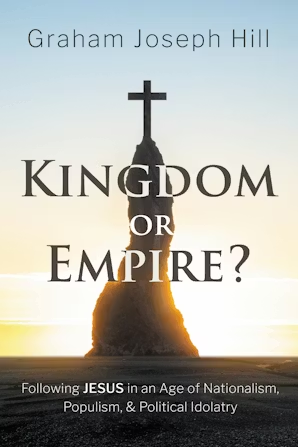
The blurb for Hill’s book says:
“Nationalism and populism promise security, belonging, and power, but at the cost of distorting the gospel. Too often, the cross is wrapped in a flag, and allegiance to Christ is replaced with loyalty to empire.
… Hill exposes the dangers of Christian nationalism while offering a compelling vision of the kingdom of God: a kingdom marked by justice, humility, reconciliation, and love.
… [He] invites Christians to disentangle faith from partisan agendas and to rediscover the dangerous, beautiful hope of following Jesus in a world that confuses power with truth.”
Graham Hill’s theology is admirable, but his presentation left me feeling that the church’s response is too timid for the scale of the threat.
Nevertheless, I was impressed that, early in his talk, Graham mentioned we could all learn a lot from the sovereignty of First Nations people – a sovereignty that doesn’t seek to dominate others, exploit resources, or to build empires.
Conversely, he reminded us of the close connection between Christian nationalism and its complicity in colonialism. It was Christian nationalism, says Graham that justified British colonialism – the British felt (or at least argued) that they had a “divine mandate” to Christianise the world. (And I would say look at how well that went, but apparently we’re not supposed to expect another “Spanish Inquisition” – which is awkward because history suggests we probably should.)
In Australia, Graham continued, the same ideology was used to legitimate the dispossession of Aboriginal lands, the removal of children and cultural erasure.
Australia, says Graham, is experiencing the “quiet arrival of a loud ideology.” Christian Nationalism is being promoted on Youtube, through imported sermon series, from vocabulary being adopted by congregations and by rhetoric from the pulpit. It’s being discussed in prayer meetings and in pastoral conversations. There are small groups, he says, where “conspiracy and scripture sit side by side.”
The fear that Australia’s imagined “Christian heritage” is being undermined is not always expressed in religious language. The ideology is masked by populist slogans like “Stop the Boats!” and “Jobs and Growth”.
Dr Hill would be too refined to mention this, but the one that comes to mind for me is, “Fuck off, we’re full!”
The message, says Graham, is that, for Christians, the primary danger is no longer sin, but cultural decline. The refugee becomes the invader. Worship becomes a source of anxiety. “The cross is refashioned as a tribal banner.” It is reminiscent, he says, of the German church under Naziism.
Graham concedes that this “rhetoric of national grievance” is beginning to infiltrate Australian churches, and that the wider church community is starting to see the danger.
“History shows the danger to which it leads,” says Graham.
Meanwhile, we heathens have been raising the red flag on Christian Nationalism since the early 2000s and begging the mainstream church to get involved and take care of its own dirty laundry.
Referring to his book, Kingdom or Empire, Graham acknowledges the patriarchal tendencies of the church, but notes that Jesus was not a king. Jesus didn’t rule by fear, domination or violence. In his own time, he was revolutionary and subversive. He offered the promise of liberation from the Roman Empire, but by embracing love, not war, (as the war-mongering MAGA would have said when they were hippies back in the 60s). The Jesus of the New Testament was about love, peace and reconciliation. He was humble and non-violent.
Contrast this with the rhetoric of US Secretary of Defence, Pete Hegseth, this week. Hegseth delivered a prayer at a Pentagon worship service he claimed was inspired by Ezekiel 25:1 but which was, in fact, nearly a verbatim recitation of Samuel L Jackson’s fictional monologue from Pulp Fiction.
Mercifully failing to appear in black face and effecting a Samuel L Jackson impersonation, Hegseth nevertheless repeated his dialogue almost word for word:
“Blessed is he who, in the name of camaraderie and duty, shepherds the lost through the valley of darkness for he is truly his brother’s keeper and the finder of lost children.
And I will strike down upon thee with great vengeance and furious anger those who attempt to capture and destroy my brothers.”
This is a language that is familiar to me. Many years ago during the HIV AIDS crisis, an ecumenical service was organised in Tasmania to pray for those who were afflicted by this, then incurable, disease. A friend who attended a Pentecostal Church was outraged by this plan.
“Surely,” I said, “A loving god would be happy to see his followers put aside their differences and come together to pray for the end to a disease that’s causing so much suffering.”
She was a small, quietly-spoken woman of habitually meek demeanour, but at that moment her eyes blazed and her face grew hard as she spat at me, “He is NOT a loving God – he is a RIGHTEOUS God!” This is the version of God that was being taught to worshippers at the Assemblies of God in the 1980s.
Christians, says Graham, need to resist populism and the “pull of the crowd.” He reminds us that propaganda and conspiracy theories during Jesus’ lifetime led to crowds shifting from calling “Hosanna!” to “Crucify him!”
Christianity is not meant to be forced upon populations, Graham insists. It is not – or should not be – a religion of conquest and domination. In Graham’s understanding of the Bible, the Kingdom of God is meant to “grow like a mustard seed” – quietly, organically, relationally, and not through force, domination, or conquest. This is the opposite of the spirit of Christian nationalism and populism.
This struck a chord with me as I remembered a conversation I had with my late, fundamentalist Christian brother.
“Why won’t you believe in God and accept Jesus as your Lord and Saviour? What has turned you away from God?”
“You!” I replied truthfully. “I love you, and I know you’re a good person, but your religion is teaching you to hate, to be bigoted and judgemental, to lose your sense of humour, and to rudely impose your religion forcefully on people like me who have no interest in it. As far as I can see it only makes you angry and unhappy. You aren’t modelling a faith I would want any part of.”
At the time, he was working on a project to prove to the Jews that they were wrong.
I said, “I have this vision of Jesus poking his head through the clouds and shouting at your pastor, “Shut up! Shut up! Shut up! You’re not bloody helping!”
So what is the answer to the incipient Christian nationalism seeping through Australian churches? It’s an important question because it’s not just divisive for the country, but for Christianity itself.
I can’t see myself ever believing in God, but Graham’s version of Christianity is one I can respect, while the Christianity of Lyle Shelton and David Pellowe is one I have sworn to oppose with every fibre of my being.
For Graham, within the church, there should be more pastoral guidance, and more important questions about how this ideology is a mismatch for Christian theology. Graham does not propose waging a religious war against Christian nationalists, but to gently persuade them of the error of their ways.
He says that more liberal Christians need to find ways to listen deeply to the concerns of Christian nationalists. Othering them and treating their views with disdain, he says, will only entrench their positions.
I recall American Episcopalian Archbishop Shelby Spong warning that fundamentalism was going to destroy the Christian Church. I agree. And I have said repeatedly that while those of us outside the church can be allies, real change will only come from within the church – which is why I attend these kinds of conferences.
And yes, a Zoom conference is a nice, if belated, start to turn the tide. But the mainstream church needs to be far more proactive and outspoken. It needs a far more energetic approach if it wants to protect its own institutions from these “reconstructionists” who, despite their name, are busy burning down the house.
I guess it’s a start, at least, and Graham does concede that “silence can become complicity.” But, I openly admit, my own approach would be far more bellicose. It’s going to take more than a polite sprinkle of holy water to put out the fire.
Chrys Stevenson
Again, for clarity, please note that any snarkiness about fundamentalism or Christian nationalism in this article comes from me, not from Dr Hill.
See also: Christian Nationalism in Australia: A Religious View (Part One)
Part Three coming soon.

