Author Archives: thatsmyphilosophy

Shining a spotlight on “Shine”

gender-rolesShine is a ‘self-development’ program run as an extra-curricular activity in schools throughout the country. It’s promoted to parents as being secular, but it isn’t. The program was developed by Hillsong Church and is highly gendered. Shine operates very much like a trojan-horse within schools. Girls are encouraged into the program and the aim is for facilitators to ‘form relationships’ with the girls and to peak their interest in another program, not connected with the school. Facilitators are advised:

“When you go into a high school as a Shine facilitator you are strategically positioned to place value on each girl and her LIFE. It may take a few months from the first meeting until you get a green light to take the program into the school. Be encouraged to develop a good relationship with the school through being patient, gracious and committed… Maintain a servant heart and a desire to be a blessing, remembering that you are in their school environment! If the school is not open to the full course, offer to do a single unit as a sample. We have found consistently that this opens the door for the full program. You will need to contact us if you are in this situation…. If a question arises about the ‘faith-based nature of the program advise the school that the program is based on fundamental life principles. It is not a religious program in any way, shape or form. The values and principles are solely to do with the truth that girls have worth, can develop strength and have purpose. Stay with the basics.” – Source

When the girls have completed the 9 session program they are encouraged to participate in the next phase – outside the school. There, the restrictions of religious evangelising do not apply. It’s about identifying kids who might be vulnerable to a religious message and encouraging them to form a relationship with the facilitators outside the school environment. It is, in my opinion, predatory. Have a listen to one facilitator, Sunshine, describing how she sees this ‘non religious’ program: https://www.youtube.com/watch?v=2W-CnTcdFzQ

The Australian Secular Lobby, in collaboration with the Humanist Society of Queensland, has decided to shine a spotlight on Shine and their equally-gendered program for boys, Strength.

They are seeking input from parents of state school children on their experiences with the program.

If you have had any dealings with Shine or Strength at your school presently or in the past, say, five years, please consider sharing your experience

The ASL and the HSQ promise they will respect contributors’ privacy and will not post the stories submitted anywhere, ever. However, they will be asking some parents, maybe all depending on what comes to light, to consider speaking to a journalist who is interested in a Queensland story on the topic.

Please send details of your experience to one of the following:

ASL@australiansecularlobby.com

info@hsq.org.au

Chrys Stevenson

Quarter of a billion taxpayers’ dollars for THIS, Mr Hockey?

I have a Twitter friend, an ordinary Aussie mum, so outraged at the allocation of nearly quarter of a billion dollars in taxpayers’ money to the National School Chaplaincy Program, she’s taken to scanning the internet for information about what chaplains actually do.

We’re told they can’t proselytise, the guidelines say they can’t ‘counsel’. In a budget which slashed funding for the CSIRO, failed to provide ongoing funding to help students with disabilities to stay in school, cut millions out of Federal funding for dental care and alternative energy, and slashed $80 billion from state-provided health and education services  – how does Mr Hockey justify one-quarter of a billion dollars for chaplains!

What do they actually do?

In my previous post I revealed that, despite the ban on proselytising, chaplains, and the funding recipients which provide them, see one of their key roles as ‘making disciples’.

No, that doesn’t involve a piece of folded up paper and a pair of scissors. It means making your kids into Bible-believing, happy-clapping, tithe-paying followers of Christ; whether you, as a parent, like it or not.

You don’t get to sign a permission slip for your child to ‘attend’ the chaplain’s ‘office’. The chaplain is ubiquitous in the school – speaking (even praying) on assembly and special school events,  in the classroom as a teachers’ aide, coaching sporting teams, running sausage sizzles and crazy hair days, presiding over lunch-time ‘clubs’, mixing and mingling on the playground and accompanying the kids on school excursions. If you want to exclude your child from interaction from the chaplain, you’ll pretty much need to exclude them from school.

Now, chaplains aren’t allowed to proselytise. But if your child finds lunch time a bit boring, they might just follow some of their friends into the chaplain’s lunch time ‘club’ or ‘group’. This, apparently, is allowed under the guidelines.

And, thanks to my curious Twitter friend, we have an insight into the kinds of things that go on in these taxpayer funded sessions in taxpayer funded school rooms. Now, you can see – at least in part – what your quarter of a billion dollars is being spent on!

Calum Henderson is a Christian primary school teacher. Recently, under the auspices of the Crusader Union of Australia – Crusaders: Sharing Jesus with a new generation – Henderson presented a session at a development day for teachers and school chaplains. The session focused on games that can be played during lunchtime Christian group sessions.

No intellectual discussion about the wisdom of the crusades, here, folks! No education about the impact of religion on art and politics, no insights into the theological differences that led to the split between Protestants and Catholics, no introspection about whether modern ethics and Biblical law are compatible!

No. Instead, Calum suggests that chaplains should remove the labels from cans of food and let the kids guess what’s inside them. Could be anything, right? That’s the fun! Bet you would never have guessed Split Pea and Ham Soup! Gotcha!

Here’s another great activity that’s apparently worth more than providing funding for hospitals and dental care:   line up three glasses with three different kinds of Coke in them and see if the kids can tell which is which.

That’ll get those intellectual juices flowing!

And, just to make sure the kids get in some vital physical activity, there’s this great game where one player holds up a finger and the other person tries to grab it. Riveting stuff!

Yes, it’s true, I’m being facetious and misrepresenting these suggestions somewhat. You see, these are not just silly but fun games for bored kids. No. They’re designed to loosen the kids up to be receptive to the chaplain’s message. 

“Try to link games to the Bible topic as often as possible,” Henderson advises. “If you only have 30 minutes, a 10 minute game which reinforces the main point will be incredibly helpful.”

The aim, as the Crusader Union puts it so succinctly is to ‘share Jesus with a new generation’.

Mr Hockey’s quarter of a billion dollar gift is allowing chaplains to do just that – in our public, secular, taxpayer funded schools.

“There is nothing more wonderful than witnessing a young person put their trust in the Lord, walking alongside them as they learn to treasure God’s Word and seeing them go out to declare their faith among their peers. And Crusaders is there to help them!”

“Since 1930,” I learn from their website, “Crusaders has been blessed to see lives transformed by the Gospel on a regular basis. This year, Crusaders staff and volunteer leaders will reach over 2,500 children and teenagers each week across NSW and the ACT with the Good News of Jesus.”

But, Crusaders isn’t just about getting chaplains and teachers to proselytise to children. The aim is to train up kids to bring in their friends. It’s works just like network marketing.

Here’s the blurb:

“CRU knows it can be hard to share Jesus with your friends and stay strong in your faith at school.

That’s why CRU has 6 full-time staff workers to visit, support and speak at your CRU Lunchtime Group, give Bible talks at chapel and help train you for Christian leadership.”

Well, that’s a relief! And your chappie is right there in the school to help you get all your unchurched friends to come to lunchtime groups and, “Hey! Guess what? CRU also holds holiday camps! Cool, huh?” 

You see, the thing is, there’s this inconvenient ban on proselytising in schools, so chaplains have to be a bit subtle. If you can just encourage the kids to attend a camp – and peer pressure functions hugely in this – then you’re free of the constrictions of the National School Chaplaincy and Education Department guidelines. It’s gloves off.

“CRU Camps endeavor to provide all campers with a camp experience where they can build meaningful friendships, see ‘real’ Christian leaders live out what they believe, and have heaps of fun.”

While Australians wait up to six years to see a specialist, while kids’ teeth rot for want of dental care, while science is sold down the river, while pensioners are told they have to pull in their belts even further to help a nation suffering crippling debt, Mr Hockey has found a quarter of a billion dollars for this travesty. 

Mr Hockey will be answering viewers’ questions on Q and A on Monday night. Maybe you’d like to submit one?

Chrys Stevenson


School Chaplains – Making Disciples

make-disciples-textIn last night’s budget, the Abbott government commited a further $245 million to fund the presence of religious chaplains in state schools for the next five years.  This, despite the High Court having already ruled once that such funding is illegal and another decision pending,  following plaintiff, Ron Williams’ return to the High Court last week.

It is not for the High Court to decide on the value or otherwise of placing religious practitioners into schools at the expense of professionals with tertiary qualifications in psychology, counselling and youth work. The Williams decision will be made on the basis of whether the funding arrangements are permitted under the limited legislative parameters placed on the Federal government by the Constitution. 

The argument about whether chaplaincy is a wise or responsible use of public money must take place in the public square, not the High Court. It is for the Australian public to decide whether that money could be better spent on, say, disability services in schools, text books, better IT equipment, airconditioning, swimming pools, or, God forbid, tertiary trained, welfare workers with no particular religious axe to grind.

It is up to the Australian public to exert pressure on their political representatives – both Federal and state –  to end this cynical attempt to purchase the votes of an imagined ‘Christian constituency’.  At its worse, it is outright pork-barreling. At its best, it is pork-barreling combined with an ideological agenda to ‘re-Christianise’ a nation which is moving rapidly away from religious faith by infiltrating the educational incubators of our next generation of workers and leaders. 

The evangelistic tendencies of the mostly fundamentalist, Protestant, religious evangelists who profit from the National School Chaplaincy Program are inexplicably talked up as representing one of the key benefits of the program, while, at the same time frantically obfuscated to deflect criticism.

Chaplains are unashamedly in schools to inculcate ‘values’. They are religious chaplains for a reason: (there never were many truly  ‘secular’ welfare workers’, and the new budget provides only for those of a religious bent). 

John Howard said when he announced the program in 2006 that he was unashamedly calling them chaplains:

“Yes I am calling them chaplains because that has a particular connotation in our language, and as you know, I am not ever overwhelmed by political correctness. To call a chaplain a counsellor is to bow to political correctness. Chaplain has a particular connotation. People understand it, they know exactly what I am talking about.”

When atheist Prime Minister, Julia Gillard, was grilled about her views on the chaplaincy program, she cowered in front of Australian Christian Lobby chief, Jim Wallace and recited a well-rehearsed:

“… my view about the chaplaincy program is yes, it would continue as a chaplaincy program, with everything that that implies.”

And yet, in the face of criticism from various quarters including teachers, parents, psychologists, members of non-Christian religious groups and secularists that the program breaches the spirit of the separation of church and state and compromises the principle of Australian education as ‘free, compulsory and secular’, its advocates stand, hand on Bible, and swear that the religious component is ‘incidental’ because chaplains are expressly forbidden from proselytising in the program’s guidelines.

Confusion reigned in the High Court, this week, when the Commonwealth solicitor-general and the QC representing Scripture Union Queensland made passionate representations about the value of chaplains as counselors – until it was pointed out by both one of the Justices and by Mr Williams’ barrister that the guidelines expressly forbid chaplains from counseling students. 

Mr Williams’ barrister also questioned how the inculcation of ‘values’ – put forward as a benefit of the program –  could be achieved when the specific values associated with religious chaplains (surely irrevocably entwined with the concept of following Christ and his teachings) were not permitted to be proselytised. 

Ron Williams, Hugh Wilson and I, of course, knew the answer to this question was that chaplains routinely counsel and proselytise in a clear breach of the National School Chaplaincy Program guidelines and Education Queensland policy. If they do not, there is really very little purpose to them being in schools beyond running crazy hair days and presiding over sausage sizzles.

So, I was not surprised, this morning, when a Twitter follower sent me a link to a blog called “The crossroad – thoughts on theology, society, justice and discipleship” by Daniel Baxter, a school chaplain who appears to be working in two state schools in Brisbane.

On 12 February, this year, Daniel wrote a blog in which he confessed:

“Discipleship is a journey where we are consistently changed, renewed and restored. It is ultimately a journey deeper into a relationship with Jesus, and to becoming more effective at seeing and establishing the Kingdom of God in our world. It’s a journey I am very passionate about personally, and it is my mission to disciple others, including kids and their families in the schools I work in, as well as those around me in church life. ” [Emphasis added]

I’ve taken a screenshot because experience has shown me that, once spotlighted, these kinds of frank statements tend to magically disappear into the ether.

Baxter Blog

Baxter’s words echo those of Evonne Paddison, whose organisation, Access Ministries, receives millions of taxpayers’ dolars to place chaplains and religious instructors in Victorian schools:

“What really matters is seizing the God-given opportunity we have to reach kids in schools. Without Jesus, our students are lost”.

“It’s important that the church recognize its commission is to make disciples. Our young people need Christ”.

“What a commandment, make disciples (of school children). What a responsibility. What a privilege we have been given. Let’s go for it!”

Similarly, ‘Sunshine’ who spoke for the ‘value’ of Hillsong’s ‘Shine’ program – which was (perhaps unwisely) touted by Scripture Union’s QC as one of the beneficial offshoots of chaplaincy – candidly reveals its real purpose of religion-in-schools in this video:

“This program’s important to me because it gives me an opportunity to connect with the girls out there; it gives the Church an opportunity to have a foot in the door … and to give them those principles that my mom gave me that I know they might not get if they’re not in a Christian family. I want to see these young girls come to knowledge of Salvation; to get to know Jesus Christ as their Lord and Saviour.” – Sunshine Wretham, Shine promotional video

For those chaplains who might be a bit squeamish about openly flouting the rules the solution is easy – and we know it happens routinely; find vulnerable, unchurched kids and encourage them to attend a Scripture Union Queensland camp on the holidays, where the evangelising gloves can come off. It helps if you can encourage their friends to exert a little gentle peer pressure – “Oh come on, we’re all going! It’ll be fun!”

It is well meaning. I have no doubt of the sincerity of these ‘fishers of children’. But at its heart it is predatory behaviour and completely ignores the rights of parents – of all faiths and of none – to maintain control over this aspect of their childrens’ education and philosophical development. 

There is no doubt in my mind at all that the majority of chaplains see their role as making disciples of impressionable children. That their overriding mission in our country’s supposedly secular schools is conversion.

I find it offensive, in the extreme, that in a multi-faith, secular nation, our government is spending an obscene amount of money on this fundamentalist, ideological offensive at the expense of programs that would provide real, tangible benefits to our students. Surely they deserve better.

Chrys Stevenson

Baptist bastardry stripped bare …

Isn’t it curious that those same ‘good’ Christians who believe our kids need to be inculcated with ‘Christian’ values via the National School Chaplaincy Program are quite happy for the Federal government to defy the High Court and spend taxpayers’ money in contravention of the Constitution (according to High Court rulings in Pape and Williams (1)) so long as their own interests are served.

What kinds of ‘values’ are these?

Do we really want our children told that it’s OK to break the law as long as you gain an advantage from it?

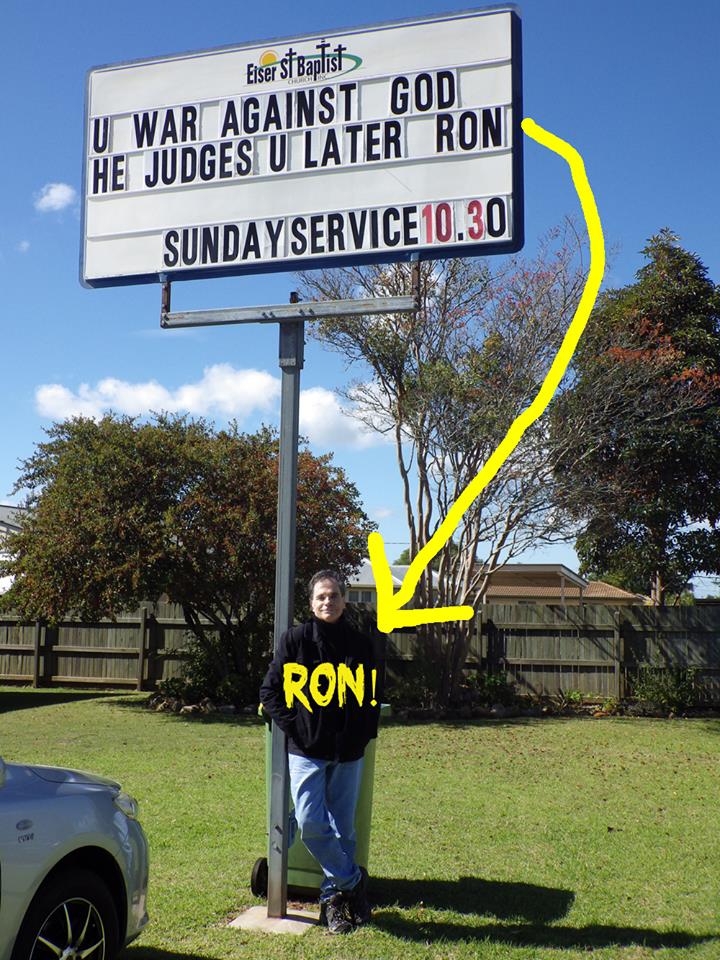
How about using a public sign to bully, threaten and publicly shame someone whose perfectly legal actions you’ve taken issue with? Is this the kind of ‘Christian behaviour’ being modeled by the chaplains who, to date, have cost Australian taxpayers half a billion dollars (and to whom another $250 million has been promised in tonight’s budget).

Eiser St Baptist Church


And, what about when your bad behaviour is ‘outed’ – is it ‘Christian’ to apologise for a lapse of judgement or do you just change the sign so it looks like the meaning was misconstrued?

Who me? No! I didn’t do anything bad – LOOK!


admin-ajax


But the Eiser Street Baptists shouldn’t think that they’ve put the wind up Ron Williams. As they say, threatening a non-believer with hell is like a hippie threatening to punch you in your aura.

Ron Eiser Street

When I spoke to Ron this morning he was nearly weeping with laughter and rushed right out to get a happy snap.

But, still, shame on you, Eiser Street Baptist Church, Toowoomba. This is Baptist bastardry stripped bare.

Chrys Stevenson


Williams – Day 4: Closing Argument

Walker

Counsel for Ron Williams, Bret Walker SC

The hearing relating to Williams vs the Commonwealth and Others on the matter of Federal funding for the National School Chaplaincy Program was scheduled to finish on Thursday, 8 May, but ran over time.

On Thursday afternoon, a decision was made to extend the hearing through Friday morning to give Williams’ barrister, Bret Walker, a fair chance to reply to the arguments of the Commonwealth solicitor-general and Scripture Union’s QC.

Because of the last-minute change, Ron Williams, Hugh Wilson (Australian Secular Lobby) and Nelson Lau, our ‘team photographer’ were all unable to attend the conclusion to the hearing. A mad scramble to change flights and organise alternative accommodation meant that I was able to stay on.

In court on Friday morning, I took up what Ron humorously described as the ‘Oscar Pistorius’ position directly behind his solicitor. In Ron’s absence I felt obligated to take on his role of bending poor Bilinsky’s ear about the vital points we thought Bret Walker should be putting to the Bench.

“Claude,” I said, “What nobody seems to be asking is, even if there is a need for ‘welfare’ services and ‘values’ in schools, where is the evidence that chaplains are the appropriate method of fulfilling that need?”

Claude just looked at me with studied patience and a little twinkle in his eye that said, “You’ve got the best barrister in the country. Trust him.”

I sat back, notebook in hand, and waited for the show to begin.

Bret Walker looks impressive in his black waistcoat and robe. He has a smooth, calm method of delivery and it’s obvious that he commands the respect and attention of the High Court Justices. This is a summary of his closing argument, begun, briefly, on Thursday afternoon and concluded on Friday morning (although not necessarily provided in the order presented to the Court).

It has proved impossible to do justice to the arguments presented by Walker in a short blog post. For those who are only moderately interested, I have listed the main points in the introduction. For those who want a comprehensive (if not full) account of Walker’s arguments, I have done my best to translate the legalese into plain English and provide some background commentary on the key terms and concepts discussed in the case.

For those who would like to read Walker’s arguments in full, they are available at AustLII, here and here.

Introduction

The  arguments which ‘fell from’ the Commonwealth solicitor-general, Mr Gleeson and Scripture Union’s QC, Mr Jackson, said Walker, centre upon a long-running controversy over spending power which has  raged ‘at the Bar table’ since Federation.

Not all of the questions relating to the balance of state and federal power have been resolved. But, the basic tenets essential to the Williams case have been dealt with and have been quelled; specifically in Pape and Williams (1).

The need for legislation in order to authorise expenditure from the Commonwealth Revenue Fund was conclusively determined in Pape, Walker reminded the Court.

Reinforced by the decisions in Pape and Williams (1), the Constitution insists that appropriation is ‘legally anterior’ to expenditure and that “[t]here is a very important constitutional and functional difference” between appropriation and actual expenditure.

Appropriation first (earmarking the funds), legislation second (presenting a bill to gain parliamentary approval to withdraw money from the Commonwealth Revenue Fund), then disbursement is the constitutional rule upheld by the High Court in Pape and Williams (1).

Across two High Court cases, Ron Williams has contended that funding for the National School Chaplaincy Program is invalid because the appropriation of nearly half a billion dollars from the Commonwealth Revenue Fund was never supported by legislation.

In simple terms, this means that:

  • A National School Chaplaincy bill has never been put to the Parliament for discussion and debate.
  • (Until recently) the program has never been approved by statute.
  • The documents which dictate the nature of the program and its services are not statutory documents.

Further, the validity of the statute to which the program was hastily attached following the ruling in Williams (1) – Section 32B of the Financial Management and Accountability Act 1997 – is also in question.

In his closing address, Walker made six main arguments:

1)      That the issues raised in Williams (2) had already been determined in Pape and Williams (1).

2)      That the history of Federation and the Constitution, itself, give no credence to the proposition that the Executive arm of the government is intended to wield an unlimited power to spend and enter into contracts.

3)      That the legislation enacted to counter the decision in Williams (1) is invalid because:

a)      It grants virtually unlimited power to the Executive, and

b)      It is not linked, specifically, to any head of Commonwealth government power (although the programs listed under its auspices may, or may not be).

4)      That even if legislation enacted as Section 32B of the Financial Management and Accountability Act 1997 is valid, funding for the National School Chaplaincy Program is invalid because it links to no head of Commonwealth government power; neither the ‘corporations’ nor the ‘benefits to students’ power.

5)      That the lack of statutory documentation makes it impossible to determine the benefits or otherwise of the program.

6)      That the particular benefits of the program elucidated by the defence, are specifically benefits which the non-statutory documentation proves cannot (other than incidentally) be delivered.

Pape and Williams (2)

The defence argued that Sections 53 and 54 provide the Commonwealth with authority to spend; that appropriation provides sufficient Parliamentary oversight for the disbursement of money to fund executive schemes like the National School Chaplaincy Program. In their view, the passage of a bill is not a necessary prerequisite for this kind of expenditure.

But, said Walker, Sections 53 and 54 are about appropriation not expenditure; they do not negate the need for the Parliamentary debate which takes place during the passage of a bill.

Further, the High Court had supported this reading of the Constitution in both Pape and Williams (1).

Throughout the hearing, the defence took issue with the Court’s ruling in Pape and Williams (1), telling the Justices their arguments in respect to these cases were ‘fundamentally flawed’.  But, perhaps not wishing to press their luck too far, neither the Commonwealth nor Scripture Union Queensland called directly for the High Court to overturn their decisions in these two landmark cases.

Mr Jackson QC, representing Scripture Union Queensland contended that the need to legislate does not apply to executive schemes – even those lacking a ‘head of power’.

Perhaps it’s appropriate to pause to provide a little background history here.

When Australia federated in 1901, legislative powers were divided between the Commonwealth and the states. The Constitution sets out the division of these powers.

In the ‘divvying-up’, the Commonwealth got the bulk of the money. This was balanced by limiting the legislative powers of the Commonwealth and giving wider freedom to legislate to the states. To deal with the financial imbalance, a section of the Constitution allows the Commonwealth to provide grants to the states to fund areas (like education and health) which fall under the powers granted, exclusively, to the states.

The subjects on which the Commonwealth can legislate are specified in the Constitution; these are called the ‘heads of power’.

The ‘Executive’ comprises the cabinet and the ministry, led by the Prime Minister. The Australian Constitution sets out, in three separate chapters (although not entirely clearly), the powers allocated to legislative, executive and judicial powers.

Powers allocated to the Executive include the right to enter into certain contracts and commercial arrangements without the sanction of the Parliament. The key role of the executive is set out in Section 61 which explains that the executive power ‘extends to the execution and maintenance of this Constitution, and of the laws of the Commonwealth.’

In Jackson’s view, the Executive’s freedom to make expenditure and enter into contracts is not bound by the restrictions related to legislating policy. The submission of Scripture Union Queensland is that the executive does not need legislative approval to fund the National School Chaplaincy Program, nor does the program, necessarily, need to be attached to some head of Commonwealth power.

Relying on a literal reading of Sections 81 and 82 of the Constitution, Mr Jackson (for SUQ) argued that, providing Executive expenditure comes under the very broad umbrella of something that is ‘for the purposes of the Commonwealth’ and providing the expenditure has been authorised through appropriation, the disbursement of funds from the Commonwealth Revenue Fund is legal, valid and Constitutional.

This is contrary to the High Court rulings in both Pape or Williams (1).

Asked “Who determines what is ‘for the purposes of the Commonwealth’?”, the defence’s reply was, “The Commonwealth’.

This reading of the Constitution, said Walker, provides the Executive with god-like powers. As soon as they say they have the power, they do. In the defence’s view, they have the power because they say so!

“As soon as it is thought ‘purposes for Commonwealth’ or ‘peace, order and good government of the Commonwealth’ then there is executive power to spend in relation to it.”

Furthermore, Walker reminded the Court, in the defence’s view, it was beyond the power of the High Court to question the Executive’s judgement on what might legitimately be spent under the heading ‘purposes of the Commonwealth’.

The breadth of power advocated by the defence, said Walker “is as wide as one can imagine in a constitution” and is “entirely at odds with what this Court has repeatedly said flows from the federal nature of the nation formed by the people united in the Commonwealth”.

In short, the Constitution was never intended to confer unlimited power upon the Federal government.

“[It] is a limited, and must be, a limited government, with limits to be descried and enforced by this Court.”

Walker acknowledged “the long-held, vociferously proclaimed ambition of the Commonwealth to have … extremely broad Executive power” but insisted such power could not be textually justified by the Constitution.

Couching his words in the excessively courteous language of ‘legalese’, Walker seemed to be saying to the Justices:

“Why are we arguing about this? Your honours have already made a decision and the decision favours Williams. End of story.”

Effectively:

The Constitution therefore Williams wins.

Pape therefore Williams wins.

Williams (1) therefore Williams wins.

The authority of the High Court therefore Williams wins.

It was a simple, yet powerful argument.

The integrity of the Constitution

Speaking in reply to Jackson, Walker began to eviscerate his thesis with logic. Walker pointed out that, if the Constitution was intended to supply the breadth of power claimed by the Commonwealth and SUQ, its framers would have had no need to insert Section 109 (which deals with clashes over concurrent powers) or Section 96 (which allows the Commonwealth to channel funds to the states to fund projects for which the Commonwealth, itself, has no legislative power – e.g. health and education).

If the Executive isn’t bound by the Constitution and can, effectively, spend money on anything then it follows that the Commonwealth prevails on all things – not just those areas where the powers of the Commonwealth and the states overlap. Under this interpretation, Section 109 becomes redundant.

The same applies to Section 96. If the Commonwealth can fund and administer programs for which it has no heads of power, the division of powers between the Commonwealth and the states dissolves and Section 96 has no purpose.

No wonder all six states intervened to support Williams! The argument of the Commonwealth fundamentally changes the balance of power between the Commonwealth and the states in favour of a centralized Commonwealth. This case was not just about chaplaincy, but about the Commonwealth trying to grab powers that have hitherto belonged, exclusively, to the states.

Walker’s logic is hard to fault. He says we can assume that if something is in the Constitution it is there for a purpose. Any legal interpretation (no matter how brilliantly creative) which ignores sections of the Constitution or renders them irrelevant must, by definition, be erroneous. Jackson’s creative reading of the Constitution does both.

Given the history of Federation and the Constitution, it is clear there was always an intention to limit the power of the Commonwealth – otherwise the colonies simply wouldn’t have agreed to federate!

Walker said it would be “remarkable” if, as the counsel for Scripture Union Queensland claimed, “this is a constitution that has said there is this virtually unlimited sea of power to legislate for expenditure …”.

“… the defence’s view, ” he said, “accords to the Executive an almost unlimited power to spend.”

Section 32B

Notwithstanding the defence’s view that neither legislation nor a head of power are necessary to authorise expenditure on the National School Chaplaincy Program, they had to argue a case which assumed the High Court would not agree.

It was, therefore, incumbent upon the defence, to show that the National School Chaplaincy Program is now:

  • the subject of valid legislation (under Section 32B of the Financial Management and Accountability Act I 1997), and
  • relates to at least one of two Commonwealth heads of power set out in Section 51 of the Constitution: the ‘corporations’ power which gives the Commonwealth the right to legislate with respect to ‘trading corporations’, and/or the power to legislate for the provision of ‘benefits to students’.

When the High Court ruled in Williams (1) that the Executive does not have the power to spend without legislation, the government introduced an amendment into the Financial Management and Accountability Act (1997). In this amendment, inserted into the FMA as Section 32B, the Parliament delegates authority to the Executive to fund a number of projects and other miscellaneous expenses without the need to legislate for them individually.

During the Williams (2) hearing, it was evident the Justices were acutely aware that Section 32 B was an attempt to override their decision in Williams (1).

Walker rejected the defence’s attempt to justify Section 32B by conjuring up ‘the image of a limping or crippled Commonwealth whose executive power is lacking’ because of the High Court’s judgement in Pape.

He pointed to the “fantastic lack of reality of that submission”.

The Executive power is intended, said Walker, to allow the Executive to do the things that need to be done so that the Constitution can be observed. That power was never intended to allow them to fund programs outside their Constitutional remit. The Executive has not lost power or been weakened as a result of Pape and Williams (1); it has simply been restricted to operating within the parameters set out in the Constitution.

Walker attacked Section 32B on two grounds:

  1. That it is invalid because it grants almost unlimited power to the Executive
  2. That, as a piece of legislation, it is an empty vessel which, of itself, does not attach to any particular head of Commonwealth power.

Limitations

By definition, it seems, a law which gives you carte blanche to do anything you like, can’t be a valid law. If I understood the discussion at the Bar correctly, a law without limits is no law at all.

This is why Mr Gleeson (representing the Commonwealth) was at pains to point out to the Justices that Section 32b of the Financial Management and Accountability Act (1997) does not provide the Executive with unlimited power to spend, because there are at least seven, probably eight ways in which that power is curtailed.

But, said Walker, Gleeson’s argument is constitutionally insupportable:

“The seven [alleged limitations] combined say nothing about why there should be this power and indeed, looked at from the point of view of, “Why would this be urged as some reassurance?”, if anything excites rather allays concern.”

An argument from the defence, for example, there is no compromise of representative democracy in the current system because the Senate can exercise the power of veto over an appropriations bill which contains something they don’t like. This was presented as a ‘limit’ to the Executive power provided in Section 32B.

Walker took particular issue with this:

“The power, as it was put, to request omission or amendment is so different, so remotely unlike the power of amendment [of a bill] that, in our submission, the argument goes nowhere. This is a power to be rebuffed, is another way of putting it.”

Walker pointed out that if the only way the Senate can reject expenditure on a problematic program is to reject an appropriation bill (or, effectively block supply), it brings forth “all the evils of the choice of “bring down the government” by rejecting the Appropriation Act, or allow through a program that the majority of the Senate is against.”

“Then we come to number eight”, said Walker, in a tone suggesting ominous portent.

In their submissions, the defence argued that the “executive power to contract and spend under Section 61 of the Constitution extends to all those matters that are reasonably capable of being seen as of national benefit or concern”.

Ironically, the proposition that the executive can disburse money for anything that falls under this astoundingly broad definition, was offered up as one of the limits which lends validation to Section 32B.

“In many ways,” Walker explained, “it is a self-fulfilling prophecy all at once in one blow when the national Parliament says, ‘We are concerned with X  … Why is it of national concern? Because national legislatures say so.’”

It is impossible to imagine, said Walker, that the ‘constraint’ that expenditure must be “of national benefit or concern” imposes any limitation whatsoever; especially when the decision of what is “of national benefit or concern” is made by the government itself and is purported not to be subject to review by the High Court.

The net effect of these so-called ‘limitations’, Walker insisted, is to provide the Executive with “virtually unlimited contracting or expenditure power”.

That is exactly what the Bench argued against in both Pape and Williams (1).

Is it conceivable they will rule differently in a case in which the Commonwealth, backed by Scripture Union, has argued for even greater power?

Heads of Power

Having argued that Section 32B fails as a law because it lacks limits, Walker went on to explain that it also fails because, in and of itself, it is not anchored to any Commonwealth head of power.

Section 32B, said Walker, is a ‘portmanteau template’ – empty of content until, from time to time, the programs to be authorised under its umbrella are added. It is the programs, not the law, which are anchored by the heads of power (and, in the case of the National School Chaplaincy Program, even that may not be so!).

According to Walker, the validity of Section 32B will wax and wane, depending on what items or regulations are applied to it. (I couldn’t help thinking of protons popping in and out of existence in a vacuum).

Further, as Walker would argue next, there being no statutory documentation attached to the programs listed under Section 32B, it is practically impossible to specify, in any Constitutional sense, whether they are attached to a head of power or not.

High Court Ruling on Section 32B?

Justice Kiefel suggested the Justices may be reluctant to rule on the valildity of Section 32B, recognizing that, if the High Court starts messing with it, it would affect, not just the National School Chaplaincy Program, but the 400 odd other programs which have been bundled into it.

Walker was cautious on this subject. He advised the Justices to go no further on 32B than they had to.  But, if Williams lost on all other points, he said, it would be critical to the decision of the case for them to determine whether 32B represented ‘excessive delegation’ of power to the Executive.

Why? Because, said Walker, the National School Chaplaincy Program “cannot rise higher than its source, it cannot be authorised by a form of statute which has the defects we have identified.”

Whether or not Section 32B is valid, it seems unlikely that the defence’s argument will succeed without being able to show that its funding is justified under some head of Commonwealth power.

Heads of Power

Corporations Power

Because the Commonwealth is authorised to make contracts with ‘trading corporations’ there was some attempt by the defence to argue that this provides the necessary ‘head of power’ to validate funding for the National School Chaplaincy Program.

But, in Williams (1), Scripture Union Queensland was ruled not to qualify as a trading corporation because SUQ, as an entity, does not exist for the purpose of buying and selling things.

Mr Jackson tried valiantly to argue that SUQ became a trading corporation when it started ‘trading’ with the Federal government, but it didn’t seem to gain much traction with the Justices and Walker did not refer to it in his rebuttal.

Benefits to Students

Instead, Walker focussed on the contention that the National School Chaplaincy Program linked to the Commonwealth head of power to provide ‘benefits to students’ – located in Section 51 (xxiiia) of the Constitution.

To prove this, the defence needs to show that the services offered by chaplains in schools accords with the meaning of the word ‘benefit’ as it is understood in its constitutional sense.

Walker referred dismissively to the ‘motley mixture of material, ultimately literally inconclusive’, which the defence had presented as evidence of the beneficial nature of the National School Chaplaincy Program. (This was the same material Justice Gummow (now retired)  had labeled as  ‘garbled’  in Williams’ first hearing.)

Because it is non-statutory, if the Justices rule on the basis of this material now,  it may well change in the future – with no need for parliamentary approval or review; there is nothing ‘in law’ to anchor the program to its own guidelines.

The dilemma for the Justices is whether to judge the program’s ‘benefit’ from that which is statutory, or whether to ‘drill down’ into the reams of supplementary, but non-statutory material.

Neither approach seems likely to result in a happy ending for the defence.

The argument surrounding Section 51 (xxiiia) does not concern the question of whether the service provided by chaplains is good or bad. The High Court does not exist to make subjective value judgments about policy decisions.  This is a question of definition.

The notion that chaplaincy provides ‘benefits to students’ according to the received definition of ‘benefit’ in the Constitution, was rejected in Williams (1), but the argument had been resurrected in Williams (2).

Walker referred to a previous discussion in which Justice Hayne clarified that the general meaning of ‘benefit’ as being ‘anything good’ is not the definition of benefit referred to in the Constitutional sense. As Walker now reminded the Bench:

“… the generalisations that are supplied fit only the illegitimate approach to (xxiiia), that which says benefit is anything with bestows advantage.”

Rather, the ‘benefit’ needs to be something tangible or measurable which specifically relates to the experience of the recipient as ‘a student’. For example, provision of a benefit – in money or kind – for the supply of text books or laptop computers would be considered valid under Section 51 (xxiiia).

This part of the case, said Walker, “raises fundamental questions about constitutional fact finding and permissible material to enable the Court to do so.”

Because the National School Chaplaincy Program, itself, has never been the subject of legislation, the materials which describe it are not statutory documents. The only things about the NSCP which are the subject of legislation are its title and a reference to the ‘outcomes’ document to which it is attached via appropriation. Effectively, in the absence of statutory documents, the Court has been asked to find ‘content in a name’, said Walker.

The Justices, he noted, had been directed to a huge quantity of material but, which, he asked:

“… would enable you to know what is the chaplain doing at my client’s children’s school? Which is after all what the case is about – whether the agreement purporting to authorise that is itself validly authorised by one or other of the statutes in question.”

Why, asked Justice Hayne, should the Justices have to ‘drill down’ any further than the Portfolio Budget Statement (which appears to be the primary statutory document – or at least the one that gives the most (albeit vague and incomplete) account of the nature of the program).

“Ultimately,” Walker replied, “I am saying you should not …”

His purpose, in going beyond the statutory material was to demonstrate to the Justices there was no advantage in doing so.

Walker noted that, as you proceed through the material offered by the defence, starting with the NSCP guidelines (which is where the Commonwealth wants to start) what emerges is that the nature of the services offered by the program is not to be found in the documents offered into evidence but in the individual arrangements between the chaplaincy provider and the school.

The National School Chaplaincy Program Guidelines state explicitly that:

“The nature of the chaplaincy/student welfare services to be provided, including whether they are provided by a school chaplain or secular student welfare worker, is a matter which must be decided by the school, following consultation with the school community.”

As Walker told the High Court Justices:

“It turns out this is a program under which, depending upon specific times and places and people, the nature of the services will alter.”

Because of this, said Walker, the Justices are left with a “will-o’-the-wisp idea of examining something which, it turns out, is not definitively described at all in terms that will enable the constitutional inquiry to be addressed.”

Because the guidelines are subsidiary to individual agreements between the schools and the chaplaincy provider, and subject to restrictions by individual state education departments, it follows that the ‘benefits’ offered may be different at each of the 3,000 (odd) schools in which the program operates. The Justices have no way of knowing if a benefit offered at Darling Heights State School in Toowoomba is offered at a school in the next suburb because the nature of the service offered  depends on individual agreements.

Despite being touted as a program which requires Commonwealth funding and administration because of its need for uniformity, it turns out there is no uniformity in the delivery of services for the National School Chaplaincy Program at all.

Instead, the list of services provided by chaplains is vague, nebulous and dependent on local agreements. On the other hand, the program is, quite strongly negatively defined; that is, there are some activities which are specifically and universally prohibited by the guidelines.

For example, said Walker, (having delivered a left hook and now moving in to deliver the knock-out punch):

“… as Justice Crennan identified yesterday …  there is an outright prohibition on counselling to found.”

“In our submission, you are left with the following conclusion, that the thing which in the arguments against us was most concretely put as the nature of the service constituting the constitutional benefit – I will call it counselling – it is a familiar expression; it describes an occupational pursuit – that thing which is the only, I will call it, recognisable or solid mode of work or activity that was referred to in address, that is not it. That is not part of it.”

It is true! The Commonwealth solicitor-general and the QC representing Scripture Union Queensland told the Court, almost with tears in their eyes, about the wonderful and necessary work chaplains perform in counselling poor, anguished students prostrate with  grief over the loss of a parent, a sibling or a grandparent. Understandably, this grief affects the children’s ability to flourish in their learning environment so the counselling provided by the chaplain provides a vital and necessary benefit to a student in this situation.

But, as Walker definitively showed, counselling is:

Specifically

Prohibited

by the

Program’s Own Guidelines

It’s true that, in some states, chaplains who have counselling qualifications are permitted to counsel students. Crucially, however, in Queensland, the locus of the Williams’ case, even chaplains who are ‘appropriately’ qualified are prohibited by Education Queensland from counselling.

If counselling is the ‘benefit’ supplied to students through the National School Chaplaincy Program,  it is a benefit supplied only incidentally in most states, not at all in Queensland, and certainly not at Darling Heights State School, the institution attended by Ron Williams’ children.

Everything that was talked about in terms of the ‘benefits’ of counselling is not done by chaplains but by others, said Walker: “the professional, school appointed, so-called guidance officers.”

But, said Walker, almost gleefully, “… it gets worse!”

“… in our submission, it would be appropriate, having as it were, lifted the covers to see what a mess it is – it is not definitive, in other words, this is not something where you will find a document saying, ‘the National School Chaplaincy and Student Welfare Program is a program for the delivery of the following services to students’.

You will not find that.

You will find that it is a program for funding arrangements which require the services to be provided to be defined and prohibit them from being of a certain kind, and having certain characteristics such as compulsory. They must be voluntary, they must be defined at local level, they must not be counselling – the only one that has really been offered from the Bar table here – and they must not be proselytising.”

Walker was now hammering his point home and Williams’ solicitor, directly in front of me, was leaning back in his chair, grinning broadly.

Walker argued that the two things that might be said to be ‘of benefit’ to students – counselling and the inculcation of [Christian?] values – were the two things specifically and clearly prohibited by the guidelines.

“… once one goes down the track of wellbeing and when one sees that that includes strengthening values, one is entitled to ask what is the material aid in question at all bearing in mind that there is no counselling and no proselytising.”

“By proselytising,” Walker explained:

“I am not talking about the attempted persuasion by people who might be regarded by others as bigots. I am talking about sincere persuasion to matters which are regarded by the persuader as essential to the inculcation of proper values which for many people embrace what is summed up by the expression ‘spiritual’. Why that would be regarded as something that can be provided to students qua students, not by counselling and not by proselytising, questions are constantly raised.”

In other words, how can one inculcate Christian values (and one must suppose that a program specifically initiated to place Christian chaplains into schools was set up with that view in mind) if one is precluded by the guidelines from proselytising (i.e. sharing) those values or counselling – giving advice – about how those values can assist a child to work through a particular problem?

Further, said Walker (going in for ‘the kill’), to qualify as a ‘benefit to students’, the purported ‘benefit’ has to be shown to be specifically ‘for’ students, as a discrete class of people. And yet, he reminded the Justices, “this is a project which constantly says it is for others [the school community] as well as for students. When you add all of that together, it simply cannot fit within (xxiiiA).”

Whether the Justices decide to limit themselves to the statutory material or decide to ‘drill down’ into the supplementary documents, Walker advised them:

 “… you will not find specification enabling the constitutional question to be answered favourably. It is for those reasons, in our submission ….there cannot be satisfaction of 51(xxiiia), and the case should – the law should – fail accordingly. May it please the Court.”

As the Justices filed out of the Court and barristers and solicitors shuffled their books and files, Ron’s solicitor, Claude Bilinsky, turned to me and said, “Now, what was it you wanted Mr Walker to argue?”

Call me optimistic, but I can’t see how the Justices can find otherwise but for Williams. To find for the defence is to concede the High Court was wrong in its rulings on Pape and Williams (1) or that the defence succeeded in supporting the contention that a) the NSCP falls under some head of Constitutional power or b) the Executive is not answerable to the Constitution.

I may not be a constitutional lawyer, but I don’t believe either of those arguments were made convincingly over the four day hearing. Judging by the responses and the body language of the Justices, my sense is that these rather desperate attempts to hold back the tide of Williams were in vain.

Judgement is reserved and we do not know when the ruling will be handed down. The last decision took 10 months.

In the meantime, Williams has still not been paid his costs from the first hearing and is now in debt for the costs of his second hearing.

If you agree that Williams has performed a service for all Australians in bringing this matter to the High Court of Australia – not once, but twice – please consider making a donation at his website:

High Court Challenge

All donations go into a solicitors’ trust and are used only for the legitimate payment of legal fees.

Chrys Stevenson
 

Williams – Update delayed

Sunday, 11 May, 8.15am 

For those anxiously awaiting my blog post on Ron Williams’ counsel’s closing argument in the matter of Williams vs the Commonwealth and Others over Federal funding for the National School Chaplaincy Program, I regret that it may not be up until much later this evening (Sunday, 11 May). 

This is the most important part of the case to report and the legal language is exceedingly dense. I have to try very hard not to misrepresent Walker’s intent, while ‘translating’ his comments into plain language and providing commentary so that my readers can understand the background to some of his statements.

It’s slow going and Walker’s address was long – around 15,000 words.

I have it down to a 7,000 word exposition but that’s way too long for a blog and I wouldn’t put you all through that. So, I must go about my day now – chiefly, get myself home from Brisbane – and when I’m home I’ll return to the task.

Let me say, however, that thanks to Walker’s brilliance – not mine – it will be well worth waiting for.

Again, sorry for the delay but the flu, the interruption of having to travel home and the enormity of the task have all conspired against me.

For those who can’t wait and think they can wade through the legalese, the transcript are here and here.


Chrys Stevenson

Williams: – Day 3: Gravitas and Grand Claims

The Castle ... Charles 'Bud' Tingwell with Tiriel Mora.After the filibuster from ‘Mr Solicitor’ – the solicitor-general for the Commonwealth – on Day 2, we looked forward to hearing Williams’ counsel, Bret Walker SC, take to the bar again on Day 3. But, we were disappointed. The Defence clung doggedly to the bar leaving Walker only a few minutes at the end of the day to commence his closing argument.

There was a brief break in proceedings as the Justices discussed what should be done and it was decided to reconvene today – throwing our travel plans into chaos.

Back at Williams HQ there was a flurry as the three of us explored the possibility of changing flights, extending accommodation, and postponing our various post-Williams obligations.  It just wasn’t possible for Ron and Hugh for various reasons. So, in the wee hours of this morning, with great reluctance, Williams and Wilson headed for the airport leaving me here to represent ‘the team’.

This blog post reports on yesterday’s proceedings. I shall blog about Mr Walker’s closing arguments for – but sadly, largely in the absence of – Williams tomorrow.

Yesterday morning, Mr Gleeson for the Commonwealth continued his argument. This time, his attentions turned to Section 51 xxiiiA of the Constitution; the section which provides a ‘head of power’ to the Federal government to provide funds ‘for the benefit of students’.

The problem for the Commonwealth is that ‘benefit’ is not defined broadly, but within certain parameters that, in Williams (1) were thought not to encompass the rather intangible ‘benefits’ of providing spiritual succor to a ‘school community’. Student housing, text books, school lunches, computers – this is the kind of beneficence authorised by xxiiiA ; not prayers and proselytising.

“Once you inject metaphor, you distract attention from the text,” he rebuked the solicitor-general at one point, resting his chin on his hand and rocking backwards and forwards in his chair.

But, “why not chaplains?” the solicitor-general insisted. Why differentiate between material tools and equipment that assist children with their learning and the provision of ‘tools and equipment’ to help them deal with their emotional and psychological needs? Surely this too would benefit children in their learning environment?

Well, perhaps. But the point which never seems to be discussed by anyone is whether the remedy applied to the identified need is appropriate. If one identified a need for psychological and welfare support for students and the government decided that the ‘fix’ was to issue each and every state school child with their very own pogo stick, there may well be a discussion about whether the provision of pogo sticks qualified as a benefit, given they were unlikely to do very much to address the identified need. Pogo sticks would be a response but not a benefit. 

It seems to me that an appropriate response, if there is an identified need for psychological and welfare services in schools (and, let us hasten to add that no credible, unbiased academic research has been done on this subject), the appropriate response is to provide university qualified psychologists and youth workers not chaplains who may or may not have a Cert IV in Pastoral Care and come laden with a religious agenda.

Chaplaincy, justice Hayne observed in his typically dry manner, seems to provide only ‘amorphous kinds of advantage’.

Ron, Hugh and I had to restrain ourselves from standing up and cheering.

Mr Gleeson tried valiantly in his attempt to convince Justice Hayne that the provision of chaplaincy services was analogous to providing school lunches.

Hayne was not buying it, telling Gleeson he had made a quantum leap “from free lunch to a radically separate program, Mr Solicitor”.

Gleeson continued regardless, challenging Haynes’ judgement on this issue in Williams (1) and insisting that Haynes understanding of the ‘Alexandra Hospital’ issue was flawed.

Hayne responded by rocking furiously in his chair.

There are two distinct meanings of ‘benefit’, Hayne explained to Gleeson with studied patience. The first encompasses the general sense of ‘anything good’. The other is captured in the term ‘going on ‘the benefit’. This alludes to payments in money or ‘money’s worth’ to or on behalf of persons identified in the relevant heads of power (in this case, ‘students’). The second meaning is that which needs to be satisfied in order to claim that chaplaincy provides a ‘benefit to students’ under the Constitution.

Gleeson argued that there is a ‘middle category’ which Hayne was missing.

Justice French was not convinced, telling Gleeson that his definition of ‘benefit’ made an ‘evaluative judgement’.

We noted that Gleeson was making a point of discussing the role of ‘secular welfare workers’ and shying away from using the ‘c’ word; chaplains.

Justice Crennan returned to her earlier argument that all of this should have been thrashed out in a Parliamentary debate over a National School Chaplaincy bill.

It would be easier to understand, she said, if there was a ‘Chaplains Act’. As it stands, the ‘statutory documents’ defining the purpose of the program and the role of chaplains are scarce and vague. Really, all that has been passed into ‘statute’ is the name of the program and a vague descripition of its purpose. The ‘guidelines’ document is ancillary and can be changed at any time. It is not bound by statute. Further, it does not contain the kind of precise language necessary for the judges to make an informed decision on whether or not chaplains provide a ‘benefit to students’ in the Constitutional sense.

“If there were a statute,” Crennan told Gleeson, “the force of what you say would be different.”

Throughout his argument about the ‘benefit’ bestowed upon students by the chaplaincy program, Gleeson focused heavily on the need to supply grief counseling to children who may have lost a parent, sibling or grandparent.

Crennan was skeptical.

“You are putting to us this is about counseling services?”

“Yes.”

“Isn’t this about more than counseling services?”

She would return to this subject after lunch, pointing out then that having consulted the ‘guidelines’ she discovered (as we already knew) that, unless chaplains happened to have appropriate counseling qualifications, they were not allowed to ‘counsel’ at all.

What Crennan did not mention is that, in Queensland, chaplains are not permitted to counsel students – regardless of their qualifications.

Hugh Wilson (Australian Secular Lobby) told me that he had once asked the director of the National School Chaplaincy Program (who has been sitting next to him in court) what they meant by an ‘appropriate’ counseling qualification.  A Cert IV, a degree?

“Appropriate means appropriate” he was told repeatedly.

That reflects the lack of specificity of language which surrounds this whole sorry mess of a program.

Hayne was also dubious about the apparent need for the Justices to look at non-statutory documents in order to make a determination.

“To understand validity, one must go to these non-statutory documents,” he complained, “But how does one identify the program as a matter of principle?”

Justice French worried that the concept of ‘benefits’ they were being asked to embrace was likely to remove the ‘limit of the concept’.

Having tried his level best to convince the Justices their judgement on Section 51 xxxiiiA in Williams (1) was wrong, Gleeson concluded his argument.

Stephen Donaghue QC, also representing the Commonwealth, took Gleeson’s place at the bar. What ensued was an interminably long dissertation on why Section 32B of the Financial Amendment Act is valid and, by extension, validates expenditure on the National School Chaplaincy Program.

However, Donaghue conceded that he would be making an argument that the NSCP is valid, with or without S 32B in case ‘S 32B falls over’ – an admission that caused some amusement on the bench.

At the heart of Donaghue’s argument was that appropriation is sufficient to authorise expenditure, without the need of supporting legislation. As discussed throughout this case, that contention flies in the face of the judgement in Pape.

Donaghue seemed to have no more success in his attempt to convince Hayne than his ‘learned associate’ Mr Gleeson. At one point, Hayne responded to an assertion by Donaghue, “That is an exercise in self-levitation, is it not?”

The problem for the Defence is that they keep arguing against former judgements by members of the bench.

Justice French reminded Donaghue that, despite the advent of Section 32B, the National School Chaplaincy Program was not supported by any head of power.

“It depends ….” said Donaghue, not even sounding fully convinced himself.

The thrust of Donaghue’s argument seemed to be that as long as Parliament was happy to accept funding for the National School Chaplaincy Program, the High Court had no reason to question it.

The question is, of course, whether Parliament had the opportunity to look at the program in detail.

The Defence suggests that this is not the issue. Parliament could have rejected the appropriation (by calling for its deletion and presentation as a separate Bill, or asking for an amendment of the Portfolio Budget Statement which included it, but they did not.  This would be a theme extended by counsel for Scripture Union Queensland, Mr David Jackson QC.

Donaghue tried to argue that the National School Chaplaincy Program was valid because the Constitution gives the Executive the power to make contracts with ‘trading corporations’. Again, this was something that was knocked on the head in Williams (1) as Scripture Union Queensland was deemed not to fit the description of a ‘trading corporation’. This is contested by the Defence.

“Are you saying,” said Justice French, “that any contract with a trading corporation is valid because it is with a trading corporation?”

“Yes,” said Donaghue.

French looked doubtful.

Donaghue challenged the idea that the powers of the Federal government and the states were divided by some kind of non-permeable barrier. There is not, he suggested, a line dividing what can be funded by the Commonwealth and what can be funded by the States. Instead, he contended, the Constitution allows concurrent powers as long as the subject of the funding is something that the Commonwealth ‘may properly’ deal with. This begs the question, “Is a chaplaincy program which appears not to fall under any head of Commonwealth power something that the Commonwealth ‘may properly’ spend nearly half a billion taxpayers’ dollars on?”

The question, said Justice Hayne, is whether the Commonwealth can make any payment on any account for any reason to any trading corporation whatsoever.

I couldn’t see the High Court agreeing to that proposition.

To the amusement of the court, Donaghue conceded that his argument represented a ‘proposition of some breadth’.

Following Donaghue, Mr David Jackson QC took the stand for Scripture Union Queensland. Jackson is impressive. If Central Casting were to look for someone to play him in a movie, they could not go past the late Bud Tingwell who played the QC in The Castle. Jackson looks and sounds eerily like Tingwell. This is not a man to make light of. His legal knowledge is obviously encyclopedic and it was obvious that he commanded the respect of the bench.

Hugh Wilson told me that in early discussions about taking the chaplaincy matter to the High Court, Jackson’s name had been raised as a possibly suitable counsel to represent Williams. In my opinion, Bret Walker SC was a better choice, having both gravitas and charisma, but SUQ made a very wise choice in selecting Jackson.

S 32b, said Jackson, is justified. He then proceeded to make a surprising and very novel argument. In Jackson’s view, the Constitutional restraints upon legislation do not apply to Executive expenditure. That is not to say there are no limitations on the Executive’s ability to spend the taxpayers’ money on whatever they damn well please, but those limits seemed, to me at least, to be mightily broad, vague and permeable.

The contention seems to be that the Constitution is written in ‘chapters’ or ‘parts’ and that, therefore, one should not assume the limitations outlined in one part necessarily apply to the subject matter discussed in another part.

The idea that you have to have a ‘head of power’ to enact legislation comes under one section of the Constitution. The discussion of ‘Executive power’ comes under another. It seemed to be Jackson’s contention then, that the Executive was authorised to expend money with, or without the support of a legislative ‘head of power’.

There is no reason, said Jackson, why the Commonwealth’s ability to spend money should be limited by its power to legislate.

Jackson was dismissive of the argument that the states had ‘rights’ that were protected by the division of powers outlined in the Constitution.

You can “beat the drum of states rights” all you like, he said, but Sections 106-108, Section 109 and Section 55 of the Constitution Act all recognise the superior position of the Commonwealth. Further, he said, the history of Federation shows that, in Federating, the states agreed to hand over their major source of revenue (customs and excise) to the Commonwealth. This suggests it was expected the Commonwealth would fund major projects that the states could not otherwise afford.

In Jackson’s view, the Executive is fully authorised to make any payment (without legislation) on items that are ‘for the purposes of the Commonwealth’. Further, it is for the Executive, not the High Court, to determine what those purposes are. The parameters of the term “for the purposes of the Commonwealth”, said Jackson, are ‘not justiciable’. It is for Parliament to determine whether expenditure fits within that definition; not the court’s.

Justice Hayne asked if Jackson was arguing for broader powers for the Executive than were allowed in the AAP case.

“I think I may [be],” said Jackson (with a hint of amusement).

We broke for lunch with Jackson having made quite an ambitious argument that the power of the Commonwealth is not limited by its legislative power.

After lunch, Jackson made what I thought was one of the most audacious statements of the entire case. He suggested that the Executive not only had the power to spend without the need to legislate but that the limitation on that power – that expenditure must be ‘for the purposes of the Commonwealth’ – should be determined by the Parliament, not the court. That it was not ‘justiciable’ . In other words, whatever Parliament decides is ‘for the purposes of the Commonwealth’ is. And the court cannot rule otherwise. That seems to me to be no limit at all!

Generally speaking, said Jackson, the government is better placed to judge the needs of the Commonwealth than the court.

The limitation and the power of the States, argued Jackson, is retained because the Senate has the power to reject an appropriation bill.

Justice Hayne was doubtful.

Jackson, undeterred, went on to argue that the power of the Commonwealth may extend beyond the Constitution. That Section 32B of the financial Management Act is valid even if it authorises expenditure on subjects not covered by a Constitutional head of power.

Justice Crennan said she had considered the possibility that the National School Chaplaincy Program may constitute a ‘benefit to students’ – one of the ‘heads of power’ which would validate the expenditure.

It has been argued, she said, that counselling services may ‘help’ – i.e. be of benefit to students. But, said Crennan, she couldn’t help noticing in the NSCP guidelines that …. Ron and I realised where this was going and beat out a quiet drum roll on our notebooks …. counselling is listed as an something that chaplains should not do. Exactly!!!!

“Could I first avoid the question then try to answer it?” said Jackson, clearly stalemated.

“Do you venture any summary of the meets and bounds of the program?” asked Crennan.

“Both the solicitor-general and yourself have mentioned grief counselling services …”

There is a great deal of ‘explication’ in the guidelines, said Crennan, but what use is the court to make of it?

Her point was that the language in this non-statutory document is vague and inexact and, at times, contradicts itself.

Chaplains, for example, are urged to offer ‘spiritual guidance’ but are prohibited from using ‘theological language’.

Jackson turned next to the argument that expenditure on the NSCP is valid because the Executive is empowered to make contracts with trading corporations. This had already been thrashed out in Williams (1) where it was decided that Scripture Union Queensland did not meet the definition of a trading corporation.

Corporations do not need to be typical commercial entities, argued Jackson. His extraordinary argument was that SUQ and other funding recipients somehow ‘become’ or transfigure into trading corporations by virtue of entering into a contract with the government. It seemed to me this was arguing for almost a miraculous transformation as turning water into wine – or a sow’s ear into a silk purse, perhaps?

This would mean that the definition ‘trading corporation’ meant anyone with whom the government does business!

Jackson had made some huge ambit claims for almost unlimited Executive spending power unrestrained by either the Constitution and beyond the jurisdiction of the High Court.

It was clear that the QC commanded the respect of the bench but my sense was that this concept of unprecedented spending power would not sit well with the Justices in their commitment to protect the Constitution and ensure that the government works within its limits.

Arguments from the defence had, again, taken nearly the whole day. The hearing was due to end today and Williams’ counsel, Bret Walker SC had not yet had a chance to reply.

With barely 15 minutes remaining, he was asked how long he needed.

At least an hour or more, he replied.

The judges retired briefly to discuss what should be done.

It was decided to allow Walker to speak for the remaining few minutes and extend the hearing to the next day.

Ron, Hugh and I looked at each other with alarm. We were booked to fly out of Canberra on 6.30am flights!!!

Ultimately, for various reasons, Williams and Wilson were unable to change their plans. It was decided that I should stay on and represent ‘the team’, taking up, as Ron described it in a perfect South African accent, the ‘Oscar Pistorius’ position behind his solicitors in the front row of the court.

Tomorrow, I’ll report on Walker’s closing argument.

Chrys Stevenson

Williams – Day 2: The Black Knight

The_Black_KnightAfter such a positive day in the High Court yesterday, I was a little apprehensive as we walked over the Commonwealth Bridge towards the court this morning. I had a recollection of my university days where I’d hear an argument in favour of a particular proposition and find myself nodding sagely in agreement, only to be presented, later, with an opposing argument which I inevitably found equally convincing.

The arguments presented yesterday by Williams’ counsel and the solicitors-general of the six states were, predominantly, in Williams’ favour. Of course we found them persuasive. But what if the defence was able to deliver some knock-out punch? What if there was some aspect of the case nobody had considered that served our opposition’s purpose? What if they had a better argument than us? Perhaps we would emerge from Day Two with a tad less elation than yesterday.

In a marathon effort that really has to be admired, the solicitor-general for the Commonwealth, Justin Gleeson SC, took the entire day to defend the government’s position – and had still not finished when we adjourned this afternoon!

It would have been a hard slog even if the Justices were nodding enthusiastically in agreement at every word he uttered. Sadly, for Gleeson, that wasn’t the case.

Gleeson began by insisting that the National School Chaplaincy program considered by the court in Williams’ first case was significantly different from that which exists now. Since then, he explained, there had been a public consultation process which had established the ‘need’ for school chaplains in order to support the social and emotional development of students.

It seemed to me that the NSCP really hadn’t changed very much. And, I wondered whether  public opinion was really a valid way of assessing the mental health needs of students or the most appropriate way of discerning how those (purported) needs should be met. But, I could see where Gleeson was going with this.

The Commonwealth is arguing that the NSCP is valid (with or without S 32b – the remedy invoked to side-step the decision in Williams 1) because it comes under a Constitutional head of power – Section 51 xxiii A – which says that the Commonwealth can expend money in relation to supplying ‘benefits to students’. If they can prove that, then funding for the NSCP would be valid.

In Williams (1) it was decided that notwithstanding that chaplaincy might confer some kind of intangible spiritual ‘benefit’ it was not a benefit which accorded with ‘benefits’ as understood in the Constitutional sense. Gleeson was trying to establish that the NSCP must be providing a ‘benefit to students’ because it fills an ‘identified need.’

I wondered whether it was advisable to flog a dead horse while simultaneously clutching at straws. It didn’t take long until an answer was supplied from the bench.

“What are we looking at?” grumbled Justice Hayne. “Constitutional fact?”

“Yes,” replied Gleeson.

What’s the Constitutional fact, Mr Solicitor?” said Haynes, an eyebrow raised nearly as high as the ceiling of the court.

Later, Justice Kiefel chimed in that presenting the ‘Have Your Say’ survey as evidence that the NSCP represented a ‘benefit to students’ wasn’t a contention she found persuasive. And, the day had only just begun.

‘The need,” said Gleeson – in a tone reminiscent of Denis Denuto invoking “the vibe” –  is identified in the Melbourne Declaration (a 2008 document, made by all Australian Education Ministers, setting out the Educational Goals for Young Australians).

One of the goals articulated in the Melbourne Declaration is that students should have “a sense of self-worth, self-awareness and personal identity that enables them to manage their emotional, mental, spiritual and physical wellbeing.”

Laudable, perhaps – even if one questions the inclusion of ‘spiritual’. But, there is no evidence that evangelical Christian chaplains provide the best means of delivering these outcomes. None. And that particular solution is certainly is not articulated in the Melbourne Declaration.

Gleeson had barely stumbled over the first hurdle of the bench’s monumental indifference to his opening argument before he courageously galloped towards the High Court equivalent of Beecher’s Brook.

The decision made by the High Court in Williams (1), he told the bench, “was wrong – and fundamentally wrong”.

At that, there was an audible collective intake of breath in the court and Justice Haynes’ face was a picture I’ll take home and treasure.

It would be presumptuous to assume I could tell what the High Court justices were thinking, but my sense was that they just weren’t buying what Gleeson was selling.

But, the day was still young ….

Gleeson soldiered on, complaining that all of the states which had stuck it so gleefully to the Commonwealth on ‘Day One’ had actually agreed to the National School Chaplaincy Program and indicated they were quite happy for the Commonwealth to administer it. It seemed to me Gleeson might as well be making the argument out in the forecourt. It certainly didn’t seem to be gaining him any traction on the bench.

Gleeson asked the Court to recognise that there are a number of scenarios under which the Commonwealth might validly expend money where there is no head of power per se. Take, for instance, the National Immunisation Scheme and the National Health Scheme ….

“Really?” I asked myself, “He’s equating Immunisation with Chaplaincy?”

“Good luck with that one!” I thought.

But the analogies became even more bizarre.

Gleeson asked the Court to imagine that a passenger plane had crashed in the territorial waters of one of the states, necessitating a major search for the wreckage. Should that search be undertaken by the state in which the plane had crashed, he asked, or could the Federal government authorise expenditure on a search without the need to recall Parliament to pass appropriate legislation?

Surely, the search for a plane was a matter of ‘national benefit’ in the same sense that school chaplaincy was for the ‘national benefit’. Why is one kind of expenditure for the national benefit acceptable but not the other?

“Ummm, where do I start to enumerate the differences,” I thought.

But then, I’m not a constitutional lawyer. What do I know?

It seems I wasn’t too far off the mark, though. Justice Crennan interjected to observe that emergency situations are different.

Unwisely, perhaps, Gleeson returned to an earlier point – if, perhaps a little more hesitantly than his first foray into the jaws of judicial death.

The point is, he said, that the decision in Williams is just ….. [very long pause] …. wrong.

You could have cut the air with a knife.

Next, Gleeson set out to disabuse the Court of the argument that Section 32b of the Financial Management Act was part of a conspiracy to undermine representative democracy. His argument was that approving a program through appropriations – rather than a specific Bill – in no way undermined the principle of responsible and representative government.

When the Senate receives an appropriations bill, Gleeson explained, it has the ability to scrutinise any and every program under that Act and ask for pages to be deleted and presented as a separate bill or as a special standing appropriation.

It is true, he said, that the Senate can’t reject an ordinary bill but they can request amendments.

Under sections 53 and 54 of the Constitution, the Senate has full power to move items from under the heading of ‘Ordinary Annual Services’ to a separate bill.

The degree to which appropriations bills are scrutinised remains in the hands of the House of Representatives and the Senate.

This, Gleeson insisted, meets the concerns expressed in Williams (1) and expressed again,  in Williams (2), in the arguments from the plaintiff  and the states about responsible and representative government.

(What Gleeson may be true, in theory, perhaps, but one wonders how much scrutiny those line items get in practice.)

In the case of the NSCP, for example, said Gleeson, the Senate knows exactly what it’s being asked to approve. They know the name of the program, its purpose, and the Education ‘outcomes’ it is intended to meet.

Since its introduction in 2006, the Senate has been content to approve the NSCP as part of the ordinary annual services of government.

Further, said Gleeson, on the day Section 32b was passed, the Parliament could have repudiated the National School Chaplaincy Program as one of the programs protected under its umbrella, but didn’t.

The tenor of Gleeson’s argument was that, despite the protestations of the states, it’s hard to argue that the Parliament hasn’t effectively ‘approved’ the NSCP.

“So,” said Justice Haynes, “You are saying that appropriation is enough?”

There was a long silence.

“I don’t think that’s so, your honour,” Gleeson replied – having just, as far as I could tell, said exactly that.

“Perhaps you can tell me why it’s wrong,” said Haynes.

I didn’t catch Gleeson’s answer. Perhaps there wasn’t one.

Gleeson insisted that it is wrong to suggest that Section 32b is invalid because it provides the executive with unfettered power to spend. There are limits and boundaries, he said.

But, Justice Crennan interjected, Mr Williams is a taxpayer and doesn’t want taxpayers’ funds to fund that program [the NSCP]. Do you argue that the Executive had the power to authorise it?”

It had, said Gleeson, a ‘bounded’ power to authorise it.

“Your argument is perfectly symmetrical,” grumbled Haynes, “because it is circular!”

Haynes rejected the argument that the Executive has the power to spend because it can limit that power.

Gleeson ploughed on, enumerating the ways in which the Executive’s power was bounded, but the ‘restrictions’ seemed to me to be impossibly broad.

Haynes continued to insist that the argument was circular.

Gleeson did not seem to be having a happy day in court.

I thought Gleeson was probably silently fantasising about a holiday in the Bahamas or a good stiff dram of very expensive whisky.

Gleeson proceeded, then, to entertain us with seven precedents in which the Court has looked at issues similar to those raised in Williams (1) and taken a different approach.

Seven cases – in detail. It took a Very. Long. Time.

Remember slide nights with your Uncle Jack and Aunty Jean? It was a bit like that.

The decision in Williams (1), Gleeson concluded at length, sits opposite to the tradition of the Court.

Justice Bell, however, made the observation that had occurred to me during the interminable procession of precedents. All of the cases utilised by the solicitor-general preceded the decision in Pape and it was Pape which informed the decision in Williams. It was not until Pape that the Court ruled that appropriation was not sufficient to authorise expenditure. That seems to invalidate the argument about the precedents.

By now, Gleeson was beginning to remind me of the Black Knight in Monty Python and the Holy Grail who, despite losing every limb in turn, doggedly refused to give up the fight. In a flight of what I can only describe as a legalese-induced hysteria, I imagined him turning to face us punters in the cheap seats to insist,  “It’s only a flesh wound!”

Sensing, perhaps, that his arguments about the validity of the NSCP were not cutting through, Gleeson decided to try to save Section 32b. Even if the NSCP was not considered valid for funding under the Constitution, he insisted, there was no reason to invoke a ‘prophylactic rule’. Programs should be analysed on a case by case basis, he said.

I found the idea that Williams was responsible for the application of a ‘prophylactic’ against government expenditure unreasonably amusing and reverted to fourteen-year-old-me. It is possible that I was moved to jot down a few tabloid  newspaper headlines and doodle some appropriate illustrations.

Gleeson moved on, then, to explain why the fact that the states could, reasonably, administer a chaplaincy program themselves was no bar against the involvement of the Federal government. Gleeson rejected the idea that the Commonwealth had no business meddling in issues that were within the purview of the states. That rule, he said, should only be applied in matters where an activity of the Commonwealth threatens the competence of state institutions. The NSCP does not do that.

The analogy the solicitor-general drew was rather unfortunate. It might be argued, he said, that scientific research is an activity that could take place in any of the states, under the jurisdiction of state governments. However, he reasoned, that does not invalidate the CSIRO as a Commonwealth-administered program.

The irony of comparing the National School Chaplaincy Program to a program for scientific research didn’t escape us. Predictably, it didn’t escape the bench, either.

Justice Keane reminded Mr Gleeson that the CSIRO was set up during war time and that its research,(then, at least), would have involved matters of national defence. This was the justification for a national science program.

Gleeson deflected the blow by insisting that, while the administration of school chaplaincy programs may be within the competency of the states, a national program was quite different in respect to its extent, uniformity and ambition.

I wondered quietly why a program of such astonishing ambition didn’t seem to have any defined outcomes, no tangible benefits,  nor any process by which the performance of chaplains might be measured. But, I kept my own counsel.

Around this time, Justice Hayne presented a hypothetical situation to the Commonwealth’s solicitor-general. Hayne reminded Mr Gleeson that, in Victoria, there is a long tradition, indeed, a mantra, that education should be ‘free, compulsory and secular’.

Ron and I looked at each other and nearly high-fived at the mention of the magic ‘s’ word!

The Education Act of Victoria, said Justice Hayne, says that government schools will promote a secular education. Expressed there is an overarching idea about how the state of Victoria wishes to organise its state provided schools.

Suppose, said Hayne, that Victoria decided that its commitment to secular education necessitated its rejection of the Commonwealth’s offer of a Federally funded National School Chaplaincy Program. Would the non-participation of Victoria invalidate the program because, by definition, it would no longer be a ‘national’ scheme?

Would Federal funding still be valid under the rationale that the NSCP was a ‘national’ program?

Gleeson believed that it could.

Hayne looked doubtful.

There was more technical discussion before Gleeson ventured once more into the breach to inform Justice Crennan that she had ‘over-reached’ in her decision in Williams (1).

Oh dear!

Contrary to Crennan’s view, the Senate, said Gleeson,  has powers under Sections 53 and 54 of the Constitution that are not weakened by approving programs through appropriations.

Crennan’s response suggested that boat had sailed in the wake of Pape.

But Gleeson was unmoved. There are grounds, he insisted, to reconsider the decision in Williams (1).

I expect we will know more tomorrow, but my gut feeling, given the Very. Dark. Looks. emanating from Justices Hayne and French,  is that Williams has more chance of winning a Grammy award for his hip-hop stylings than Gleeson has of getting the court to reconsider Williams (1).

“You’re putting that the Executive has unfettered power to contract and spend,” insisted Crennan.

“No!” said Gleeson, reiterating that the two Houses have control of the process through appropriations.

But, Crennan pointed out, it is not the same as having a debate in Parliament over a policy.

Exactly!

Justice Kiefel asked Mr Gleeson if he did not regard the reasoning in Williams as being informed by Pape.

“Is anything in Williams contrary to the reasoning as expressed in Pape?” she asked.

It seems that, post-Pape, the Justices were not going to be moved by an argument based on the presumption that appropriation, alone, provides sufficient authority for expenditure. The Court had ruled otherwise in Pape and arguing against that notion seemed, as Sir Humphrey Appleby might have said, “Courageous.”

The Justices seemed, to me at least, to be dubious about the extent of power Section 32 B confers upon the Executive.

The Act, Justice French observed, seems to be for ‘things on which money may be spent’.

That covers quite a lot, really.

Should the Court consider the whole question of the validity of Section 32B or should it confine itself only to the validity of funding for the National School Chaplaincy Program?

Predictably, perhaps, the Commonwealth favours the latter approach.

There was some more argie-bargie between Hayne and Gleeson before the court adjourned. As the second day’s hearing moved towards its end,  Gleeson belaboured a point about a case with which Haynes was obviously intimately familiar.

A nearly-but-not-quite defeated Gleeson observed, “Your honour’s shaking his head!”

Hayne, leaning as far back as his chair would go, splayed his fingers over his right eye.

Kiefel took issue with Gleeson’s insistence that the NSCP offered a benefit to students within the Constitutional definition of ‘benefit’.

“Who perceives the need?” she asked. “Who is to determine what is the need in a human want situation?”

Kiefel questioned whether chaplaincy provided a benefit that was uniquely a benefit ‘to students’. Surely it would be ‘of benefit’ to anyone of any class? And did the intangible welfare needs of students fall within the conception of a Constitutional head of power?

Neither can it be said, said Kiefel, that students ‘as a class’ require chaplaincy services. Surely the benefits fall only to particular students?

If it would be acceptable for the Federal government to supply funds for additional tutoring, ventured Gleeson, why not also meet a need for additional counselling.

Ron gasped.

Hugh Wilson gasped.

I gasped.

If I had a dog, the dog would have gasped too.

In general (with some limited exceptions in some states, but not Queensland to which the Williams’ case principally pertains) chaplains are not permitted to counsel students – although, of course, we know they do. It is an activity labelled as ‘dangerous’ by the Australian Psychology Society and I was shocked (shocked I tell you!) to hear Gleeson suggest in the High Court that the purpose of chaplains was to counsel students.

Gleeson continued to press his point insisting, with a faint air of desperation, “I’m going to put this until I’m howled down.”

“Why not chaplains?” he repeated, insisting that students’ welfare needs were more important than the material needs of children.

Maybe so, but what research, what expert educationalists, what mental health professionals have recommended that the best means of meeting students’ welfare needs is through the provision of school chaplains? It was a question neither asked nor answered.

Justice Keane seemed to understand that ‘chaplaincy’ provides a service which falls well outside the ordinary services of a state school.

Would the provision of Section 51 xxiiiA of the Constitution support the Commonwealth funding courses of study outside the school curriculum, asked Keane?

“Good question,” said a rapidly flagging Gleeson, observing with some relief, that it was 4.15pm and time for the Court to adjourn!

But, when pressed, he answered, “No.”

It was a valiant day’s effort but the beaming smile on Bret Walker’s face at the end of the day suggested it had been a rather good day for Williams and perhaps less so for the Commonwealth.

Let us see what tomorrow will bring ….

Chrys Stevenson


Williams – Day 1: An ‘optimistic’ start

High Court Media

At the High Court

I’m in Canberra with Ron Williams and Hugh Wilson (National Director of the Australian Secular Lobby) for Ron’s second High Court Challenge against the National School Chaplaincy Program.

See my background article on the case here, on Independent Australia.

After a late night blogging about a particularly poor report on the case on ABC’s Lateline program, I surprised how happily I sprang out of bed at 7am yesterday morning. Adrenaline is a wonderful thing.

I wasn’t early enough to beat the indomitable Ron Williams though – he was already up, still in his pyjamas and tapping away on his computer by the time I emerged.

Coincidentally, all three of us are on a health kick, so we decided to walk to the court, a half-hour stroll along Lake Burley Griffin and over the Commonwealth bridge. Canberra in autumn is beautiful – crisp and clear and cold, but not bone chillingly so.

High Court Media 2In the forecourt of the High Court building Ron was immediately cornered by media. As he was interviewed by AAP (see article at The Guardian), Peter James, CEO of Scripture Union Queensland, looked on.

University studies support Chaplaincy?

When it was time for James’ interview, we were a bit bemused to hear him insist that two university studies had confirmed that  “students, teachers and psychologists all valued the program”.  Hmmmm!

The first, ‘The Effectiveness of Chaplaincy’ by Dr Philip Hughes of Edith Cowan University and Prof. Margaret Sims of the University of New England was the subject of close investigation by Greens MP and academic, John Kaye.  The Greens challenged the validity of the report which has never gained currency with anyone but the vested interests it serves. 

Dr Kaye (who has a Masters in Engineering Science from the University of Melbourne. and a PhD from the University of California, Berkeley), was scathing in his criticism of the sloppy research method employed in this report.

But further – and this is something Peter James really should mention – the report failed to disclose that Hughes, the lead author,  was employed four days a week by the Christian Research Association, a group established and administered by the very same churches that provide many of the chaplains.

The methodological flaws, the failure of the report to justify its own conclusions, and Dr Hughes’ failure to disclose his conflict of interest combine to make this particular ‘university study’ highly questionable as ‘evidence’ for the value of school chaplaincy.

Mr 97% Porkie Goes to Parliament from Secular Public Education Lobby on Vimeo.

The second study was harder to locate but Peter James, we think, may be referring to a PhD thesis (by definition, NOT a university ‘study’)  by David John Pohlman – now a …. wait for it … chaplain with Scripture Union Queensland.

The only other ‘study’ I can find is referred to in SUQ’s ‘special case’ document, submitted to the High Court. It refers to a ‘pilot’ project, a ‘paper-based survey’ conducted during the annual SU Qld chaplains’ conference in August 2013, but I can find no reference to the participation of any university.

By any measure, these are hardly ‘independent’ studies on which any kind of government policy could be, or should be, based.

Of course, as I explained in yesterday’s blog post, the fact (or otherwise) that the chaplaincy program is ‘popular’ has absolutely nothing to do with the Williams case and will have no influence whatsoever in the decision of the High Court.  Peter James is a solicitor so he is obviously well aware that what he is feeding the media is irrelevant to the case before the court; it’s all part of the winning the propaganda war.

Pollies dodge a bullet

BilinskySoon after the media interviews, Ron’s solicitors, Claude Bilinsky and Liam Carney emerged from the High Court building for a pre-hearing chat.

Bilinsky reminded me that prior to Williams’ first hearing the statute books recorded the expenditure of money from Consolidated Revenue without appropriate approval as a jailable offence for the responsible government ministers. Strangely, after Williams’ first hearing (but before the decision was handed down) , that particular law was quietly removed from the books. Amazing, the power of the parliament, eh? Why did the media never pick up on that nifty little duck and weave?

The case begins

And then, it was into the High Court for the first day of the hearing in the matter of Williams v the Commonwealth and Others. I sat with Ron, Hugh, our friend Dr Nelson Lau (our unofficial photographer), and local supporter, Emeritus Professor Dr Robert Gregson from the Australian National University. Before us sat nearly 40 solicitors and barristers – representatives of the plaintiff (Williams), the defendants (the Commonwealth of Australia, the Minister for Education and Scripture Union Queensland) and the six intervening states (Queensland, NSW, Victoria, South Australia, Tasmania and Western Australia).

I nudged Ron.

“This is all your fault!” I said.

“I know!” he smiled, “You couldn’t write a script as bizarre as this! Perhaps I should just stand up and plead guilty now.”

Ron’s barrister, Bret Walker SC was the first to address the bench. Only six (rather than the usual seven) justices are hearing this case; Justice Gageler having recused himself because he was involved as solicitor-general for the Commonwealth in Williams’ first case.

The problem with Section 32b

Walker (unlike the media and SUQ) zoned in on the crux of the Williams (2) with pinpoint accuracy.

The proceedings, he said, are to test the validity of a ‘repair act’, now Section 32b of the The Financial Management and Accountability Act 1997. This section was introduced in the wake of and as a response to the decision in Williams’ first case. The premise of S 32b, said Walker,  is based upon a perceived lack of power; the power to expend money without supporting legislation. It’s purpose is to provide Parliament’s assent to delegate legislative authority to the Executive.  Its affect is to authorise expenditure ‘in blank’; effectively providing the government with a blank cheque to spend on anything it likes without the authorisation of the Parliament.

In a complaint that would be echoed throughout the day by the various states’ representatives, Walker pointed to the exceptionally vague and general terms in which S 32b is framed.  Questions are raised by this legislation, said Walker, but no answers supplied; where specification is needed, there is silence.

32b provides no fine detail about the grants or programs authorised under its umbrella. All that is included is the name of the program and a short comment on its ‘purpose’.

Later in the day, the vagueness of the programs funded was pointed out by one of the solicitor’s general:

The “Tasmanian Forest Industry Adjustment”, the “Australian Animal Welfare Strategy” – the titles provide no specificity about the programs at all. There is no detail by which the appropriateness of the expenditure can be judged, and yet, S32b authorises expenditure based on no more detail than is provided by a vague title and a general statement of ‘purpose’.

The terminology used in the amendment, Williams’ barrister suggested, is so imprecise as to be meaningless. Its breadth is ‘legislatively uncontrolled’.  Indeed, S32b is a remarkable proposition in its generality. Read literally, it says that if the Commonwealth doesn’t have the power to act …. the Commonwealth has the power (by virtue of this legislation).

For Walker, it seems inconceivable that a statute providing the Commonwealth with almost unlimited power to spend money without the proper scrutiny and assent of the House of Representatives and the Senate could be considered ‘valid’.  It is beyond legislative competence to enact a law providing the legal power to spend ‘in blank’.

The legislation, he explained, delegates almost unlimited power to the government to spend money, without the approval of parliament, on almost anything.

The programs listed in the schedule, are ‘utterly unlimited in their scope of subject matter’.

It is, said Walker, an act of supererogation on the part of the Commonwealth Parliament – a statute that goes far too far. Section 32b, he said, travels too far beyond the law-making function. In Walker’s opinion, S 32b does not meet the threshhold of a law at all as (in practical, legal terms) it cannot do what it purports to do – i.e.  provide the government with unlimited power to spend.

So vague, so general is this ‘punitively, excessively broad statement’ said Walker, it simply cannot be valid.

The solicitor-general for WA agreed, noting that the greater the extent of power authorised by an Act, the less likely it is to be a valid delegation; and S32b grants almost unlimited power to the executive to spend money without the authorisation of the Parliament!

The only way 32b might become valid is for it to be ‘read down’; that is, interpreted by the court in some narrow sense that would limit its power.  But, said Walker, despite using language which ‘cannot on its face be taken literally’, neither can it be read down for “Where does one read it down to?”

The argument seemed to be that the only way this legislation can work is for it to be read literally, but reading it literally makes it antithetical to the ruling in Williams’ first case.

It is, said Walker, an ‘extraordinary pseudo-law’ which ‘fails in its entirety.

Recognising the obstacle posed by the High Court’s ruling in Williams (1), the Commonwealth has argued that it should be ‘revisited’. There were issues in that case, the Commonwealth complains, that were not properly interrogated by the justices. It’s an argument that didn’t seem to fly with the Justices and the feeling in the court was that it’s highly likely the decisions made in Williams (1) will stand.

Walker was scathing in his response to the Commonwealth’s implied criticism of the decision in Williams (1). It must be the proposition, he said, that the case was decided wrongly because the reasons advanced by the justices were wrong. It constitutes, he said, a thorough-going criticism of the court which is without foundation.  It is not ‘ordinary’ he said to ask for a case heard in the High Court to be re-opened. There is no reason to say that what stands in law should be reversed. To say otherwise threatens the integrity of the court and the stability of its decisions.

As the day moved on, each of the states’ solicitors-general, with the exception of Queensland, agreed (broadly) with Walker’s views on S 32b.

Five of the six states agreed that the legislation could not be ‘read down’.

The solicitor-general for Victoria noted that the Commonwealth seemed to imply that S32b would be ‘read down’ by means of ‘regulations’ imposed upon it. But, he said, there is no head of power, no ‘foothold’ to limit what the executive is capable of doing under S 32b and no criterion by which it can be read down.

Queensland, however, argued that the legislation may be valid, even though funding for discrete programs specified within its schedule (the laundry list of ‘allowable’ programs) may not be.

NSW complained that S 32b was ineffective in meeting Constitutional requirements, not to mention the requirements confirmed in the Williams (1) ruling. The solicitor-general for NSW also noted that 32b authorises a minister to delegate his or her authority to sign off on expenditure to a public servant ‘well below’ the status of a person responsible to the government. It allows millions – even billions – of taxpayers’ money to be spent, without parliamentary authority, at the stroke of a bureaucrat’s pen.

In the opinion of NSW, S32b ‘fails as a law in respect to any identifiable head of power’.

NSW insisted that, in line with the court’s decision in Williams (1), parliamentary scrutiny is required for expenditure and the Parliament cannot abrogate that responsibility.

In Williams (1) it was made clear that an ‘appropriation’ – the Parliament’s assent to a request to ‘set aside’ funds for a specific purpose – does not (as previously supposed) provide sufficient authority to actually spend money. For that to occur, legislation must be enacted after parliamentary scrutiny of a Bill pertaining to the specific program or grant on which money is proposed to be spent.  S 32b completely circumvents both the need for legislation and for detailed parliamentary scrutiny of the subjects of expenditure. S 32b provides blanket approval based on no more than a title and a brief, vague, generalised descriptor of its ‘purpose’.

Further, the government has supposed that, with the benefit of S 32b, it no longer needs a ‘head of power’ to expend money. If the Constitution does not provide it with the authority to spend money for a particular purpose, 32 b does. In this sense, 32 b acts outside of the Constitution in a way that cannot possibly be validated by the High Court whose role is to protect the authority of that document.

It was also pointed out by the solicitor-general for Tasmania that, if S 32b is valid, then it leaves no purpose for S96 of the Constitution which enables the Commonwealth to make grants to States. There is no need to make a grant to a State if the Commonwealth is authorised to spend the money itself. The separation of powers inherent in a Federation are completely undermined and, again, S32b seems to undermine the Constitution.

The submission of the Commonwealth, said the solicitor-general for Tasmania, seeks to diminish the concept of Federation endorsed by the founders of our Federation.

Power to spend

Yet, at least in respect to the National School Chaplaincy Program, the Commonwealth insists that it does have Constitutional authority with reference to sections  51(xx) and section 51(xxiiiA) of the Constitution with respect to trading corporations and the provision of benefits to students; this, despite the High Court having ruled otherwise in Williams (1).

The question raised by Walker is, that if the Commonwealth already has legislative power to spend, what is the purpose of S32b? And if it does not have the power to spend and S32b provides it, then 32b’s purpose must be to override the Constitution.

Walker insisted that the National School Chaplaincy Program does not meet the criteria of providing ‘benefits to students’ as intended in the Constitution. For example, he pointed out, to be eligible under this head of power, the ‘benefit’ has to be endowed on a voluntary basis. While the guidelines for the NSCP did, once, stipulate that students’ engagement with the program was ‘voluntary’, that word has since ‘disappeared’ from the amended description.

Further, to be considered ‘a benefit to students’, the ‘benefit’ has to be uniquely applicable and relevant specifically to someone’s ‘character as a student’ – e.g. the provision of a lap top computer. In the case of school chaplaincy, the guidelines themselves stipulate that the ‘benefit’ serves the ‘school community’, not students exclusively, and the ‘benefit’ supplied is not anything material or tangible – e.g. money or a piece of equipment. The purported benefit, said Walker, is ‘obscure’.

The Commonwealth also claims Constitutional authority under the provision which allows it to make contracts with ‘trading corporations’. Scripture Union Queensland, the recipient of millions of dollars of taxpayers’ money, is not, however, a ‘trading corporation’. The requirements to meet the definition of a ‘trading corporation’, said Walker are ‘completely absent’. It is, he said a ‘hopeless proposition’ that spending for the NSCP is authorised in this way. Indeed, one of the solicitors-general ventured that even if SUQ was deemed to be a trading corporation, this would not be sufficient to validate the expenditure on the NSCP.

Conclusion

At the end of the first day’s hearing, we were delighted to see Ron’s barrister emerge from the court with a beaming smile on his face. Ron had been asked, earlier, in an interview if he thought he would win. He replied, cautiously, that one could never tell with these things but that he was ‘optimistic’.

Optimism was certainly the mood following the first day of Wiliams (2).

Section 32b appeared to have been left in tatters on the courtroom floor and there seemed to be no support for the contention that the ruling in Williams 1 (that expenditure requires approval through the passage of a Bill) should be overturned.

Today, we shall hear arguments from the Commonwealth …

Chrys Stevenson


Williams Day – 1: It’s about the Constitution, stupid!

In a fairly surreal moment, I’m sitting on a sofa next to Ron Williams in a Canberra apartment, watching Ron Williams on ABC’s Lateline.

Ron LatelineThe interview, focussing on Williams’ second High Court challenge to  Federal funding for the National School Chaplaincy Program, took place earlier in the afternoon in this same apartment, soon after we arrived.

Ron and I, along with Hugh Wilson, National Director  of the Australian Secular Lobby, are ‘housemates’ for the next week. It’s an unofficial ‘team’ and our apartment has quickly become the unofficial HQ for Ron’s many Canberra friends and supporters.

The Lateline story comes up and we watch, with some dismay, as Ron’s novelty song, “Why Don’t Bees Go to Heaven?” plays as an intro.

Really? Really????? Bees?????

Our eyes widen and we look at each other in disbelief.

In the Sydney Morning Herald today, constitutional expert, George Williams, referred to the forthcoming Williams case as “the most anticipated of the year”; a case that could “could rewrite the book on how the Commonwealth and the states spend public money.”

And yet, instead of an interview with Professor Williams  explaining how Ron’s case could rewrite Australian Constitutional history, Lateline wasted valuable airtime playing a fun but totally irrelevant song that has nothing, zero, zilch, nada to do with Williams’ case.

In my own article, published today at Independent Australia, I explain how the Williams case has evolved beyond its initial focus on school chaplaincy to a defence of representative democracy and financial accountability.  It’s an angle that seems to have eluded the producers of Lateline.

Whoever put this story together seems to have thought – mistakenly in my view – that it needed ‘padding’.

God forbid (no pun intended) that Eddie Mabo or Brian Pape had released a music video prior to their forays into the High Court! Would Aunty have thought it appropriate to cut their playful little ditties into stories about their landmark Constitutional cases? Would reports on Mabo have benefited from a peppy little jingle? 

Williams vs the Commonwealth and Others (2) will be played out in the High Court of Australia over the next three days. This is a deadly serious, historic case on a crucially important issue affecting all Australians.  It’s up there in importance with Mabo and Pape.  It deserves a little respect. It didn’t get that respect tonight on Lateline.

The Williams case is not just about chaplaincy. It’s about whether the Federal government should, arbitrarily, be able to sign off on massively expensive programs without jumping through the hoops put in place by the Constitution.

It’s also about the questionable validity of fundamental changes that have been made to the ‘rules’ about government spending; changes which seem to ignore the principle that, in a representative democracy, government expenditure requires parliamentary scrutiny.

Constitutional expert, Anne Twomey, describes the Federal government’s cynical response to the decision in Williams’ first case as “… an abject surrender of its powers of financial scrutiny to the Executive”.

Apparently John Stewart and the producers of Lateline didn’t think that provided enough interest for ABC viewers.

I can just imagine the production meeting:

“Yeah, yeah, selling out representative democracy so that governments can fund pork-barrel programs, circumventing a decision of the High Court, rubber-stamping billions of dollars of government expenditure, spending half a billion taxpayers’ dollars to buy votes from the Christian right … It’s all very well, but where’s the public interest, guys? Where’s the hook?”

“I know! Williams is a singer. What this story really needs is music.”

Seriously, ABC? Seriously?????? Has it really come to this?

And, at issue, isn’t just the use of the silly song, the presentation of an historic constitutional case as a ‘fluff’ piece and the implication that ‘atheism’ is the driving force behind Williams’ attack on chaplains (it isn’t, as Ron would happily have explained to Stewart if Stewart had bothered to ask (but didn’t)).  What really irked us is that the story completely misrepresented what the case is about.

Hugh Wilson and I winced in unison as Peter James of Scripture Union came on to repeat  the now familiar SUQ mantra that chaplains are wonderful people doing great work in our schools. Maybe they are, maybe they aren’t. You wouldn’t expect James to say anything else. But a senior political journalist reporting on a High Court case should have realised (and perhaps found someone to explain to viewers) that the performance of chaplains is absolutely irrelevant to the success or failure of the Williams case.

The great pity is that neither the non-government defendant (Scripture Union) nor John Stewart,  seem to grasp one very simple concept about Williams vs the Commonwealth and Others:

It’s about the Constitution, stupid!

This is a case before the High Court of Australia. It’s not about whether chaplains are helpful. It’s not about whether Ron Williams is an atheist, an apiarist, a Buddhist, a new-age crystal-gazing hippie or a jumping Calathumpian. 

The High Court rules, exclusively, on Constitutional issues. The High Court doesn’t care whether chaplains are good, bad or indifferent. It doesn’t care about Williams’ religious beliefs. These things are totally irrelevant to the Williams case.  

What is relevant is that the High Court has already ruled in Williams (1) that  successive Commonwealth governments have been spending taxpayers’ money without appropriate authority and beyond the limits of their constitutional powers.

What is relevant is that in order to continue doing what the High Court said they shouldn’t, the government passed legislation which undermines the Constitutional role of the House of Representatives and the Senate in approving expenditure.

What is disappointing is that in a four minute story, Ron singing a fun, but ultimately meaningless song about bees was inexplicably deemed more important than explaining to the Australian public why this case should matter to them  – regardless of their views on chaplaincy.

After the program, we had quite an animated discussion about the story.

What was the point of cutting in Ron’s “Bees” video?

To add  ‘entertainment value’ to an otherwise dull story?

To diminish Ron’s credibility with the public?

To flesh out a story a journalist mistakenly thought had insufficient substance?

Who knows?

“It’s disappointing,” said Hugh Wilson, “that a high quality program like Lateline with a top-notch political journalist like John Stewart would stoop to cheapening an important story with irrelevant fripperies.”

“The producers have confused an important constitutional issue with a personal point of view and a rorting of the system with a novelty song that predates the High Court Challenge,” Wilson lamented.

I was a little more sanguine. The song was, after all, in the public domain. I  thought it was probably predictable (if both lazy and disappointing) that a journalist or producer would think it was a good idea to use it as ‘leavening’ for a story that could have stood on its own merits if only they’d taken the time to understand it. Ron was his usual calm self, but perhaps a bit puzzled that a journalist of such long experience could so cavalierly undersell the national significance of the case.

Ultimately, we decided, it was of no great import. The poor and arguably irresponsible reporting of the Williams’ case on Lateline will have no bearing on the decision of the High Court. Ultimately, the choices made in presenting the story reflect more poorly upon Lateline’s credibility than Williams’ reputation.

And now,  it’s the wee, small hours of the morning and both Ron and Hugh have, sensibly, retired. They have lost, I expect, not one jot of sleep over a story we had rather hoped would be good, but wasn’t.

And having vented my spleen, I’m heading off too; because what happens tomorrow, in the High Court, amongst professionals who actually understand what this case is about, is what counts – not just for Williams but for every Australian.

It’s about the Constitution, stupid.

Chrys Stevenson

If, unlike Lateline, you understand the significance of this case and appreciate that a suburban Dad with very little money has had the guts to take on the Federal government, not once, but twice, in the High Court, you can donate towards Ron Williams’ legal fees at his website: http://highcourtchallenge.com