Author Archives: thatsmyphilosophy

Julia Gillard’s De-Evolution on Gay Rights

In October 2004, when asked for his opinon on same-sex marriage, Barack Obama replied, “What I believe is that marriage is between a man and a woman … we have a set of traditions in place that, I think, need to be preserved …I don’t think marriage is a civil right.”

By 2010, the President had softened his stance, saying, “My feelings about this are constantly evolving. I struggle with this.”

In October 2011, when asked if he would extend his support for civil unions to same-sex marriage, he replied, “I’m still working on it,”

And, this week, a fully ‘evolved’ Obama said:

“I’ve been going through an evolution on this issue. I’ve always been adamant that gay and lesbian Americans should be treated fairly and equally. At a certain point I’ve just concluded that, for me personally, it is important for me to go ahead and affirm that I think same-sex couples should be able to get married.”

This is a courageous move for Obama. He leads one of the most religious countries on earth. He is facing a difficult election against an openly religious opponent. He is not an atheist – he is a Christian – and his views will not be popular with many of his religious supporters. And yet, despite the possible political consequences, he has decided to speak out for what he has come to believe is right and just.

In contrast, our own atheist Prime Minister, Julia Gillard says she opposes same-sex marriage. She confirmed today that she will not change her mind on this issue, despite Obama’s change of heart. It appears that, like the religious zealots of the fundamentalist Australian Christian Lobby, Gillard’s mind and heart are shut firmly against reason and compassion.

Unlike Obama, Gillard refuses to ‘evolve’. In fact, it appears that she has ‘de-evolved’.

When she was at university, Gillard was a staunch supporter of gay rights, as this old news clipping shows.
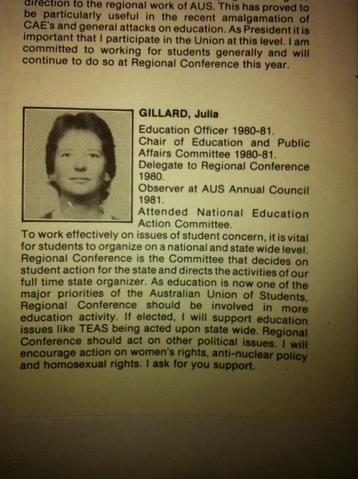
“If elected,” said the young Julia Gillard, “I will encourage action on women’s rights, anti-nuclear policy and homosexual rights.”

What happened?

Gillard’s objection to same-sex marriage cannot be religious. She is an atheist.

It cannot be the result of homophobia. Gillard appointed Penny Wong, an openly gay woman in a stable same-sex partnership, to the very senior cabinet position of Minister for Finance and Deregulation.

It cannot be a commitment to the ideal of traditional marriage. Gillard, herself, lives in a de-facto relationship with partner, Tim Mathieson.

Gillard has hinted that her Baptist upbringing influences her worldview. But, it was obviously not influential enough to convince her that God exists, or that living ‘in sin’ is wrong. Further, some Baptist clergy have openly spoken out in support of same-sex marriage. Gillard’s opposition is in line only with hard-line Christian fundamentalists, not with the majority of Australian Christians, or even, necessarily, Baptists.

Nor can Gillard’s stance be based on populism. The majority of Australians clearly support same-sex marriage. The Senate Inquiry into Marriage Equality received an unprecedented number of submissions and, despite the best efforts of conservative Christian lobbyists, 44,000 of the 75,000 submissions support same-sex marriage. Even the Australian Christian Lobby was forced to admit to their members that they were ‘comprehensively losing‘ the debate in the court of public opinion.

Gillard’s position cannot be based on some conception that marriage and religion are inextricably linked. Indeed, the secular nature of marriage in this country is illustrated by the fact that the majority of Australians (67 per cent in 2009) are married by civil celebrants.

Nor is her intransigence based on ALP policy. She is at odds with the majority Labor view on same-sex marriage.

Gillard has even recently conceded that the legalisation of same-sex marriage is inevitable – and still she remains opposed.

As far as I am aware, Gillard has articulated no clear argument for her opposition apart from a slightly robotic:

“My position flows from my strong conviction that the institution of marriage has come to have a particular meaning and standing in our culture and nation and that should continue unchanged.”

So, one has to ask – why has Obama ‘evolved’ on this issue while Gillard seems to have ‘de-evolved’?

Political commentator Paul Barry suggests that Gillard’s opposition to same-sex marriage “is not mysterious at all to those who understand the power of conservative Catholic South Australian senator Don Farrell, widely known as ‘The Pope’.”

Farrell was one of the core group of ‘faceless’ men who conspired against Rudd to install Gillard as prime miniter back in 2010. According to former ALP deputy leader, Ralph Clarke, Farrell “controls the pre-selection directly or indirectly of every MP in South Australia. If you want to get on, you get on with Don.”

In fact, according to Wikileaks, Senator Farrell had the ‘inside dope’ on Gillard’s leadership aspirations well before that fateful night in June 2010 when she rolled Rudd. A Wikileak cable suggests that Farrell told US embassy staff as early as June 2009 that Ms Gillard was gunning for Rudd’s job. That couldn’t have been ‘common knowledge’. Could it be that Farrell and Gillard were doing deals well in advance of the 2010 coup? And was a stance against gay marriage a part of that deal?

Farrell controlled the votes from South Australia and as a former leader of the Shop, Distributive and Allied Employees’ Association (SDA) he had tremendous influence over the votes of the union’s parliamentary wing. Votes controlled by Farrell were critical for Gillard to win the prime ministership in the party room. It’s not inconceivable that his support came at a price.

Gillard was never a member of the extreme right faction of the Labor party. She began her political career as part of Labor’s Socialist Left faction and later migrated to the centre. Yet now there are many, including Australian Marriage Equality national convenor, Alex Greenwich, who say that Gillard “appears to be captive of the extreme right of the Labor Party led by SDA union boss Joe de Bruyn”.

De Bruyn opposed the Rudd spill in 2010. But, when Gillard’s leadership position was challenged earlier this year, he supported Gillard. Is it possible that a commitment not to support same-sex marriage was part of some quiet back-room deal forged between Gillard, de Bruyn and Farrell?

If this is the case – and I freely admit this is mere speculation – it is likely that the ‘deal’ was based on de Bruyns personal power given that even his own union, the SDA, don’t seem to support his stance on gay marriage. Just this month, SDA Members for Equality spokesman Duncan Hart said he believes that most SDA members don’t agree with de Bruyn’s position.

“This is especially the case amongst retail workers, who are predominantly young and urban,” said Hart.

“It is farcical that our union leadership is so out of touch with members’ attitudes.”

And in supporting de Bruyn’s and Farrell’s view, Gillard has put herself at odds with the powerful Australian Workers’ Union. Prior to this year’s ALP conference, AWU leader Paul Howes described Labor’s opposition to gay marriage as “indefensible”. Even in terms of ‘placating the unions’ Gillard’s position makes no sense.

At the ALP’s National Conference in December last year, de Bruyn was not even able to hold his own right wing faction together on the issue of same-sex marriage. De Bruyn was booed and jeered by other party members as he spoke out against same-sex marriage at the conference.

Gillard’s continued opposition to same-sex marriage is contrary to the views of the majority of Australians, her own party, the majority of Australian Christians, the president of the United States, the new French president, Francois Hollande and even conservative British prime minister David Cameron. Her intransigence makes no sense in terms of her religious beliefs, her lifestyle choice or her previous passionate support for gay rights. Neither does it make political sense, given the widespread public support for legislative change.

The only conclusion I can draw is that Gillard sold out Australia’s queer community as part of a back room deal for political power. The only thing that makes sense to me is that Gillard is personally in debt to Farrell and de Bruyn and relies on their continuing support to shore up her increasingly shaky hold on the prime ministership.

How secular is a nation in which the prime minister is held captive to fundamentalist Catholic dogma? How democratic is this country when two men appear to control the prime minister’s stance on an issue which is so central to notions of justice, equality and human rights?
What does it say about the strength of our prime minister’s personal ethics if, in exchange for political power, she agreed to act as a ventriloquist’s dummy for religious zealots whose views represent neither her own beliefs nor those of the majority of her party?

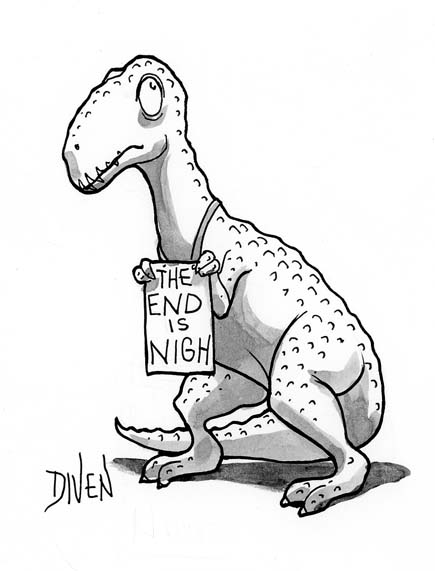
Perhaps Gillard should consider that evolution favours those who can best adapt to changing environments. She, herself, has conceded that the political environment has changed with respect to same-sex marriage. And yet, it seems, while nimbler politicians are evolving, she has chosen to throw her lot in with dinosaurs like de Bruyn and Farrell – and we know how evolution deals with dinosaurs.

Chrys Stevenson

To help put pressure on the PM to change her position on same-sex marriage, please consider signing this petition, asking her to show the same kind of courageous leadership as Barack Obama.

Julia Gillard show leadership like Obama has – support #ISupportSameSexMarriage

Update 11 May 2012:  Crikey’s Jeremy Sear has now taken up this issue, asking the Canberra press gallery to start asking some of the questions raised in this post.

Cardinal Pell sings Streisand’s greatest hits

When I briefly reviewed Australian comedian Catherine Deveny’s gig at the Global Atheist Convention, I suggested that her story about confronting Cardinal George Pell at the Sydney Opera House in 2010 was getting a bit old, and that she should ‘let it go’ and look for some new material. It seems she took me at my word! I’ve just heard that one of Dev’s recent tweets has upset George so much he threatened her with a defamation suit – a threat which he has, today, withdrawn.

Nevertheless, there is all too much of this bullying-by-defamation going on and, although the threat has now been withdrawn, Deveny was moved to apologise to Pell (when, in my opinion, no apology was warranted) and no doubt she spent some very anxious hours worrying about her financial future and her chances of battling an organisation as cashed up as the Holy Church of Rome.

So here’s the story. It appears that, having recently made an absolute bumbling fool of himself on national television, George was less than impressed when Dev tweeted a photo which did little else but  illustrate a gaffe of his own making.

In case you’ve been living in a cave in Siberia for the last couple of months, let me explain.

George foolishly signed up to a one-on-one debate with Richard Dawkins on ABC’s Q and A. Now, if I had been the media consultant to the Catholic church of Australia when that invite came in, the corridors would still be reverberating with the sound of me screaming “NOOOOOOOO!  DON’T DO IT GEORGE!!!!!!”

But, clerical hubris being what it is, George turned up in all his silly regalia and predictably, Dawkins annihilated him.  Jetlagged Dawkins, in fact, achieved it effortlessly with one hand effectively tied behind his back. Dawkins soon twigged to the fact that if he just shut up, George would hang himself with his own cincture – which is exactly what happened.  You can see the whole thing here:

Or you can just watch here to see the particular section of George’s inarticulate stumbling that tickled Dev’s funnybone:

Recalling a time when he was preparing some young English boys for holy communion, George made an unfortunately long pause after the word ‘boys’. The audience tittered and laughed at the obvious implication and even Dawkins couldn’t hide a broad grin.  It was, quite frankly, comedy gold.

It’s not surprising that Deveny seized on it and tweeted a photo of Pell captioned with his hanging half-sentence, “When in England, we were preparing some young English boys”.

Pell alleged that the image and caption was defamatory because it suggests that he is associated with the sexual abuse of young boys.

Well, imagine that!  In this day and age, how bizarre that someone might look at the image of a leader of the Catholic church and – with or without a droll caption – reach the conclusion that, in some way, they are associated with the sexual abuse scandals which riddle that vile institution.

And, if this is the case – as it most certainly is – who is at fault for that association? Certainly not Deveny!

If the Catholic church and its leaders were squeaky clean on the issue of sexual abuse of children, there would have been no titters and laughs from the Q and A audience as Pell spoke of his dealings with young English boys – and Deveny would have had nothing to tweet about.  The association made by the audience, by Dawkins, by the twitter-sphere and by Deveny is entirely due to the actions of the church itself. It’s no use pinning the blame on the messenger!

As a Cardinal, George Pell accepts the many benefits that flow from being a ‘prince’ of the church. One would think that, celibate or not, he would not be so lacking in testicular fortitude as to go into a major funk when some of the church’s sins came back to bite him on the bum.

Like it or not, George, your church has been and still is riddled with child rapists. You are a leader of that church. Members of your church have covered up multiple instances of child rape and protected the perpetrators rather than the victims. When brought to account, members of your church have lied, dissembled, prevaricated and been generally uncooperative. You are a leader of the church and you must shoulder some responsibility for its sins. It is  not only inevitable, but just, that you should be associated with the rapes perpetrated by the clergy within it.

If you only wanted to bask in the glory of being a Cardinal, George, you shouldn’t have taken the job.

This is not to say that George Pell has personally abused children. Not at all. And I don’t believe Deveny’s captioned photo suggests that either.

But, perhaps it should be noted that Pell has been accused of sexually abusing a 12 year old boy at a Catholic youth camp in 1961.  Ultimately, no action was taken due to insufficient evidence and the questionable character of his accuser. It does seem feasible, though, that a man who alleges that he was raped as a child by someone he trusted might well, as a result, have turned to a life of crime. Wouldn’t it be ironic, if this were true, if this was exactly what ruined his credibility and may well (if his allegations had any basis in fact) have denied him justice!

Ultimately, the QC who headed the inquiry concluded:

“I accept as correct the submissions of Mr Tovey [for the complainant] that the complainant, when giving evidence of molesting, gave the impression that he was speaking honestly from an actual recollection. However, the respondent, also, gave me the impression that he was speaking the truth. … In the end, and notwithstanding that impression of the complainant, bearing in mind the forensic difficulties of the defence occasioned by the very long delay, some valid criticism of the complainant’s credibility, the lack of corroborative evidence and the sworn denial of the respondent, I find I am not ‘satisfied that the complaint has been established …”

Father Ridsdale (with his features obscured by dark glasses and a cap) walked to the Melbourne Magistrates Court with his support person, Bishop Pell (wearing clerical garb) – Source: Broken Rites.

But this allegation is not the only direct association between Pell and child rape. In 1993 when Father Gerald Ridsdale was brought before the Melbourne Magistrates Court, charged with 30 incidents of indecent assault, involving nine boys  aged between 12 and 16 he was supported by (then) Bishop Pell.

Interesting, isn’t it, that neither Pell, nor any other member of his church, turned up to support the victims of Ridsdale’s assaults – only the perpetrator (who pleaded guilty).

In 2010, Pell again came under scrutiny for his ham-fisted handling of complaints against Father Terence Goodall for ‘sexualising his pastoral relationships’ with a 10 year old altar boy and a religious instruction teacher, Anthony Jones, who had come to him for guidance.

Remarkably, although an independent investigator found both cases established, Pell reversed the investigator’s finding in respect to Jones, rejected his allegations of sexual abuse and implied that the sexualised ‘relationship’ was consensual (despite Goodall having admitted otherwise). Pell later apologised that his letter to Jones was  ‘poorly drafted’ – an apology rejected by Jones as ‘not genuine’.

Let’s put aside, for a moment, the worldwide scandal of institutionalised child rape within the Catholic church – of which Cardinal Pell is a leader. Instead, let’s focus only on the small part of the globe with which he is most intimately associated – the Archdiocese of Melbourne.

Here are just some of the cases against Catholic priests on Pell’s home turf:

  • Michael Charles Glennon: former diocesan priest, sentenced to at least 15 years in jail for sexually abusing four Aboriginal boys between 1984 and 1991.
  • Wilfred James Baker: sentenced to four years in prison (parole after 2 years) for crimes involving eight boys.
  • David Daniel: sentenced to six years jail, with parole after 4.5 years, for molesting four boys, a girl and an adult male.
  • Rex Elmer: sentenced in 1998 to five years jail (with parole after 3 years 4 months) for molesting 12 boys at St Vincent’s orphanage in South Melbourne.
  • Paul Pavlou: convicted on 29 June 2009 of committing an indecent act with a child under 16 and of being knowingly in possession of child pornography. He was sentenced to an 18 month jail sentence suspended for 24 months and to a two-year community based order. He was registered on the Sex Offenders Register for 15 years. These offences occurred in 2005-2006 while he was the priest at Healesville in the Archdiocese of Melbourne.
  • John Ayres SDB: The Salesian Order is alleged to have had an Australian victim sign a secrecy agreement and paid him compensation in 2000 in regard to allegations about Ayer’s actions.
  • Francis Klep SDB: convicted of indecent assault in 1994, and charged with an additional five counts. He moved to Samoa, but in 2004 the Samoan government made moves to deport him from the country after becoming aware of the previous conviction and charges.

It should surprise no-one then, least of all Pell, that, in the collective imagination of the Australian public,  his name is inextricably connected with the issue of child rape. Pell leads a church in which this is an on-going problem, he is the Archbishop of a diocese in which child rape and sexual abuse has been prevalent, he has personally supported a child rapist who plead guilty and was subsequently convicted, he has been criticised for his handling of sex abuse cases within the church and he has, himself, been accused (but not convicted) of sexual abuse in a case in which the accuser’s testimony ‘gave the impression’, at least, that he was speaking honestly.

And now, here is the important point.

I have met Catherine Deveny. I follow her on Facebook and on Twitter. While I can’t claim a personal friendship with Dev, some of her friends are my friends. We frequent the same circles. And yet, until today, I was completely ignorant of her offending tweet about George Pell. Yep, somehow I missed it.

The only reason it came to my attention was because Pell decided to make an issue of it.  This afternoon, his threat to sue Deveny for defamation did reach my inbox.

Because, and only because, of this threat did I decide to dig into old George’s past associations with sexual abuse cases. If he hadn’t threatened to sue Deveny, I wouldn’t have bothered and I wouldn’t have known that he was once accused of being a sexual abuser himself.

Futher, I wouldn’t have bothered writing this blog post which brings issues he would probably rather put behind him back into the public spotlight.

You see, George, even threatening defamation sets the Streisand effect into action. Deveny didn’t call you a paedophile and I’m absolutely sure that no-one would have read her tweet that way. What we read in it is that, as a Cardinal, you are the personification of a church which is intimately and scandalously embroiled in the institutional abuse of children in its care over decades (or, more correctly, centuries).  You made the gaffe that exposed you to public ridicule. Your church’s failings (and some of your own) have put you into the position where the mention of ‘preparing boys’ inevitably comes with sexual connotations. That is your fault and the fault of your church – it is no fault of Deveny or anyone else.

I am glad that you have decided not to pursue legal action against Catherine Deveny, although I suspect it’s  probably because you were told you didn’t have a case, rather than Christian compassion. What I am not glad about is that these kind of bullying tactics function to try to silence bloggers, comedians, writers, even victims who fear that speaking out against the Catholic church may ruin them financially.

I support the right of any person to defend themselves in a genuine case of defamation. But when defamation threats are used to bully and silence, I feel compelled to speak out.

Perhaps next time (and there will be a next time), George, you might just consider taking some personal responsibility for the tarnished reputation of your church, its leadership and its clergy before thuggishly threatening to shoot the messenger.

Chrys Stevenson

* It is worth noting that Catherine Deveny was not the originator of the ‘meme’ to which Pell took offence, nor was she the only person to retweet it. In fact, it has just been brought to my attention that there is a record of this meme being retweeted under my name, although I did not initiate any such tweet. Amber Jamieson’s Crikey article “Devamation: George Pell pursues legal action over a Deveny tweet” provides a good account of the whole misguided mess.

For another perspective, see Gregory Storer’s “Free Speech, Catherine Deveny and George Pell” – “I can’t help but draw a comparison between the hatred and bigotry that is thrown out by the church with regards to gay people… Religions such as christianity have perpetrated the myth that if you’re gay you’re a pedophile … Do you have any idea how offensive I find such remarks?” – Gregory Storer.

See also: “Pell vs Morality” by Hilton T – aka The Outspoken Wookie

“Hilarious letter (by Phil Degenhardt) to George Pell’s Lawyers” – classic!

ACL’s Lyle Shelton – talkin’ trash on Twitter

A story on the Ellen DeGeneres show today showed a variety of heterosexual couples getting married in Las Vegas.

One couple said their vows in front of a comedian – newly-ordained by paying $39 to some company he found by googling. Apparently, in some states of America, this is entirely legal.  Same-sex marriage, however, is not.

Another couple,  sitting in the back seat of a convertible, were married by an Elvis impersonator as they passed through a ‘drive through’ – “Do you want fries with that?”

Apparently this does not demean marriage. Same-sex marriage between long-term committed partners, however, does.

The world watched mesmerised as famous-for-being-famous Kim Kardashian went through a sham,  made-for-tv wedding and divorced 72 days later.  Within the space of a year, I hear, she’s now thinking of marrying rapper Kanye West. All perfectly legal and socially acceptable.

Poorly matched heterosexual couples routinely enter into ill-advised marriages and, it seems, that’s perfectly okay.  Even divorced couples can remarry in most churches these days, so if at first you don’t succeed – try, try try again.

It seems that as long as the couple walking up the aisle – or passing through the drive-through – are one of each sex, the ‘dignity’ of marriage is preserved.

And, really, even if we might think some of these unions are a bit ‘strange’, ill-advised or just plain nutty – who would be so churlish as to directly sneer at any of these couples on the happiest day of their lives (so far)?  We might quietly raise an eyebrow, or have a private titter, but most of us are not so crass as to try to ruin someone’s wedding by being intentionally mean to them.

I once MC’d at a wedding I knew was destined for disaster. The bride was a friend. She was happy and excited, so I kept my own counsel.

Years later, she rang to tell me it had been all been a huge mistake.

“But you knew that, didn’t you?” she said.

“Yup.” I answered.

“Why didn’t you say something?”

“Would it have made any difference?”

“No.”

“There ya go.”

As it happens, she’s stuck it out – but it was not the life she wanted for herself and she lives a life of quiet desperation. How much value does that marriage really have? A trapped wife and a husband who, whether he knows it or not, doesn’t make her happy?

Today, I heard the happy news that Alex Greenwich, head of Australian Marriage Equality, is in Argentina preparing to wed his long-term partner, Victor Hoeld. Same-sex marriage is not legal in Australia, hence the need to travel to the opposite side of the world.

Alex and Victor must be so happy and excited, just like any couple in the days preceeding their wedding.

Of course there are those who think their marriage is ill-advised – not because they know them – but because they happen to be two people of the same sex. They will raise their eyebrows and titter amongst themselves – and that’s perfectly okay, they don’t have to agree to the nuptials any more than I have to agree that Kim Kardashian marrying Kanye West is a brilliant idea.

But being privately vituperative just wasn’t enough for the Australian Christian Lobby’s Lyle Shelton. With his organisation already forced to admit they are ‘comprehensively losing’ the marriage equality debate, he decided to ‘seize the day’ and take the opportunity to score some cheap political points.

Shelton tweeted today:

“Alex Greenwich not at Senate Inquiry because today he is in Argentina getting ‘married’ — coincidental or emotional leverage?”

Even in far-off Argentina on private business, it seems, Alex Greenwich is not free of the sneering, carping, petty, hateful, bigoted voice of the Australian Christian Lobby.

The fact that the ACL is reduced to this kind of gutter politics speaks volumes.

Yes, they are comprehensively losing the same-sex marriage debate because the vast majority of Australians are fair-minded and compassionate. Some Aussies might think two blokes ‘doing it’ is a bit ‘icky’ or that two sheilas ‘getting it on’ is OK to fantasise about, but a bit much in ‘real life’ – but, generally, Australians just want to mind their own business and have others stay out of theirs. Same-sex marriage doesn’t effect anyone else.  Study after study shows the children of same-sex parents are perfectly safe and not in the least disadvantaged.  There is simply no reason to oppose it other than anachronistic wowserism and religious bigotry; the two things for which the ACL so proudly stands.

Lost for arguments, and their argument lost, the Australian Christian Lobby now slink furtively on the fringes of polite society, slinging nasty barbs at gays and Muslims and anyone else who doesn’t conform to their narrow idea of morality.

“Nyah, nyah – your wedding’s just a political stunt!”

“Loser! It’s not a real marriage!  See, I’ve put ‘married’ in inverted commas! Take that!”

 It reeks of the ACL’s Jim Wallace’s 2011 ANZAC Day tweet in which he managed to insult just about everyone in Australia by suggesting that the ANZACS didn’t fight for gays or Muslims.

In a way, I’m delighted to see the Australian Christian Lobby reduced to this. No longer a respected religious lobby group, they are at last widely recognized as a privately funded boys’ club of religious extremists. Politicians who might once have entertained them are now refusing to meet with them. Their views, exposed as being exactly contrary to the majority of the Australian population, are as rancid as last week’s dog food.  So, with their political capital in tatters, what do they do? They stand on the sidelines hurling epithets. Classy!

Justice Michael Kirby recently wrote that despite his position as a High Court Justice he has always felt like a second class citizen because the law will not allow him to marry his long-term partner, Johan van Vloten.

“A loving relationship of tenderness, of gentleness and affection, and fidelity and support is a beautiful thing and anyone who would disrespect it is not a kind person,” he said.

He’s right.  Lyle Shelton, Jim Wallace and their cronies at the Australian Christian Lobby are not ‘kind people’. They are bigoted bullies of the worst sort.

Really, what kind of person taunts someone on twitter about their forthcoming nuptials?

How would Alex’s marriage or a marriage between Michael Kirby and his partner of over four decades ‘demean’ marriage? How can love ever be demeaning?

Surely the job of demeaning marriage has already been comprehensively achieved by heterosexuals?

And, if we’re talking about trashy, how demeaning is it to take to Twitter to try to undermine someone else’s wedding?

Chrys Stevenson

See also:  Rodney Croome, Eclipsing the Religious Right, Online Opinion 4/5/12

“The hundreds of thousands of Australians who have engaged with the marriage equality campaign, and now feel part of a movement for positive change, will keep an eye on who supports equality and who doesn’t, right up until they mark their ballot papers.

This is probably why Australian Christian Lobby spokesperson, Jim Wallace, is so angry.

Suddenly, the conservative Christian constituency which federal politicians have kowtowed to at every opportunity and which Wallace purports to speak for has been eclipsed.

Seeing what is afoot, Wallace has dissed the result of the marriage equality inquiries as “simplistic polling” that “cheapens” democracy, even though he crowed about how “the people have spoken” when a 2009 marriage equality inquiry received more submissions from his side.

He has attacked advocates for being deceitful, and has manufactured marriage equality bogeys out of thin air, even though he regularly complains about the low quality of the marriage equality debate.

No wonder a number of religious leaders have distanced themselves from him.

The current marriage equality inquiries have shifted the debate on that issue, confirming its place at the centre of Australian politics and identity.

Just as importantly, the inquiries have seen a shift in the balance of power in our political system away from the religious right toward the sensible, pragmatic centre.”

Caloundra [Un]-Christian College Sacks Pregnant Teacher

What was it that Jesus said? Oh yes, it was, “Let he who is without sin cast the first stone.”

And of course there was this:

“Do not judge, or you too will be judged. For in the same way you judge others, you will be judged, and with the measure you use, it will be measured to you.“Why do you look at the speck of sawdust in your brother’s eye and pay no attention to the plank in your own eye?”

“… judgment without mercy will be shown to anyone who has not been merciful. Mercy triumphs over judgment,” says James 2:12-13

And to those who think themselves such paragons of virtue that they can put themselves in place of God by setting themselves up as judge, jury and executioner, Paul says in Romans 2:1:

“Therefore you have no excuse, O man, every one of you who judges. For in passing judgment on another you condemn yourself, because you, the judge, practice the very same things. We know that the judgment of God rightly falls on those who practice such things.”

Not since arch-bigot Jim Wallace of the Australian Christian Lobby supported the expulsion of ‘openly gay’ children from religious schools have I been so disgusted by the blatant hypocrisy of Christians who purport to follow a religion of love, mercy and forgiveness but, instead, practice one of narrow-minded, judgmental, bloody-minded persecution.

At Caloundra [un]Christian College, a kindergarten teacher,  Jess Davidson, has been sacked because she is pregnant and not married to the father of her unborn child. Ummm, excuse me, but isn’t Christianity built upon the story of a woman who became pregnant to someone other than her husband?

Apparently Ms Davidson is subject to the school’s “Lifestyle Agreement”  which allows the school to salaciously inquire into the private lives of its employees and dismiss them if they do not meet the ‘Christian values’ expected by the school.

Now, of course, no secular employer would be able to sack a woman for being pregnant and unmarried. There would be widespread public outrage. Such discrimination is rightly considered illegal in our community and prohibited by anti-discrimination laws. But religious institutions and schools are exempt.  Why? You tell me!

Why, if our community judges something to be so outrageously wrong that there is legislation to prohibit it, do we allow a section of our society to continue the persecution simply because they are ‘religious’?

As one of the parents who is supporting Ms Davidson said, her personal life “should not be an issue as long as she is performing her duties and being a good employee”.

The fact is that, legally, the school is within its rights. But this is an anomaly in our legal system that every Australian should be protesting against.

Consider also that this school is almost certainly receiving taxpayer funds. Should schools that don’t follow the same employment regulations as every other Australian company receive government funding?  Are YOU happy to be funding this kind of blatant discrimination?

Then, of course, there is the issue of the hypocrisy of the school in relation to the supposed tenets of its faith.

As one wit observed in a comment on the local paper’s website:

“I trust the school is urgently reviewing their school uniforms. As Cotton/polyester blends are in breach of the bible teachings (Leviticus), they must be burned, and the Uniform Committee sacked if they approved such outrageous behaviour. 

I also trust all sport on Saturdays will now be ceased (Exodus), and any children caught playing it expelled.

All staff are of course banned from shaving under the bible, which includes women as well as men, so it should be easy to spot their staff members in a crowd (Leviticus).

I am glad the school lets all female staff have a week or so off every month, as they would not condone women with periods mixing with anyone else (Leviticus).

And I hope the tuckshop convenor is also sacked if any of the sausage rolls that are sold had pork in them (Leviticus).”

Of course, as we know, the school will only reply that under the ‘New Covenant’, they are not subject to all the laws of the Old Testament – although that doesn’t seem to stop them referring to Leviticus when homosexuals are in their sights!

Another commenter shrewdly observed that male teachers at the CCC may well be breathing a sigh of relief that their sexual indiscretions are not so visible. I wonder how many of them will be offering to resign for having committed the same sin?

Judging by the comments on the Sunshine Coast Daily article, public opinion is firmly against the school. In a way, this kind of thing helps the cause of secularism by highlighting just how unjust, inequitable and out of touch religion is with the values of the majority of Australians. As Paul Keating may have phrased it, those who run organisations like the Australian Christian Lobby and the Caloundra Christian College are ‘unrepresentative swill’. They are an affront to Australian values and they are an affront to the central tenets of their own religion.

If religion is dying in the West, we have people like the administrators of the Caloundra Christian College to thank for it. These bigots and hypocrites do far more to kill their own religion than we atheists ever can.

If there was ever a cause which should have liberal Christians protesting against the actions of their extremist cousins, this is it. But, I doubt we’ll hear a peep from them.

But while we might revel in religion exposing, once again, its dark underbelly, we cannot forget the human cost of these religious zealots’ angry extremism.

A Facebook page has been set up to support Jess Davidson.  I’d like to ask my readers to ‘Like’ the page and spread this story amongst your own networks. Let us show Jess Davidson that her school may have rejected her, but the majority of right-thinking Australians have not.

Chrys Stevenson

Please ‘like’: I support Miss Jess

Update – Thursday, 3 May 2012:  The “I support Miss Jess” page has been removed from Facebook. I suspect this may have been a request from Ms Davidson’s legal representatives in anticipation of a law suit against the school. I am seeking more information and will post here if I receive any.

In the meantime, if you still wish to voice your displeasure at this decision you can contact Mark Hodges the Principal of Caloundra Christian College at markh@calcc.qld.edu.au .  Please be polite in your correspondence.

If you’re local to the Sunshine Coast region, non-religious (and not into ‘new age’ woo, homophobia, racism or sexism) and you’re outraged by this story, you might like to consider joining the Sunshine Coast Atheists.  Email:  sunshinecoastatheists@gmail.com

Global Atheist Convention – Sunday, 15 April (Part Eight)

The (New) Four Horsemen of the Anti-Apocalypse

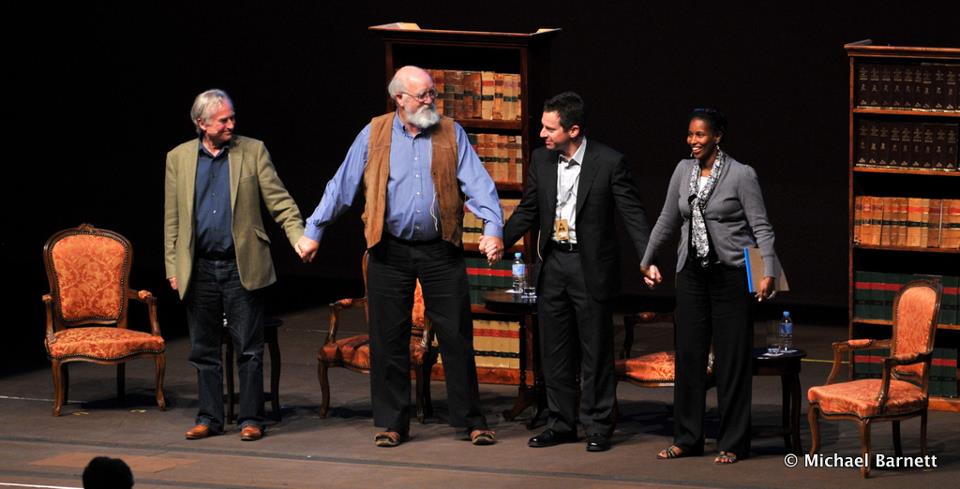
And then came the moment we had all been waiting for – the Four Horsemen of the Anti-Apocalypse, minus Christopher Hitchens but including his worthy successor, Ayaan Hirsi Ali.

Photo by courtesy of: Michael Barnett - http://mikeybear.wordpress.com/

Ironically, it was explained that Ali was supposed to have been on the panel which evolved into the Four Horsemen DVD, but was unable to attend. So, it is only fitting that she should now move into the chair so sadly vacated by Hitch.

Daniel Dennett began the discussion by questioning Ali about her charge that it is Christians rather than atheists who are doing the most to oppose Muslim fundamentalism.

Perhaps part of the problem, Dennett suggested is that liberal Muslims don’t want to ally with atheists.

Also, he said, “We have to stop being afraid of being thought racist or Islamaphobic.”

What is more racist? Ignoring the plight of women or children under Islam because they are Muslims, or opposing it because they are human beings?

Dennett insisted that we need to speak out against harmful cultural practices like genital mutilation.

“If the genitals of little white girls were being cut off there would be outrage!” Dennett reminded us. “Is it not racist, not to oppose this practice because the targets are Muslim girls?”

Ayaan Hirsi Ali agreed.

“By doing nothing, you are worse than racist, you are complicit!”

Dennett expressed concern about the attitudes engendered by  ‘hypermulticulturalism’ and ‘postmodernism’; not all religious, traditional or cultural practices should be tolerated. The mutilation of children or the abuse and oppression of women  is not culturally subjective.

Offering his take on why liberals are reluctant to take on Islamic fundamentalists, Richard Dawkins added dryly, “The threat of having your head cut off is something of a deterrent.”

He repeated his mantra to Islamic extremists:

“I fear your barbarism, but don’t for one moment confuse it with respect. I don’t respect you, I despise you.”

Dawkins noted that it would be easier to stand up against Islam if there was some kind of solidarity in the West. He told the story of Peter Mayer, the Chairman of Penguin publishing.

Mayer bravely published Salman Rushdie’s The Satanic Verses. In the outcry that followed:

[Mayer] received many death threats, including one scrawled in blood. An anonymous telephone call told Mayer that “not only would they kill me but they would take my daughter and smash her head against a concrete wall.” Cohen takes up the story:

Far from rallying to defend an innocent girl and her innocent father, the parents of her classmates demanded that the school expel her. What would happen, they asked, if the Iranian assassins went to the school and got the wrong girl? And Mayer thought, “You think my daughter is the right girl?”

 [From: “It’s Part of their Culture”: Reading Nick Cohen in the light of the Jaipur Affair by Richard Dawkins]

“Yes!” agreed Daniel Dennett, “How about sharing the risk?”

Dennett recalled that after the publication of The Satanic Verses, Salman Rushdie was pretty much ‘left cut off by himself’.

Dawkins noted that, at the Reason Rally, it was suggested we should “withhold respect from those who believe in transsubstantiation.”

But Dawkins did not entirely agree.  He thinks the stock reply to those who give credence to such ideas should be:

“I respect you too much to believe that you could possibly hold such ridiculous beliefs!”

“We should challenge Catholics who purport to believe in transubstantiation to defend the idea or admit that they are not really Roman Catholics at all,” said Dawkins.

Dennett wryly observed, “There is no gentle way to tell someone they’ve devoted their life to a folly.”

But Harris was quick to correct him, “Wasted their life! It’s time wasted!”

Dennett believes that many church leaders don’t believe what they’re preaching. They speak on two levels, he said.

They preach the gospel in order “to placate the old folks, but in such a way as to let the younk folks know you don’t really need it.”

This prompted Dawkins to recall some typical Aussie humour.

“When someone asked why there were always so many old people in church,” he said, “an Aussie dryly suggested, “Craming for the final?”

Dawkins admitted that he was not enthusiastic about allying with Christians, although he could see the political value of doing that.

Dennett noted that, “Many people view their pastor as a reliable source of information.”

Accordingly, he suggested, we need to target the pastors and the leaders who encourage the pastors to tell these preposterous stories.

These are the ‘villains’, said Dennett; their congregations are more victims than villains.

Dawkins mused about the value of attacking ‘the mild strain of the virus’.

At this point, just as a stage technician was adjusting Sam Harris’ microphone and earpiece, Ayaan Hirsi let loose with a tremendous sneeze, nearly blowing out Harris’ ear-drum!

It was a lovely moment which made these four luminaries appear so much more human!*

“Bless you!” grinned Daniel Dennett.

Recovering his composure, Harris said, “We want people to think scientifically.”

Still, said Dennett reassuringly, “Religion is losing ground everywhere. Their leaders are getting frantic.”

“But,” he wondered, “what happens when all is left are the fanatics?”

What happens when we lose the “buffer zone” of the moderates?

Ayaan Hirsi Ali remarked that the fragility of belief was exemplified in advice being given to Muslims in the USA:

“Don’t become police [i.e. join the police force] – you are in danger of becoming impressed by that system of law.”

Dennett noted that the information revolution has wrought a radical change in the “selective environment in which religions live”.

“They will have to evolve rapidly or go extinct,” he said.

Ali raised another question, “Why do middle class, highly educated [Western] women convert to Islam?”

Harris conjectured that it was “To cut through the superficiality of life.”

Harris went on to suggest how we might counter religion.

“Theologians are not lazy,” he warned. “They are burning a lot of fuel trying to make sense of their doctrines.”

“Islam,” he said, “is a huge collective to which the individual much commit completely.”

The way to attack it is to push individualism and through ridicule.

“We need to develop a competing narrative that creates a cognitive dissonance,” he said.

Dawkins noted the paradox that, “Religions prosper by making life hard for their followers.”

He suggested that religion should be subjected to the same kind of education campaign used against drunk driving.  Drunk driving was once acceptable, it is only through the recognition of the harm it does and extensive public education that its incidence is being reduced and its practice has become publicly unacceptable. It was an excellent analogy, I thought.

(For theists who may read this with ‘conspiracy theories’ in mind, there was no suggestion that the practice of faith should be made illegal – only that those who practice it should be treated with the same kind of disdain as those who drink and drive. It is the change in public attitudes, not legislation which was Dawkins’ point.)

But Dennett remains concerned about the ‘vacuum’ that might be created by eradicating belief. We can already see it being filled by, “… new age babble and conspiracy theories.”

We need to address the problem of “infectious stupidity” he said.

This reminded Dawkins of a quote by GK Chesterton:

“When people stop believing in God, they don’t believe in nothing; they believe in anything.”

So, as the Global Atheist Convention 2012 comes to a close, and we all return to our everyday lives,  how do we move on from here?  The view from the ‘Four Horseman’ was clear:

Keep in contact  – and keep on celebrating reason together.

There was a standing ovation and tremendous applause as the new Four Horsemen stood, joined hands, and bowed to the audience.

Photo by courtesy of Michael Barnett: http://mikeybear.wordpress.com/

One could not help but feel that a new chapter in the fight for reason and secularism had just begun.

Chrys Stevenson

* For more on the ‘human face’ of the Four Horsemen, see Kylie Sturgess’ “I kind of got kidnapped by Richard Dawkins and Ayaan Hirsi Ali at the Global Atheist Convention”.

This is the last of my write-ups on the presentations given during the 2012 Global Atheist Convention.  I plan to follow up in a day or two with a post summarising the main themes and highlights together with a book list, given that there were so many interesting books recommended during the event.

In the meantime, for an excellent video summary of the Convention, I highly recommend Andrew Skegg’s, “The Global Atheist Convention” (featuring me!):

Subscribe

I hope you have enjoyed this series of posts.  If so, you might consider subscribing to my blog – see the top of the right hand side-bar.

DO SOMETHING!

If you have been inspired and want to DO SOMETHING NOW,  might I encourage you to make a contribution to Ron Williams’ legal costs for his High Court Challenge against the National School Chaplaincy Program. The verdict is due soon, and Ron really should not be left out of pocket for so bravely defending the cause of secular education in this country. Any donation, small or large will be greatly appreciated.

For information on how do to donate go to:  High Court Challenge

—————–

Michael Barnett is the photographer who provided the images for this post. He is a passionate campaigner for gay rights and yes, he’s one half of the couple in that famous kiss during the convention. You can read his blog here:  Mikey Bear.

Global Atheist Convention – Sunday, 15 April (Part Seven)

Sadly, I won’t have time to blog tomorrow so I’m providing a ‘bonus’ blog to followers of this GAC series today.

Lunch – Sunday

After PZ Myers spoke on Sunday we adjourned for lunch. I was too busy grabbing food and catching up with friends like Jonathan Meddings, Warren Bonett and Kirsty Bruce from Embiggen Books, Marie Fisher from the Queensland Humanists and Bruce Everett to notice the commotion going on outside.

Sadly, I also proved that, as a ‘celebrity author’ I need a great deal more practice!  One lovely reader of The Australian Book of Atheism bounded up to me with a copy of the book for me to sign. He caught me just as I spilled the contents of a rice paper roll all down my front. I’m sure that never happens to JK Rowling!

The incident compounded my ineptitude of the previous evening when the delightful Nick Andrew (aka @elronxenu) with whom I’d dined so happily on Thursday night, brought his copy of TABOA for me to sign. While chatting to Nick, I was interrupted by another convention-goer called Martin and, muddle-headed wombat that I am, carelessly signed Nick’s book, “To Martin, thanks for a great night out! Chrys Stevenson.”

Poor Nick’s face turned white.

“But my name’s not Martin!” he exclaimed.

“Oh dear!”

I would have bought him a new book but he already had signatures from other authors. I felt awful and about 2″ high.

So, abject apologies to Nick for ruining your book and, I promise, if I ever write or contribute to another one – I’ll send you a free copy!

Islamic Protest

As I was distracted by my minor (perhaps I should say ‘miniscule’) celebrity inside the Convention Centre, far more interesting things were going on outside where a group of fundamentalist Islamic protestors had gathered.

Carrying signs predicting that atheists and, in particular, Ayaan Hirsi Ali and Christopher Hitchens were destined to burn in hell, they presented the manic face of Islam and succeeded only in showing what an embarrassment they are to the majority of educated, moderate, tolerant and peace-loving Muslim-Australians.

Of course, as PZ predicted, give sheep a microphone and all you get is amplified bleating. Also as predicted, they only succeeded in calling out the wolves. Atheists flocked outside and easily outnumbered them.

“Where are the women?” chanted the atheists – followed by a rousing chorus of “Always look on the bright side of life!” and then the simple, but effective chant, “Bull-shit! Bull-shit!”

“I’m lucky I’m in Australia! I”m lucky I’m in Australia and not in your country!” said one observer to the protestors.

It’s funny, looking at the video the Islamic zealots appear small and ridiculous – like the cartoonish caricatures of humanity they are. Symbolising all that is worst about religion and human nature they are dwarfed by the noisy but good natured and peaceful reaction from those they wish to condemn to eternal hellfire. I guess, as Josh Thomas suggests, threatening an atheist with hell is about as effective as a hippy threatening to punch you in the aura.

And then, for me, the moment that symbolises the difference between religious zealots who stand for divisiveness, intolerance and hate, and those they condemn. Two men who I am proud to call my friends stepped out of the crowd – Michael Barnett and Gregory Storer. Their answer to the vitriol of the Islamic fundamentalists was simply to stand before them and kiss.

Photo by Pete Darwin of The Caudal Lure blog: http://thecaudallure.com/

(See also:  Michael Barnett’s own account of the incident, and the YouTube photo collage of the events leading up to ‘the kiss’.)

To me, the juxtaposition of hate and love was a powerful symbol of the whole atheist convention – indeed, our whole ethos.

In that one gesture, Michael and Gregory comprehensively said, “Look! We are kissing. Where is the harm? What is the problem? Who does it hurt? It’s love – isn’t that what life should be about?  Shouldn’t you be happy and loving and tender, not angry and intolerant? Who serves humanity best? Us or you? Who gives most dignity to the human condition? Which of us elevates humanity and who brings us down to the lowest common denominator? Who exemplifies what is best in us and what is worst?”

It was a lovely moment that gained international publicity.  When I had dinner with Michael and Gregory on the Tuesday after the Convention they were still reeling, and on quite a high, from the overwhelmingly positive reaction to their spontaneous gesture.

I might add, in response to some silly rumours that appear to have been circulating – yes, Michael and Gregory are gay, and yes, they are a couple.  It was not a ‘stunt’ for the cameras. It was a gut reaction to the kind of vilification and hate that gay people face all through their lives. And what a wonderful gut reaction it was!

I was just sorry I missed it!

Christopher Hitchens Tribute

Back in the auditorium, the next session was a tribute to the late, great Christopher Hitchens. There has been some criticism that Hitchens was ‘deified’ at the Convention. I don’t believe that’s true. We were simply honouring a man of incredible intellect whose words were not only influential in forming the ‘atheist movement’ but also in changing so many individual lives.

When Hitch became ill with oesophagul cancer, one of my friends, Tracee Doherty, from the tiny outback Queensland town of Moree wrote him a letter, thanking him for changing her life.  In the glamorous world which Hitchens inhabited she was a no-one from nowhere, and yet he wrote back personally in a touching note in which he thanked her for her letter and mentioned how touched he was by these kinds of unexpected tributes.

Tracee was not in the GAC audience this time, but Robert Tobin was. Robert went through his own battle with oesophagul cancer in parallel with Hitch – and drew great strength from Hitch’s refusal to give in to the ravages of his disease. Ultimately, Robert survived and Hitch didn’t. A pensioner, Robert was unable to afford the cost of attending the Convention, but with the generosity of the Atheist Foundation of Australia, and a quick whip around my Facebook friends, we quickly raised enough money to bring him to Melbourne. It gave me great joy to see him literally bounding around the auditorium, wearing his funny “St Patrick’s Day” hat and a swag of blasphemous buttons and taking to the microphone to quiz the speakers. A true triumph of the human spirit. Hitch would have been proud.

Hitch was not perfect and he wasn’t always right. He drank too much, he smoked too much. Many of those who laud him for his fight against fundamentalism and the oppression of dictators also disagree with him vehemently on his stance on the Iraq war and his rather quaint, old-fashioned views on women.

As such, he is, perhaps, the perfect human symbol of atheism – an imperfect human being, doing the best he can to change the world for the better – just like the rest of us (although, admittedly, far more effectively!).

Richard Dawkins introduced the tribute to Hitchens.  Although he did not know Hitchens well, Dawkins paid tribute to his skills of rhetoric and oratory. These, said, Dawkins, were Hitchens’ ‘artillery’.

Dawkins noted that contrary to the view there are ‘no atheists in foxholes’, Hitchens sought them out; travelling all over the world to places where people were being abused and oppressed.

“He felt real solidarity with the victims of the tyrannies he abhorred”, said Dawkins.

“Christopher hated dictators and tyrants. His fight was political, not religious.”

Here is the Christopher Hitchens Tribute played at the Convention:

Later on Sunday afternoon I ran into Jane Caro. Jane was anxious to discuss a strange phenomenon that occurred during the Hitchens Tribute.

“All through the convention,” she said, “people have been tweeting during the speeches.”

She was right. Nearly everyone had an iphone, android or Ipad and you could watch the #GAC2012 and #atheistcon streams rolling past as each speaker made his or her presentation.

“But,” said Jane, “during the Tribute to Christopher Hitchens, the twitter streams stopped dead. Nobody tweeted.”

“People doubt that crowds can ‘self-discipline’, they insist that people need ‘rules’ to act decently and respectfully – that we need direction from authority. And yet here, in a hall full of 4,000 atheists, with no direction whatsoever, 4,000 people instinctively stopped tweeting out of respect for a fallen leader.”

It was another powerful statement about the essential morality of human nature which I will think about for a long time.

Chrys Stevenson

Global Atheist Convention – Sunday, 15 April (Part Six)

PZ Myers

PZ Myers gave my favourite presentation of the convention – comedians included. Like Leslie Cannold, he energised the crowd with his ‘take no prisoners’ style. I defy anyone to sleep through a presentation by PZ!

No polite accommodationism for PZ. The mild-mannered, bewhiskered professor from the tiny town of Morris, Minnesota, ambled onto the stage and called for an assault on heaven and the killing of God.

“In the beginning,” said PZ “was the blood”; people were bound by familial ties.

But, he said, this was limiting, They needed a new way to join together in larger groups.

At length, allegiance to a particular king became the new symbol of identity and the size of social units grew.

Next, came identification with a particular city – for example, “I am an Athenian!”

All of these identifications, he said, are built on the arrogance of pride.

But, cities fall, bloodlines fade and kings die.

And so it was that the Jews invented a new form of group identity – through allegiance to ‘the Word’, they became ‘the people of the Book’.

Words,” said PZ, “have a persistence that cities cannot have.”

In fact, when Jersualem fell the social cohesion of the Jews was strengthened.

This identification with abstract stories and histories, combined together in a ‘sacred’ book, “made Christianity bullet-proof”.

Words –  stories –  are “ecumenical”. A  common belief can cross borders – ideology is not restrained by geography.

PZ spoke of “the power of an unkillable idea”, referencing the comic book series and 2005 film V for Vendetta.

I’m not a reader of comics and I hadn’t seen this film, but I’ve subsequently learned that the main character ‘V’ is the embodiment of an idea which has persisted at least since Guy Fawkes and his co-conspirators plotted to kill the English King and overturn his Protestant government by blowing up the Parliament with gunpowder:

“People should not be afraid of their government. Governments should be afraid of their people.”  (V for Vendetta)

The film opens with a recitation of the verse:

“Remember, remember the fifth of November, the Gunpowder Treason and Plot. I know of no reason why the Gunpowder Treason should ever be forgot.”

Over the centuries, the character of Guy Fawkes has come to symbolise those who challenge the status quo. Notably, the Guy Fawkes mask worn by V in the movie is used as the icon for the protest group Anonymous and has begun to appear in the world-wide ‘Occupy’ grass-roots protest movement.

In writing V for Vendetta, Alan Moore, was, apparently concerned principally to demonstrate the power of ideas.

Moore has said, “You can’t kill an idea; and ideas can change the world.”

Changing the world is “something WE want to do”, said PZ but he disagrees with Moore on one important point.

“You CAN kill an idea,” PZ insists.  Christians have succeeded in doing this in the past, which is why they are so afraid that WE will now succeed in ‘sacking the city [i.e. idea] of God’.

“Christians,” he said, “are reacting to the rise of the new atheists the way the Romans reacted to the arrival of the Visigoths on the horizon!”

He called for “an ecumene of people united under something other than faith”.

How do we kill ideas? “We kill ideas with a better, more powerful idea.”

Religion is man-made, planned, persistent and politically strategic – “Holy books were not ‘magicked into existence in an instance,” PZ reminded us.

But Science is our weapon; our ‘God killer”.

“The Bible stories,” said PZ, “are narrow, bigoted and false”.

The power of Science is that it tells our story, it reflects us; our DNA.

Religion is divisive; Science bridges differences. People can unite in an appreciation of the natural world.

Science, he insists has real power. 

“Science shows how stuff actually works, rather than what we wish worked.”

Scientists deal directly with the subject of their study.

“I’ll have more respect for theologians when they start to question the subject of their study directly,” he said.

“They never use supernatural information,” PZ observed, “… almost as if it didn’t exist.”

Nevertheless, the “demented ghouls of the end times are a significant political lobby in the US”.

Dangerously, they believe that “Israel must be restored in order to be destroyed in the nuclear holocaust which will bring about the ‘second coming’.

“If I actually believed Jesus was coming to destroy the world in 2050,” said PZ (only half-joking), “I’d be stocking up on timber and nails.”

It is true, he said, that liberal Christians do less harm than their fundamentalist cousins.

“But,” he said, dismissing them as ‘cafeteria realists’, “they are still doing harm to foundational principles. They are promoting unreason by saying it’s okay to believe in some things without evidence.”

PZ took on the charge that atheists have nothing in common; that we do not have the unity and strength of purpose required to form a viable social (revolutionary) movement.  He insisted that he was not imposing a definition on atheists as a group, but merely observing that a broad consensus is emerging.  This consensus he believes is based on:

1.  A dedication to seeking out ‘the truth’ through learning and discovery.

2. A commitment to autonomy – a global movement in common cause with those oppressed by racist, paternalistic cultures.

3. The forging of a new kind of community.

PZ acknowledged the role of women in atheism, reminding us that, “Atheist meetings, for a long time, looked a lot like Mormon meetings!”

He also warned that, “Being an atheist doesn’t make you a rationalist.”

He spoke of the connections between atheism, feminism and LGBT rights.

“If you are a human being with real world concerns,” he said, “you should be one of us; truth and justice are our common causes. That’s what makes us part of a community.”

Although we have “good reason to be angry with a society that does stupid things in the name of ‘the Lord’ atheists,” said PZ, “are not ‘grim nihilists'”.

He told us about the Reason Rally held recently in Washington DC.

“Twenty-thousand people on the Mall in DC,” he said, “everyone smiling!”

“If I were a grinch,” he said, “my heart would have grown THREE SIZES” at that sight.

“We’re not grim and sour at all!”

In fact, he reminded us, he’d even participated in a ‘hug off’ with atheist blogger, Martin Pribble, during the convention!

“We need to value working co-operatively,” PZ advised. “It’s how we’ll win in the end.”

He spoke dismissively of the religious (Christian and Islamic) protests attracted by the convention.

“So, that’s what you get when you give a sheep a microphone,” he said, “… amplified bleating.”

“They didn’t realize they were calling out to the wolves.”

“LET’S DO IT!” said PZ, “Let’s form a ‘hunting pack’ and work together. Let’s make them tremble and demolish the City of God.”

Chrys Stevenson

Global Atheist Convention – Sunday, 15 April (Part Four)

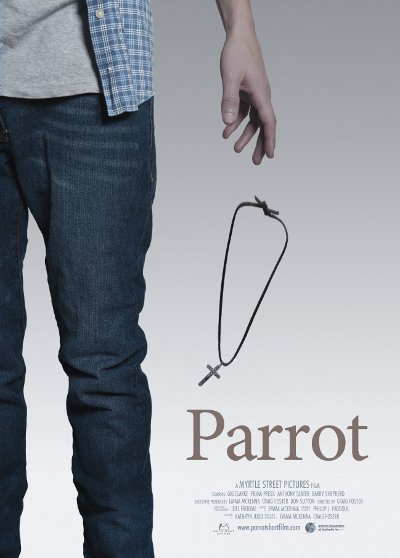
Parrot – A Short Film

After morning tea on Sunday, we were treated to the world premier screening of the short film “Parrot” by Sydney-based filmmakers Emma McKenna and Craig Foster. McKenna and Foster of Myrtle Street Pictures have made a remarkable film that reflects the experience of many whose loss of faith threatens the loss of family. While the film is a testament to how divisive religion can be, it also speaks to the strength and resilience of familial love.

Parrot was beautifully produced and directed, production values were high and the acting was natural when it could so easily have been forced. The drama was perfectly tempered with moments of humour and pathos. And, importantly, it was not coercive. The story was laid out honestly but without undue bias, allowing the viewer to draw their own meaning from the art.

After the film, McKenna and Foster said they made the film because there was a ‘void’ in the representation of atheists in television and movies. When atheists are portrayed on film, they are often, like Hugh Laurie’s Dr Gregory House, people of questionable morals. They wanted to show a sympathetic atheist character; to show the human face of atheism.

Their reasoning? “You can’t hate something you empathise with.”

The film stars some familiar faces, including Barry Shepherd (Rake, McLeod’s Daughters, Home and Away), Fiona Press (Oscar and Lucinda), Gig Clarke (Home and Away, Rescue: Special Ops) and Anthony Slater (co-host of Cybershack).

I must congratulate the Atheist Foundation of Australia for helping to finance and promote this fine film. I can highly recommend it. McKenna and Foster are now trying to enter it into film festivals to get it shown as widely as possible. Keep an eye out for it, and if you get a chance to see it, grab it – you won’t be sorry.

You should be able to keep up with future screenings by checking their website: Parrot

Here’s the trailer and ‘blurb’.

http://vimeo.com/myrtlestreetpictures/parrot-trailer

“Parrot is a tale of a family divided by faith. Todd, the youngest son of Ruth and Edmund Senior, has over the years drifted away from his strict Catholic upbringing. Too afraid to break the truth to his mother, he would feel as a complete stranger within his own family were it not for his brother Edmund Junior who shares the same secret.

When a terrible tragedy befalls the family, Todd and his parents are forced to confront their differences at the worst of all possible times. With the truth out, can they find a way to accept, support and love each other or will religion fracture this family forever?”

Chrys Stevenson

Global Atheist Convention – Sunday, 15 April (Part Three)

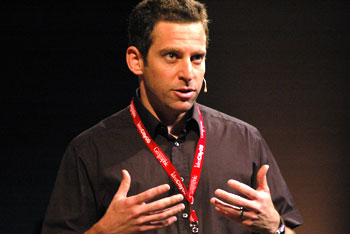
Sam Harris

I have always been interested in spirituality (see my blog post Fashion Faux Pas and Literary Lunacies: How Dawkins and Harris overhauled my intellectual wardrobe). Like many of my generation, I stopped off in ‘New Age Spiritualism’ on my journey towards atheism.

I found Sam Harris just as I was on the outskirts of Atheistville. I still had some souvenirs of “New Age Spiritualism” hanging around my neck, but I’d divested myself of most of the  ‘woo’ before I bought End of Faith and Letter to a Christian Nation – ironically with some ‘Christmas’ money given to me by a crystal-gazing aunt.

It was after reading Letter to a Christian Nation that a little light bulb went on in my head. I remember thinking, with some surprise, “Oh! I’m an atheist!”

As a new ‘gnu’ atheist, I found The End of Faith incredibly confronting with its negative portrayal of Islam – I was, and still am, far more concerned about fundamentalist Christianity.  Islam is dangerous but it’s out in the open and easy to spot.  The encroachment of fundamentalist Christianity is insidious, often silent and invisible.  We don’t recognise its stranglehold on our secular institutions until it’s happened.

Having been introduced by Harris to the ‘new atheist’ genre, I moved on to read Dawkins’ The God Delusion, and Hitchens’ God is not Great: How Religion Poisons Everything.  Like Harris, they didn’t make me an atheist, they just made me realize I was one. More importantly, they politicized me and made me realise I should get off my arse and do something about the religious assault on secularism, human rights and individual autonomy.

Sam Harris took to the GAC 2012 stage and immediately acknowledged the late, great Christopher Hitchens.

Hitch, said Harris, “had more wit, style and substance than a few civilisations I could name.”

Fittingly, perhaps, Harris then went on to talk about death.

“The ‘good news’ of atheism,” said Harris, “is that nothing happens after death. We return to nothingness; so there’s nothing to worry about.  If we’re right, death is not a problem; life is the problem.”

“To not believe in God,” he said, “is to know that it falls to us to make the world a better place.”

Harris spoke of how religion makes the world  worse, not better.

Because of the interference of the Catholic Church, they are still arguing in the US about whether women should have access to contraception. This,  he said, “while the church nurtures ‘an army of child rapists’!

Harris also spoke of religion’s ‘misuse of human energy’ and its ‘manufacturing of human unhappiness’.

Harris accepts that we can’t make the world a paradise – and who would want one?

At university, when I studied utopian thought, I quickly realised that one man’s utopia is another man’s dystopia.  Harris is not concerned with creating a ‘perfect’ world or a ‘perfect society’, but he is concerned with the human condition – with making lives happier, more meaningful, more productive and, surprisingly, more ‘spiritual’.  More ‘gross national happiness’, perhaps.

And then, the important question, “What does atheism have to offer?”

If we are to argue for an ‘End of Faith’ what do we propose to put in its place?

Harris accepts that as ‘mere disbelief in god’ atheism doesn’t have much to offer. But, he said, “Atheism clears the space for better conversation.”

But can atheism do what religion does?

Harris acknowledged, for example, that religion can help people make sense of tragedy. It provides the answer that most people think they need.

“If your child dies in a car accident,” said Harris, “believing she’s in heaven with Jesus has to be consoling.”

So, we have to ask, “What is lost when we jettison religion?”

And, at least part of the answer is, “Total consolation in the face of death.”

If we are to argue for a world without religion, said Harris, “we have to build a bridge to deal with this fact.”

“We spend most of our lives tacitly assuming we’ll live forever,” he said. “There’d better be a heaven if we’re going to waste our time!”

Accepting that we have one life, and that is all we get, is a great motivation to make the most of our time.

But, if you don’t believe in God, “What is the point?”

It’s a sensible question, said Harris, and there is an answer. But, the answer requires a change of attitude towards life.

We need to learn to live in the present moment, he said,  reminding us that  “It is always ‘now‘.”

It is a ‘liberating truth about the nature of the human mind’, he said, “that the past is a memory; the future is merely a thought arising now”.

“We need to attend to the present moment. We need to consciously experience ‘now’; “because consciousness is everything”.

“How can we truly be fulfilled in life?”

“How can we make our lives worth living?”

The answer, said Harris, is that how we think about an experience determines how we feel about it.

It was at about this time that I felt I’d tumbled down some GAC rabbit hole and ended up in at an Eckhart Tolle lecture.

Eckhart Tolle, author of The Power of Now, was Oprah Winfrey’s poster boy for a while.  He was a bit too full of ‘woo’ for my taste but he did have a lot of good ideas if you stripped away the woo.

At 29, according to Tolle, he underwent an ‘inner transformation’ that led him to experience a constant ‘state of bliss’.

To his credit, Tolle says that religions “have become so overlaid with extraneous matter that their spiritual substance has become almost completely obscured”, that they have become “to a large extent … divisive rather than unifying forces” and become “themselves part of the insanity”.

To me, Harris’ message seemed to echo Tolles words’:   “the most significant thing that can happen to a human being [is] the separation process of thinking and awareness”. He says that awareness is “the space in which thoughts exist” and that “the primary cause of unhappiness is never the situation but your thoughts about it”.

Harris confirmed that he was speaking about ‘secular spiritualism’ and that meditation was one method to help achieve the ‘mindfulness’ he was speaking of.

“The antidote to  fear of death is to live life in the present,” he said.

“We have to create a world we want to live in; and religion is a bad way to do that.”

What happened next was, to many bizarre – to others, the highlight of the convention.  Harris took us through a guided meditation.

I had sat through many guided meditations during my stay in ‘New Age Spiritualism’, but I hadn’t expected to experience it in downtown ‘Atheistville’.  I admit some discomfort at being thrust into it unexpectedly. It’s not that I objected, or that I was offended. I guess I see meditation as a rather personal thing, something I’d like to be prepared for rather than having it ‘sprung on me’ .  But, I was up for any experience, so I closed my eyes and listened to the admittedly relaxing tones of Sam’s voice.

I was speaking to my friend Anthony, at the Sunshine Coast Atheists meeting tonight. He attended the convention and said he was quite moved by the experience of Harris’ meditation.

Me? Not so much.  Three late nights in a row, no breakfast, and the soporific sound of Sam’s voice soon had me nodding off.  I was putting too much effort into staying awake to really concentrate on anything else.

For me – and this is entirely subjective – the session would have been better in the first session of the day or after morning tea or lunch when we were a bit refreshed.  This isn’t a criticism of the organisers at all. I’m not sure that they knew what Harris planned to do and it’s difficult to shuffle speakers around because one of them might happen to put the whole audience to sleep!

I know that opinion was divided on the meditation. I’m perfectly willing to take the blame for the fact it didn’t do much for me, and I’m happy for those who found it a deep and meaningful experience.

Harris was aware that what he’d done might be thought strange or controversial.

“I’ve smuggled mindfulness meditation into this talk and foisted it on 4,000 atheists!” he laughed.

But, he explained, it’s important to know how to clear your mind and focus on ‘the now’.

“It takes a long time to realise how much thought is clouding our present experience.”

He felt that mindfulness and meditation can be useful in moments of crisis.

“Relief can be gained by bearing down on the present moment; it erodes the pain.”

I think there’s a lot of value to be had in Harris’ pursuit of ‘secular spirituality’.  I also think that living in the ‘now’ is good advice for those who want to maximise their happiness (and who doesn’t?).

What Harris didn’t talk about, but Eckhart Tolle does, is monitoring your ‘self-talk’; listening to and taking note of the silent conversations you constantly have with yourself and working to expunge negative feedback.  If you actually listen to your self-talk you’ll often find yourself saying some pretty hurtful and irrational stuff about yourself!  The ‘trick’ is not to accept the truth of what you tell yourself, but to challenge it and try to change the negative thoughts ‘looping’ through your head to something more positive.

Something else Harris didn’t discuss, but which I practice in my own life , is living in gratitude – trying to be constantly aware of how lucky I am to be alive and enjoying a life of such comparative luxury that many people in the world could not even imagine such good fortune.  I know that Dawkins often touches on this.  I find this an excellent way to put life’s small tragedies into perspective.   I’m not always ‘zen’ in the moment of crisis, but I think it helps me recover more quickly and move on. Not always, but mostly.

So, is meditation and mindfulness enough to fill the ‘void’ left by religious belief?

I doubt it. People are lazy and meditating effectively takes time and dedication.

“Jesus loves me, God will fix it,” is much easier.

I don’t think meditation is a discipline most people will practice; unless of course there’s a huge culture change and meditation is taught in schools and encouraged in the workplace.

And, is  it even necessary or desirable  to fill the religious ‘void’?  I think we need to have a conversation about that!

Is there even a ‘void’ to fill?

I can only speak for myself. Certainly my ‘New Age’ belief in an afterlife helped enormously to ease my grief when my father died. In fact, I think it may have eased it too much.  I loved him deeply but, to this day, I’ve never shed a tear at his passing.  I regret that.

When I realised – after reading Harris – that I was ‘an atheist’, I thought, “Oh dear, I guess I’m going to have to give up this idea of life after death!”

But, at the time, that idea was painful. I liked to believe my Dad was watching over me;  it gave me comfort and did no-one any harm. I knew it was irrational – I half knew it was fantasy – but it was a security blanket I wasn’t prepared to part with …. yet.

So, I didn’t push myself.  I just let it sit there, completely out of place with my other beliefs, until one day I thought, “Oh, it’s gone!”

And it didn’t hurt at all.

Speaking for myself, I’m not afraid of death. I see death as exactly the same as ‘before birth’. I don’t spend a moment regretting the years I missed before I was born, and I’m quite sure I won’t spend a moment regretting the years I missed after I’ve died.  The two states are the same – nothing/non-existence.

Pain is another matter, I’m quite afraid of pain.  If there’s going to be a lot of pain, let me die quickly!

I don’t know if it’s a good thing to ease the pain of a death of a loved one. Perhaps it’s a right of passage – something we just have to work our way through. Certainly I now regret that my grief at my Dad’s death was numbed by an irrational belief that he wasn’t ‘really’ dead.

I’ve given it quite a lot of thought over the past week and I think building strong, supportive communities is more important than encouraging atheists to take up meditation to fill the alleged ‘god shaped hole’.  My friends who have left religion behind often say the biggest loss was the support of a close, co-operative community.  Of course, when my friends admitted their atheism, those loving Christian communities pulled down their shutters and put out their ‘closed for business’ signs. Share the delusion or share nothing seems to be their credo.

I draw great strength and inspiration from the atheist ‘community’ – both real life and online.  Here I’ve found friendship, laughter, emotional support and (even more important) IT support!

Personally, I don’t feel a ‘god shaped hole’ in my life at all. I know how to meditate but I don’t find it particularly helpful.  That’s not to say, of course, that others won’t.  My sense of  ‘spirituality’ comes from love and service and laughter and gratefulness.

I think Sam Harris had some important things to say. I’d like to read more. But on the strength of his GAC 2012 speech, I can’t say I’m completely buying the whole package.

Chrys Stevenson

If you’re interested in meditation, you might like to read Sam Harris’ “How to Meditate”.

Global Atheist Convention – Sunday 15 April (Part Two)

Back in 2009, in an effort to live up to their name, Atheist Alliance International decided to start hosting atheist conventions throughout the world.

With that in mind, they approached the Atheist Foundation of Australia, offering to provide seed funding for an AAI conference here in Australia.

The plan was to  give AAI a greater presence in Australia. This didn’t really happen.

Something got lost in translation (or ambition).  The AFA took the money and ran with it. They changed the name of the conference to the Global Atheist Convention, the AFA made a name for themselves and the AAI found themselves effectively sidelined. AAI became the ‘junior partner’ although the Convention was their idea and made possible with their money.

Having severed my relationship with the AFA (I don’t like the way they operate), I don’t know what’s happened in the interim but there’s been a changing of the guard and AAI had a higher profile (though not high enough IMHO) at this Convention.

Stuart Bechman, a delightful man who was president of AAI in 2010  (and MC at the 2010 Convention) has since stepped down. Replacing him is Tanya Smith an investment banker from Australia.  Tanya was on the original 2010 Global Atheist Convention organising committee and was also involved in the 2012 Convention.

It was good to see AAI given a chance to promote themselves at this Convention as I felt strongly that they’d been substantially short-changed for their investment in 2010. (That is my opinion, not necessarily that of AAI.)

Tanya Smith – Atheist Alliance International

Tanya’s speech was titled, “How do we change the world?”

She introduced Atheist Alliance International (AAI) as a global alliance of atheist groups and individual members.

One of the key functions of AAI is to help establish atheist groups, especially in countries where this is difficult. Tanya spoke, for example, of AAI’s role in establishing the Pakistani Atheists and Agnostics back in August 2011.

AAI also fields questions from around the world, from people asking about atheism, for advice and support in establishing atheist organisations, and for guidance in combating religious assaults on human rights and freedom.

The AAI now has a global convention program.  Tanya echoes my own view that making personal connections with each other is critical if we are to make an effective stand for atheism and secularism.

I was delighted to hear that AAI has been instrumental in opening the Kasese Humanist Primary School in Uganda. The school opened early in 2011 and now has 300 students, and growing. Uganda has been the victim of Christian fundamentalist dominionism. Educating children in a secular school is a brilliant strategy to help them fight back against this rampant religious imperialism.

You can learn more about the Kasese school on its website. You can also get involved by sponsoring school fees for one or more students,  or a teacher’s salary.

Here are the kids singing and shouting “Humanities!” on assembly:

Another priority for AAI is to gain international status for atheists. To that end, they are seeking to gain consultative status with the United Nations.

You can apply to have your organisation affiliated with AAI, or join as an individual member – or simply donate to the great work they’re doing.  Members also receive issues of AAI’s excellent “Secular World” magazine in which I’m very proud to have been published … twice!

For more information go to the Atheist Alliance International website.

Annie Laurie Gaylor – Freedom from Religion Foundation / Freethought Radio

One of my major complaints about atheists and atheist organisations is that we talk a lot but we really need to get out and DO SOMETHING!  That’s one reason I’m very happy to promote Atheist Alliance International which seems to be doing much more than self-promoting and putting signs on buses.

Another organisation I’m delighted to promote is America’s Freedom from Religion Foundation – run by feminist, Annie Laurie Gaylor and her husband, former evangelical preacher, Dan Barker.  FFRF has 18,000 members and functions primarily as a watchdog on violations of America’s constitutional  separation of church and state. They filed 50 lawsuits last year and won many.

Annie Laurie and Dan also have a nationally syndicated radio show and podcast: Freethought Radio.  It’s well worth subscribing to their podcasts.

Annie Laurie began by confessing that she had ‘PM’ envy. Our atheist PM may not be ideal, but an atheist President in the US is currently an impossibility.

“There is a defacto religious test for office in the USA,” she said.

It seems that it’s not only non-Americans who view America’s ‘God fixation’ with a degree of fear.

“A superpower which looks to the supernatural is just plain scary!” said Annie Laurie.

Annie Laurie Gaylor is a third generation freethinker. She believes it is immoral to indocrinate children with fear and neuroses.

Annie Laurie said she was sorry to hear that Australia’s state/church separation had been subverted (due to the 1981 High Court decision in the DoGS case).

Annie Laurie urged us to keep defending Australian secularism, “You don’t want the religious right in your country!” she said.  Unfortunately, Annie Laurie, they’re already here!

She was also adamant that the state should not fund religious programs (like the National School Chaplaincy Program).

“Where public money goes,” she said, “public accountability must follow.”

“Public money should not fund divisive programs.”

Annie Laurie told us about Jessica Ahlquist, a 16 year old atheist from Rhode Island who lobbied successfully to have a prayer removed from the wall of her high school – where it has hung for 49 years. Jessica has been vilified and threatened for doing nothing more than asking her school to uphold the Constitution. State Representative, Peter G. Palumbo, a Democrat from Cranston, even called Jessica “an evil little thing” during a radio interview.

The Freedom from Religion Foundation has supported Jessica and awarded her a $13,000 scholarship for her activism.  Wouldn’t it be great if we could do this kind of thing here in Australia and actively encourage our brightest young people to stand up for a secular Australia?

Another initiative of the FFRF has been to encourage Catholics to stop supporting the Catholic Church with their ‘membership’.  We already know there are many Catholics who are appalled at the actions of their church in relation to contraception, same-sex marriage, euthanasia, abortion, the sexual abuse of children and subsequent cover-ups,  etc – but they fail to take that extra step and quit. In particular, the Catholic Church in America is opposing the inclusion of contraception in the new Health Care Plan.

In response, in March this year, The Freedom From Religion Foundation placed a full-page ad in the New York Times, headlined:  “IT’S TIME TO CONSIDER QUITTING THE CATHOLIC CHURCH.”

The ad reminds Catholics that the Church “hasn’t persuaded you to shun contraception” and encourages Catholics to leave the church – en mass (another brilliant ‘bon mot’ from Dan Barker).

Notably, the NYT would not publish the advertisement as submitted. The original headline was “IT’S TIME TO QUIT THE CATHOLIC CHURCH”.  It had to be modified before the paper would print it.

The FFRF also produced a television commercial in response to (failed) Presidential hopeful, Rick Santorum’s claim that John F Kennedy’s landmark speech on the separation of church and state almost made him throw up.

Annie Laurie noted that the background music which we would recognise as “God save the Queen” has another lyric in the US, “Let freedom reign”.

I’ve spoken previously about the dangerous symbolism of prayers in parliament. Annie Laurie agreed.

“Government prayer is an affront to Reason!” she said, urging politicians to, “Get off your knees and get to work!”

“There is a time when religion ruled the world,” she said, “It’s known as ‘The Dark Ages’.” Hear, hear!

America is facing its own ‘dark age’. Annie Laurie noted that the US Supreme Court is now dominated by right-wing conservative Catholics who vote as a block. The ‘land of the free’ is turning into a theocracy.

This is one of the reasons I keep urging Australians to sit up and take notice of what is happening here. It’s this insidious infiltration of religious extremists into our parliaments, legislative bodies, public service and schools which will take us down the same path as America. Fundamentalists are quietly waging an assault on Australian secularism, and we are blithely standing by (with the exception of people like Ron Williams) and letting them.

Wake up and DO SOMETHING!

Chrys Stevenson