Christian Nationalists are so noisy and obnoxious you can be forgiven for thinking they form the greater part of the Christian Church. This is not true of the USA, where Christian nationalists form a vocal but significant minority group within American Christianity. In Australia, the group is becoming ever more vocal, but is, nevertheless, still an extremist, fringe group.
So, yesterday (10 April 2026), it was a pleasant relief to find myself in a Zoom conference on Christian Nationalism with more than 100 committed Christians, theologians, academics and pastors – none of whom support the idea of a Christian theocracy nor the political machinations of those who embrace the 7 Mountains Movement.
“Christian Nationalism and the Australian Church” was organised by the Salvation Army’s Eva Burrows College and hosted by Reverend Professor Glen O’Brien, a Uniting Church minister and Research Coordinator at Eva Burrows College. He was assisted by Dr Sue Holdsworth, a post-doctoral researcher at Eva Burrows College.
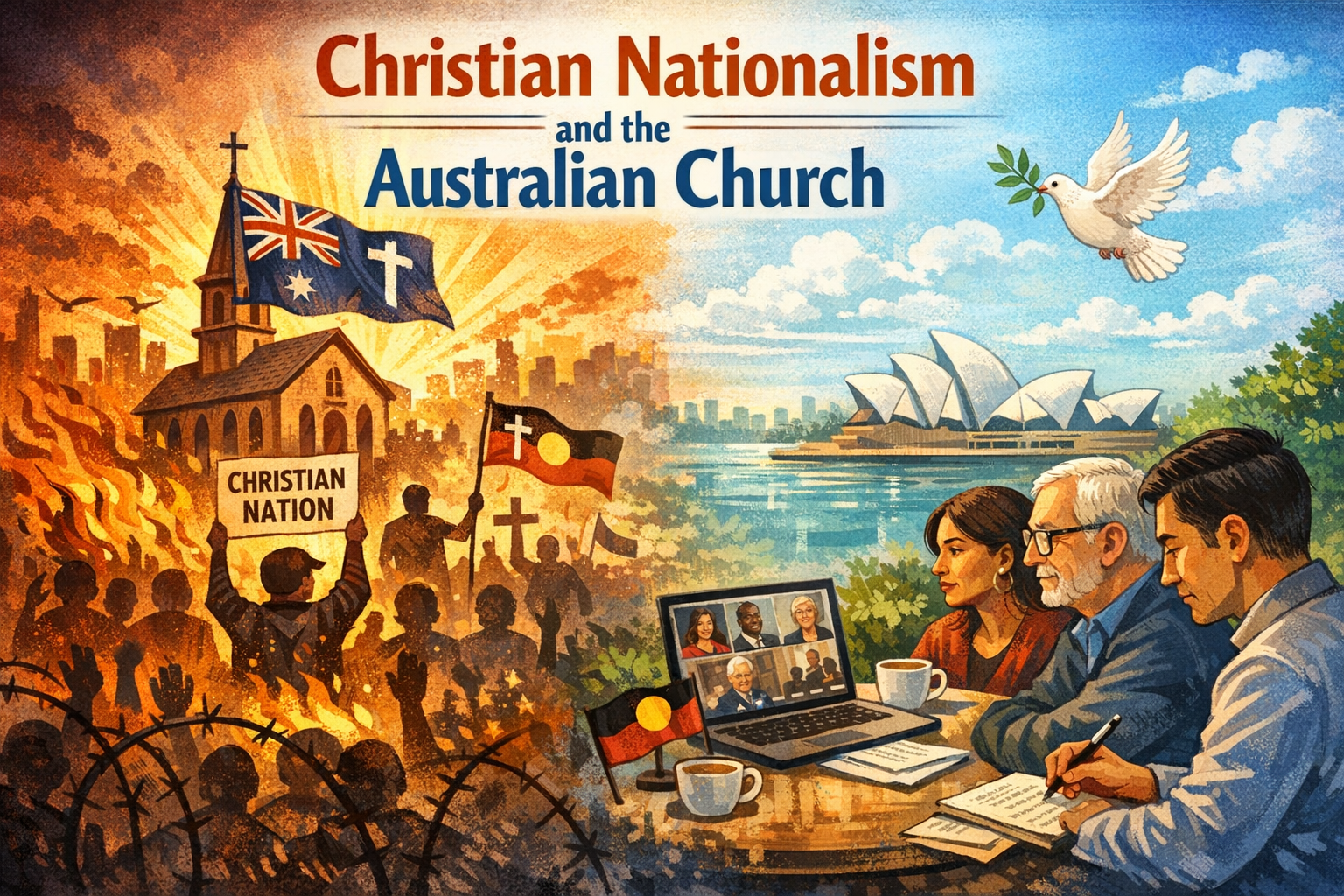
I was impressed that every speaker, without exception, acknowledged this country’s traditional owners, and many noted the Indigenous name of the land from which they were speaking. This is in stark contrast to the noisy Christian voices we heard in opposition to The Voice referendum.
The first speaker was Eleni Poulos, Adjunct Fellow at Macquarie University and a minister of the Uniting Church. Eleni’s deep, calm voice deserves its own radio program (are you listening ABC?). Eleni has written about the rise of right-wing Christian populism and its impact on Australian politics here.
Eleni noted that the Christian Nationalists’ strategy for shaping public discourse relies on creating fear, then offering themselves as a means of providing protection and a sense of “belonging” to a group which stakes an ownership claim over the nation through the myth of Australia as a “Christian nation”.
Eleni acknowledges that Christian nationalism is active in Australia but insists it is quite different to what we’re observing in the USA. It is less violent, less political, and a distant concept in the lives of most Australian Christians.
She notes that the Canberra Declaration which claims Australia’s constitution, culture, laws and values are drawn from our “Judeo-Christian heritage” (in itself, a contentious and problematic term), and that the Australian government “sits on the shoulders of Jesus Christ” – which must be a particularly difficult burden for him to bear! Initiated in 2010, the Canberra Declaration, ostensibly a Christian Nationalist document, has been signed by over 97,000 people.
The associated Daily Declaration is Australia’s largest Christian news site.
Eleni notes that Dr Augusto Zimmerman, Head of Law and Professor at Sheridan College in Perth and adjunct Professor of Law at the University of Notre Dame, has written a book arguing for the Christian Foundations of the Common Law to be recognised and restored. Not surprisingly it is enthusiastically reviewed by Dr Graham McLennan, another Christian Nationalist, previously of the Australian Christian Lobby and the ever-entertaining Bill Muehlenberg of Culture Watch whose politics are slightly to the right of Attila the Hun.
Eleni also pointed to The Spirit Behind the Voice: The Religious Dimension of the “Voice” Proposal (2023), a book edited by Gabriël Moens AM and Augusto Zimmerman which, says Eleni, contains, “truly appalling essays against The Voice” including the claim that it might lead to Aboriginal religion becoming the religion of state.
Former national party politician, John Anderson is also a concern for Eleni. His “anti-woke” website has a large readership and if you take a quick gander you’ll see him promoting books like, America’s Cultural Revolution: How the Radical Left Conquered Everything and The Queering of the American Child.
Eleni drew our attention to research by David T Smith, Associate Professor of American Politics and Foreign Policy at the University of Sydney. In 2021, Smith wrote about the “declining policy influence” of the Christian Right in Australia, and its continuous defeats on issues such as same-sex marriage and abortion. This is something I’ve noted previously when documenting the successive failures of Lyle Shelton of the Family First Party (previously Australian Christian Lobby).
Yet there are subtle reminders of the grip that Christianity has on our secular government. Eleni reminds us that every Australian parliament except for the ACT and most councils open with a Christian prayer – even in constituencies where less than half of the residents are Christian.
At its heart, says Eleni, Christian Nationalism is about belonging – who belongs, and, of course, who doesn’t. This has a tendency to consider white, western, Christian civilisation as the true citizens of the country with a mandate to “save” the rest of us. The myth of a white, Christian Australia, which most of us abandoned in the 1960s is still, she says, a powerful force.
A clear danger of this revisionist view of Australian history is that it views Black history as divisive and cultural diversity and the LGBTQ+ community as “existential threats.” It promotes fears about immigration – especially Muslim immigration – and see Christianity as the “social glue” that holds the family, and the nation, together.
But, Eleni insists, unlike in the USA, Australian Christian Nationalists are not building an agenda for Christian government – at least not yet.
Christian Nationalism, says Eleni, is not Christianity – it is a distorted view of Christianity which builds walls between people, rather than tearing them down. She refers to it as “culturalized Christianism.” Eleni says that Christian nationalists’ utopian view of a softer and better way of life masks the ideology’s racism, Islamophobia and homophobia. It may result in a better life for white, middle-class, Christians, but woe-betide the rest of us – especially those already at the margins!
So, is Christian Nationalism something we should worry about? Eleni agrees that, although it is not as fully fledged here as it is in the USA, it still poses “a serious minority threat.”
Here, the 7 Mountains Movement is still “embryonic”, although she concedes that it’s been rather more than embryonic in Victoria and Western Australia where evangelical Christian politicians have sought to strong-arm their way into local politics. Still, she says, in her own research, she is “not getting a sense for the desire for a theocracy” but rather just a desire for Christians to have more of an influence over policy.
In the question time, one attendee noted that Christian nationalism was having an enormous influence in Australian churches and was attracting a big following. Another person noted that the “end times” rhetoric, which claims that Jesus will not return until Christians head all the governments of the world, is not as potent here as it is in the US.
Another attendee also pushed back saying, “There is more happening at the political level than you think. Although they are quiet behind the scenes, Christian nationalism has got a lot further than is obvious.”
Eleni acknowledged that there is a lot of movement at the Christian nationalist station and, of great interest to me, mentioned the evangelical infiltration of Anzac Day services.
The seminar made clear that, at least in the opinions of knowledgeable, mainstream Australian Christians, Christian nationalism sits in a liminal space – neither dominant nor dormant. Despite their noisiness online this is an ideology that hovers at the edges of Australian church and public life. Yet the fact that these Christians felt the need to convene an online conference to discuss it suggests that they are looking towards America and are anxious to head off any attempts to theocratise Australia “at the pass.”
It’s encouraging to see so many within the church engaging with this issue with research, serious thought and an integrity that considers, not only the welfare of the Christians and the Church, but also those of other faiths, of no faith, and those who live on the margins of our society.
Much more was discussed during the day-long seminar, and I will write up my notes over the next week or two.
Chrys Stevenson
For clarity, snarky remarks about Christian nationalists are entirely mine, and not those of the speaker, Eleni Poulos.
 Gladly, the Cross-Eyed Bear
Hi Chrys Thank you for this … I ejoyed this article so much. I am a gay christian yogi. I attend an Anglican Church in Brisbane which has an amazing Priest who is a woman. We start every service with an acknowledgement of country. Refugees, gay people, trans people and all “others” attend and are welcome. No one cares!! I find the hijacking of spirituality by narrow minded people abhorrent. As always I love your writing. Take care and I hope all is well in your world. We had a coffee in the Valley ages ago!! *Kind Regards Don *
*Donald Pincott * *11 Keryn Place Keperra 4054 Australia MB: 0431370741 *
Where there is charity and wisdom, there is neither fear nor ignorance. Francis of Assisi http://www.donaldpincott.com/
Thanks so much, Don, Great to hear from you!
Thank,you for bringing this out into the open.
I have been concerned about Christian nationalism for decades and although I support anyone to worship whatever god they like, I don’t ever want it impacting on mine or anyone else’s freedoms. With this in mind, I believe our governments should and must be faith free. you can be one of faith but all of this must be left in the car park and never into parliament or any other government institution. We should be truly secular and god free.
Dear Chrys,
My cousin Martin is a Jewish Nationalist. He differentiates between Medinat Israel (the current legal boundaries of Israel) and Eretz Israel (an expansionist vision of Israel with indeterminate boundaries). He supports Netanyahu and the Orthodox establishment in Israel) along with reactionary politics in the US. His mother and my father were brother and sister. He lives in LA and supports Trump. At least one of his descendants has opted for sanity.
David
Jewish Nationalism is a whole other can of worms
As an Australian who lived in the US for many years and married into a Christian fundamentalist family, I live in fear that this unsavoury flavour of Christianity will take hold here, by infiltration. All of a sudden, they get into positions of power and laws change. Keep spreading the word, Chrys. Thank you!