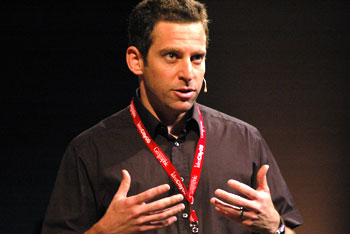
Sam Harris
 I have always been interested in spirituality (see my blog post Fashion Faux Pas and Literary Lunacies: How Dawkins and Harris overhauled my intellectual wardrobe). Like many of my generation, I stopped off in ‘New Age Spiritualism’ on my journey towards atheism.
I found Sam Harris just as I was on the outskirts of Atheistville. I still had some souvenirs of “New Age Spiritualism” hanging around my neck, but I’d divested myself of most of the ‘woo’ before I bought End of Faith and Letter to a Christian Nation – ironically with some ‘Christmas’ money given to me by a crystal-gazing aunt.
It was after reading Letter to a Christian Nation that a little light bulb went on in my head. I remember thinking, with some surprise, “Oh! I’m an atheist!”
As a new ‘gnu’ atheist, I found The End of Faith incredibly confronting with its negative portrayal of Islam – I was, and still am, far more concerned about fundamentalist Christianity. Islam is dangerous but it’s out in the open and easy to spot. The encroachment of fundamentalist Christianity is insidious, often silent and invisible. We don’t recognise its stranglehold on our secular institutions until it’s happened.
Having been introduced by Harris to the ‘new atheist’ genre, I moved on to read Dawkins’ The God Delusion, and Hitchens’ God is not Great: How Religion Poisons Everything. Like Harris, they didn’t make me an atheist, they just made me realize I was one. More importantly, they politicized me and made me realise I should get off my arse and do something about the religious assault on secularism, human rights and individual autonomy.
Sam Harris took to the GAC 2012 stage and immediately acknowledged the late, great Christopher Hitchens.
Hitch, said Harris, “had more wit, style and substance than a few civilisations I could name.”
Fittingly, perhaps, Harris then went on to talk about death.
“The ‘good news’ of atheism,” said Harris, “is that nothing happens after death. We return to nothingness; so there’s nothing to worry about. If we’re right, death is not a problem; life is the problem.”
“To not believe in God,” he said, “is to know that it falls to us to make the world a better place.”
Harris spoke of how religion makes the world worse, not better.
Because of the interference of the Catholic Church, they are still arguing in the US about whether women should have access to contraception. This, he said, “while the church nurtures ‘an army of child rapists’!
Harris also spoke of religion’s ‘misuse of human energy’ and its ‘manufacturing of human unhappiness’.
Harris accepts that we can’t make the world a paradise – and who would want one?
At university, when I studied utopian thought, I quickly realised that one man’s utopia is another man’s dystopia. Harris is not concerned with creating a ‘perfect’ world or a ‘perfect society’, but he is concerned with the human condition – with making lives happier, more meaningful, more productive and, surprisingly, more ‘spiritual’. More ‘gross national happiness’, perhaps.
And then, the important question, “What does atheism have to offer?”
If we are to argue for an ‘End of Faith’ what do we propose to put in its place?
Harris accepts that as ‘mere disbelief in god’ atheism doesn’t have much to offer. But, he said, “Atheism clears the space for better conversation.”
But can atheism do what religion does?
Harris acknowledged, for example, that religion can help people make sense of tragedy. It provides the answer that most people think they need.
“If your child dies in a car accident,” said Harris, “believing she’s in heaven with Jesus has to be consoling.”
So, we have to ask, “What is lost when we jettison religion?”
And, at least part of the answer is, “Total consolation in the face of death.”
If we are to argue for a world without religion, said Harris, “we have to build a bridge to deal with this fact.”
“We spend most of our lives tacitly assuming we’ll live forever,” he said. “There’d better be a heaven if we’re going to waste our time!”
Accepting that we have one life, and that is all we get, is a great motivation to make the most of our time.
But, if you don’t believe in God, “What is the point?”
It’s a sensible question, said Harris, and there is an answer. But, the answer requires a change of attitude towards life.
We need to learn to live in the present moment, he said, reminding us that “It is always ‘now‘.”
It is a ‘liberating truth about the nature of the human mind’, he said, “that the past is a memory; the future is merely a thought arising now”.
“We need to attend to the present moment. We need to consciously experience ‘now’; “because consciousness is everything”.
“How can we truly be fulfilled in life?”
“How can we make our lives worth living?”
The answer, said Harris, is that how we think about an experience determines how we feel about it.
It was at about this time that I felt I’d tumbled down some GAC rabbit hole and ended up in at an Eckhart Tolle lecture.
Eckhart Tolle, author of The Power of Now, was Oprah Winfrey’s poster boy for a while. He was a bit too full of ‘woo’ for my taste but he did have a lot of good ideas if you stripped away the woo.
At 29, according to Tolle, he underwent an ‘inner transformation’ that led him to experience a constant ‘state of bliss’.
To his credit, Tolle says that religions “have become so overlaid with extraneous matter that their spiritual substance has become almost completely obscured”, that they have become “to a large extent … divisive rather than unifying forces” and become “themselves part of the insanity”.
To me, Harris’ message seemed to echo Tolles words’: “the most significant thing that can happen to a human being [is] the separation process of thinking and awareness”. He says that awareness is “the space in which thoughts exist” and that “the primary cause of unhappiness is never the situation but your thoughts about it”.
Harris confirmed that he was speaking about ‘secular spiritualism’ and that meditation was one method to help achieve the ‘mindfulness’ he was speaking of.
“The antidote to fear of death is to live life in the present,” he said.
“We have to create a world we want to live in; and religion is a bad way to do that.”
What happened next was, to many bizarre – to others, the highlight of the convention. Harris took us through a guided meditation.
I had sat through many guided meditations during my stay in ‘New Age Spiritualism’, but I hadn’t expected to experience it in downtown ‘Atheistville’. I admit some discomfort at being thrust into it unexpectedly. It’s not that I objected, or that I was offended. I guess I see meditation as a rather personal thing, something I’d like to be prepared for rather than having it ‘sprung on me’ . But, I was up for any experience, so I closed my eyes and listened to the admittedly relaxing tones of Sam’s voice.
I was speaking to my friend Anthony, at the Sunshine Coast Atheists meeting tonight. He attended the convention and said he was quite moved by the experience of Harris’ meditation.
Me? Not so much. Three late nights in a row, no breakfast, and the soporific sound of Sam’s voice soon had me nodding off. I was putting too much effort into staying awake to really concentrate on anything else.
 For me – and this is entirely subjective – the session would have been better in the first session of the day or after morning tea or lunch when we were a bit refreshed. This isn’t a criticism of the organisers at all. I’m not sure that they knew what Harris planned to do and it’s difficult to shuffle speakers around because one of them might happen to put the whole audience to sleep!
I know that opinion was divided on the meditation. I’m perfectly willing to take the blame for the fact it didn’t do much for me, and I’m happy for those who found it a deep and meaningful experience.
Harris was aware that what he’d done might be thought strange or controversial.
“I’ve smuggled mindfulness meditation into this talk and foisted it on 4,000 atheists!” he laughed.
But, he explained, it’s important to know how to clear your mind and focus on ‘the now’.
“It takes a long time to realise how much thought is clouding our present experience.”
He felt that mindfulness and meditation can be useful in moments of crisis.
“Relief can be gained by bearing down on the present moment; it erodes the pain.”
I think there’s a lot of value to be had in Harris’ pursuit of ‘secular spirituality’. I also think that living in the ‘now’ is good advice for those who want to maximise their happiness (and who doesn’t?).
What Harris didn’t talk about, but Eckhart Tolle does, is monitoring your ‘self-talk’; listening to and taking note of the silent conversations you constantly have with yourself and working to expunge negative feedback. If you actually listen to your self-talk you’ll often find yourself saying some pretty hurtful and irrational stuff about yourself! The ‘trick’ is not to accept the truth of what you tell yourself, but to challenge it and try to change the negative thoughts ‘looping’ through your head to something more positive.
Something else Harris didn’t discuss, but which I practice in my own life , is living in gratitude – trying to be constantly aware of how lucky I am to be alive and enjoying a life of such comparative luxury that many people in the world could not even imagine such good fortune. I know that Dawkins often touches on this. I find this an excellent way to put life’s small tragedies into perspective. I’m not always ‘zen’ in the moment of crisis, but I think it helps me recover more quickly and move on. Not always, but mostly.
So, is meditation and mindfulness enough to fill the ‘void’ left by religious belief?
I doubt it. People are lazy and meditating effectively takes time and dedication.
“Jesus loves me, God will fix it,” is much easier.
I don’t think meditation is a discipline most people will practice; unless of course there’s a huge culture change and meditation is taught in schools and encouraged in the workplace.
And, is it even necessary or desirable to fill the religious ‘void’? I think we need to have a conversation about that!
Is there even a ‘void’ to fill?
I can only speak for myself. Certainly my ‘New Age’ belief in an afterlife helped enormously to ease my grief when my father died. In fact, I think it may have eased it too much. I loved him deeply but, to this day, I’ve never shed a tear at his passing. I regret that.
When I realised – after reading Harris – that I was ‘an atheist’, I thought, “Oh dear, I guess I’m going to have to give up this idea of life after death!”
But, at the time, that idea was painful. I liked to believe my Dad was watching over me; it gave me comfort and did no-one any harm. I knew it was irrational – I half knew it was fantasy – but it was a security blanket I wasn’t prepared to part with …. yet.
So, I didn’t push myself. I just let it sit there, completely out of place with my other beliefs, until one day I thought, “Oh, it’s gone!”
And it didn’t hurt at all.
Speaking for myself, I’m not afraid of death. I see death as exactly the same as ‘before birth’. I don’t spend a moment regretting the years I missed before I was born, and I’m quite sure I won’t spend a moment regretting the years I missed after I’ve died. The two states are the same – nothing/non-existence.
Pain is another matter, I’m quite afraid of pain. If there’s going to be a lot of pain, let me die quickly!
I don’t know if it’s a good thing to ease the pain of a death of a loved one. Perhaps it’s a right of passage – something we just have to work our way through. Certainly I now regret that my grief at my Dad’s death was numbed by an irrational belief that he wasn’t ‘really’ dead.
I’ve given it quite a lot of thought over the past week and I think building strong, supportive communities is more important than encouraging atheists to take up meditation to fill the alleged ‘god shaped hole’. My friends who have left religion behind often say the biggest loss was the support of a close, co-operative community. Of course, when my friends admitted their atheism, those loving Christian communities pulled down their shutters and put out their ‘closed for business’ signs. Share the delusion or share nothing seems to be their credo.
I draw great strength and inspiration from the atheist ‘community’ – both real life and online. Here I’ve found friendship, laughter, emotional support and (even more important) IT support!
Personally, I don’t feel a ‘god shaped hole’ in my life at all. I know how to meditate but I don’t find it particularly helpful. That’s not to say, of course, that others won’t. My sense of ‘spirituality’ comes from love and service and laughter and gratefulness.
I think Sam Harris had some important things to say. I’d like to read more. But on the strength of his GAC 2012 speech, I can’t say I’m completely buying the whole package.
Chrys Stevenson
If you’re interested in meditation, you might like to read Sam Harris’ “How to Meditate”.