Category Archives: Uncategorized

Global Atheist Convention – Gala Dinner

One of the big decisions facing those attending the Global Atheist Convention is whether to pay the exorbitant price of a ticket to the Gala Dinner.

I received a free ticket to the dinner in 2010 (apparently in lieu of a mention on the program for my many months of work – yes, it still smarts).  This year, I chose to fork out the $150 based on my very positive 2010 experience.

Was it worth it – well, yes and no.

I should preface this by saying it’s not really a criticism of the GAC organizing committee who did a superb job with the whole convention. I guess it’s more a matter of misjudgment than anything – and misjudgment made for all the right reasons, I expect.

The first issue is that $150 is a very large amount of money for dinner for one. For those of us old-fashioned enough to believe that one should dress up for a gala dinner, there’s the considerable added expense of clothes and jewellery. Yes, I know, this is entirely optional – but it’s something one has to factor in.

In 2010 the food provided by the Melbourne Convention and Entertainment Centre was superb. It was way beyond what I expected and, as I recall, everyone was raving about it. This year’s offering was very different.

The entree was a pretentious nouvelle cuisine mish-mash of mismatched tastes.  It was pretty, but that was the only sense it satisfied.

Main course for non-vegetarians  was either fish or lamb – served alternately. I hate that. I know you can swap around with people at your table, and I know that it’s probably the only workable method for such a huge crowd, but for $150 I’d really like to be able to choose my own main. Small quibble, but there it is.

I was lucky – or so I thought. I had the lamb plonked down in front of me. It was an unappetising hunk of brown meat with a tiny squirt of tasteless sauce (probably a ‘jus’ given the pretension of the entree).  The lamb was overcooked and stringy. It was supposed to have been accompanied by Potatoes Dauphinoise – misspelled Duphinoise  on the menu. Perhaps the missing ‘a’ excused the fact that it contained none of the standard ingredients of a Dauphinoise – cream, butter and cheese. Instead, it was an insipid, under-seasoned, flavourless square of potato slices which no self-respecting Frenchman would have touched with a barge pole.  A couple of forlorn baby carrots sat drearily on the plate as the ‘token’ vegetable.

The desserts were very good, but tiny. I had some kind of lemon sorbet thing and a chocolate mousse in a chocolate basket which surely came from a different kitchen than the pap served previously.

Now, none of this is the fault of the Convention organisers, but I know the MCEC can do better – and they really should have.

The entertainment for the night is my next gripe. I can understand that the organisers wanted to give us maximum value for money, and I do appreciate the thought. The entertainment program was packed – over-packed.  The thing is – the Saturday night dinner is one of the only chances Convention-goers have to catch up with each other. We find each other far more entertaining than most of the acts.  This, unfortunately, proved true as people increasingly got frustrated and just talked over the top of the entertainers.  It wasn’t fair on the entertainers, but it wasn’t fair on the dinner guests either.

Simon Taylor was the MC for the night. He did a professional job, but why book someone with Taylor’s talent as an illusionist and not have him perform?

I love Brian Dalton aka Mr Deity but a technical problem took the wind out of his sails and, I think, the momentum was lost for the whole evening. I don’t know whether the problem was the tech crew’s or Dalton’s, but having an international speaker floundering at the podium unable to launch his video wasn’t a good look.

And then there was the startling omission (again!) of Dan Barker – a brilliant musician and song-writer from our own international atheist community.  Supposedly the reason given for not including Dan was the expense of hiring a piano. I’m sorry, but if I had a chance to book Dan Barker I’d organise the budget to include the cost of a piano.

There were some laughs to be had from the other entertainers, but the sound was not great and most people just decided to chat amongst themselves.

I was blown away by Catherine Deveny’s performance at the 2010 GAC. It was a real tour de force. This time her performance seemed to lack verve and including her 2010 spat with Cardinal George Pell just seemed like she was stretching for material. Sorry, Catherine, I do love you, but the Pell thing is over – move on!

So, on the strength of the food and the entertainment, the investment of $150 for the gala dinner was definitely not worth it. But I wouldn’t have missed it for the world. The chance to dine in the company of Michael Barnett (@mikeybear), Gregory Storer (@GregoryStorer), Kieran Dennis (@dolmiogrin), Linley Kissick (@postielinley), AronRa, Andrew Skegg (@askegg), Robert Cope and Sean Jelinek (@SeanJAus) was priceless.

It was also great to catch up with Carol Wocker, @MsPraxis and @Tradrmum, OJ Lesslar, Kazza from Queensland, Martin Pribble (@MartinPribble), Colin Mackay, Russell Blackford (@Metamagician), Jonathan Meddings (@TheCarapace), Jin-Oh Choi (@JinOhChoi) and many more.

I spent quite a lot of time talking with Dr David Leaf from Dying with Dignity (NSW) and new friend, Neil Francis, head of Your Last Right. One of my new interests is forging closer links between us ‘generic’ atheists/secularists and those targets of religious propaganda and interference whose interests are more specific – e.g. voluntary euthanasia, women’s reproductive rights, scientific research, secular education, gay rights.

In this same vein I was delighted to have time to chat with Jane Caro about government funding for private schools. Perhaps because I was educated (in part) at a private school I’ve never objected greatly to reasonable funding to that sector – based on the premise that the parents of private school students pay a portion of their tax for education facilities and are entitled to the benefits of that. I have to say even a brief chat with Jane had me re-examining my stance on this.  I look forward to chatting with her further and maybe blogging on the pros and cons of government funding for private schools.

I’m not much of a ‘fan girl’, so hunting down celebrities is one of the things I’m least likely to do. One ‘celebrity’ I did want to meet, though, was Fiona Patten, leader of the Australian Sex Party. I’m not tied to any political party – nor do I intend to be – but I admire Fiona Patten greatly and she’s generously retweeted links to some of my work in the past.  But, before I had a chance to go hunting for Fiona, she found me, saying, “Chrys Stevenson? I really wanted to meet you!”

Wow! That was my ‘memorable Convention moment’ right there! Fiona turned out to be a lovely, down-to-earth gal and another person I’d like to spend far more time with.

One event at the Gala Dinner, I think, epitomised what the night should have been all about – fun and making real human connections. I’ve never thought much about the convention of sitting all the VIPs down the front – why not spread them amongst the hoi-polloi? Do we really have to set up this artificial ‘us and them’ division at atheist conventions?

PZ Myers is one of the most accessible of the Convention speakers. Throughout the Convention, PZ and Australian blogger Martin Pribble got involved in a good-natured spat over their respective rankings in a poll for the best atheist/agnostic blog for 2011.  As (mock) tensions rose during the Convention it was decided that a duel was in order and, as no duelling pistols were to hand, a hug-off seemed a reasonable compromise.

And here it is, captured for posterity by Andrew Skegg.

Yes, folks, that’s what we ‘militant atheists’ do when we get together. We hug each other – frightening, isn’t it?

So, to answer the question posed at the beginning of this post, “Was it worth attending the Gala Dinner?”
“Definitely, yes!”
But if we do it again, can I ask the organisers to consider something more informal and something which allows much more free time for Convention attendees just to ‘hang out’ and chat and hug and make real life friends out of cyber-friends. Because, you know, that’s really what we’re there for.  And, ultimately, building stronger real-life links within our various ‘communities’ is going to pay far greater dividends for secularism than watching any comedy act – no matter how good it is.
Chrys Stevenson

Global Atheist Convention – Saturday, 14 April (Part Seven)

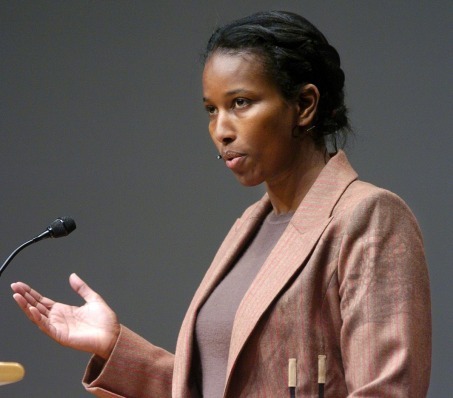
Ayaan Hirsi Ali

Ayaan Hirsi Ali, author of the books Infidel (2007) and Nomad: From Islam to America – A personal Jorney Through the Clash of Civilizations (2010) took the stage accompanied by thunderous applause.

Hirsi Ali’s key concern is the treatment of women under Islam but her most recent book takes a broader perspective in examining the relationship between Islam and the West.

Hirsi Ali referred to the grass-roots uprisings in Arab countries during 2011 – dubbed the Arab ‘secular spring’.  But, said Ali, if Arab nations are enjoying a secular spring, what would an Islamist winter look like?

Before answering that question, Hirsi Ali paused to tell us about Fatima Abdallah. This ‘detour’ so early in her speech seemed to be a deliberate attempt to gain the attention and support of the previous speaker, Geoffrey Robertson.

Fatima Abdallah’s story can be read here. Briefly, she was a divorced and barren Muslim woman, living (in a tense relationship) with her family in Florida.  Fatima died from having her head repeatedly bashed against a coffee table. She suffered broken ribs and her blood was spattered all through the house. Her family did not call 911 until 2 1/2 hours after her death.  Their testimony is riddled with inconsistencies. And yet, in an apparent concession to Sharia law, Tampa police bizarrely accepted the family’s story that Fatima committed suicide.

Hirsi Ali pleaded with Robertson to help her reopen the case, or point her towards other lawyers who may be able to help.

She then returned to the subject of her speech.

“Fellow unbelievers,” she began, “You godless lot …”

She paused again, for a moment to express her grief at the loss of Christopher Hitchens but soon moved on.

“What would a secular spring mean to the societies in North Africa?” she asked.

It would bring:

  • democracy
  • the rule of law
  • the end of corruption
  • an end to human rights violations
  • freedom of speech
  • freedom of the press
  • freedom of conscience
  • freedom of religion
  • women’s rights – including laws to protect women from domestic violence
  • peace with Israel
  • recognition of the right of Israelis to have a Jewish state
  • and the end of Islamic terrorism

And these progressive changes, she said would lead to economic growth sourced from greater foreign investment and burgeoning tourism.

Importantly, with greater freedom and better economic conditions, Muslim youth would begin to develop confidence in ‘life before death, as opposed to life after death.’

But, said Hirsi Ali, the uprisings have not brought a ‘secular spring’, but an ‘Islamist winter’.

Hirsi Ali was highly pessimistic about the changes wrought by the Arab protests.  In places like Tunisia, Yemen and Libya, she said, Islamists are already in power, or soon will be. The situation in Syria is ‘ongoing’.

Islamist governments, she said, bring ‘religiously sanctioned corruption’. They promise tolerance to non-Muslim women, but these promises are broken. They are jailing authors and artists on charges of ‘provoking society’.

“Provoking society!” said Hirsi Ali, “What else is an artist supposed to do?”

As Islamists move in to fill the void left by the expulsion of the dictators, human rights will be violated and excused as the will of Allah.  There will be no freedom of speech, no freedom of conscience.

The legal age of marriage for girls will be lowered to nine.

Women will live in a state of perpetual guardianship.

Sharia law will justify violence against women – both in public and in the home.

There will be no peace with Israel – although Islamic governments will continue to make noises about trying to achieve it.

“The double-speak will continue,” said Hirsi Ali, “but they do not support the two state solution.”

Domestic terrorism will increase.

Elections have been held but it is significant that the secular parties did not do as well as the Islamists. These secular parties are not atheistic, she said, but they do support the separation of church and state.

It was a bleak assessment of the result of the popular uprisings which had given many of us hope for change in the Middle East and North Africa.

But, said Hirsi Ali, there is hope, and it comes from pressure being exerted by the Muslim diaspora.

She also spoke of young, pro-democracy activists like Hamza Kashgari, a Saudi poet and former columnist for the Saudi daily newspaper, al-Bilad.  On the day of the ‘prophet’s birthday’ in February this year Kashgari sent a series of tweets:

  • On your birthday, I shall not bow to you. I shall not kiss your hand. Rather, I shall shake it as equals do, and smile at you as you smile at me. I shall speak to you as a friend, no more.
  • On your birthday, I find you wherever I turn. I will say that I have loved aspects of you, hated others, and could not understand many more.
  • On your birthday, I will say that I have loved the rebel in you, that you’ve always been a source of inspiration to me, and that I do not like the halos of divinity around you. I shall not pray for you.

Kashgari made the tweets to make a point about human rights and freedom of expression.

He also enraged his critics by saying that Saudi women “won’t go to hell ‘because it’s impossible to go there twice.'”

Soon, there were 30,000 tweets calling for Kashgari’s death.

Kashgari is in deep trouble. But there is pressure being exerted from more moderate voices in the diaspora. For example, the Association of British Muslims has called on the Saudi King to drop any charges against Kashgari, arguing that:

“Thought crime is no crime at all, … Any state enforced penalty for perceived blasphemy runs contrary to the true spirit of Islam, and of our Prophet, peace be upon him, who was compassionate even to those who scorned him. … No one should be legally prosecuted, imprisoned or detained for simply expressing themselves.”

Secular forces in Muslim nations need help from the West, said Hirsi Ali. Their secular parties need our help to win Islamic hearts and minds. But help is not forthcoming. Why?

She spoke of the tendency to ‘romanticize’ the primitivism of ancient cultures – to view Islam, in a way, through the distortion of our own dissatisfaction with Western civilization.

She spoke of ‘white guilt’ – that special sort of embarrassment we in the West feel about our inability to defend the ideas that liberated African-Americans and women.

She said that it was conservatives and Christians who had stepped up to defend free speech and to defend Israel – not liberals. For example, said Hirsi Ali, it is a Christian group which has taken on the case of Fatima Abdallah.

Personally, I’m not sure that I agree with much of what Hirsi Ali said in this part of her speech – although I may change my mind after reading her book. I think perhaps there are at least four things which prevent Western secularists from charging into the internal politics of Muslim nations:

1) fear of reprisals – who wants to risk a fatwah against them?

2) fear of being accused of being racist or Islamaphobic

3) a feeling that we don’t understand Islam sufficiently to fight it in the same way we oppose Christian assaults on freedom of democracy

4) a feeling that while we have a ‘right’ to criticise Christianity (because that’s our culture) we have less right to attack Islam

5) a feeling of helplessness (and hopelessness?) and a lack of direction – we don’t know what will be helpful, and the problem seems just too large.

Hirsi Ali called on Westerners to:

1.  Develop a secular/liberal narrative to counter Islamist doctrine and methodology.

2. To help build up liberal institutions in Muslim nations.

3. To help secular activists with policital and policy training.

It is time for action, said Hirsi Ali.

Ayaan Hirsi Ali has suffered greatly for her apostasy. Even at the Global Atheist Convention she was flanked by security guards.  Outside the Convention Centre, the day after her speech, Islamic protestors held placards that read, “Message to INFIDEL Ayaan Ali Hirsi [sic] BURN IN HELL FOREVER”

During her speech Hirsi Ali explained how the Dutch government first housed her in a ‘bullet proof’ house – and then moved her to one that was ‘bazooka proof’. She has endured the murder of her friend and collaborator, Theo van Gogh.

Her life is constantly at risk. Her freedom curtailed by the threats of religious extremists and fanatics.

And yet, as she concluded her speech (and the day’s proceedings – for me*) at the Global Atheist Convention she said, “Infidel is a label I now wear with pride and joy.”

On that, I think, we can all agree.

Chrys Stevenson

* I do have to apologise to my readers.  Richard Dawkins spoke after Ayaan Hirsi Ali but by then I was so tired I had to make a choice between staying to hear Dawkins or forgoing the Gala Dinner.  I have already heard Dawkins speak twice and so I made the difficult decision to choose a sleep and a bubble bath instead. Sorry Professor!

I heard that his speech was particularly good, so if someone has written it up, please let me know and I’ll link to it.  I’d make a poor war correspondent, wouldn’t I?

“Ooops, sorry, missed that battle, I fell asleep in the bath!”

Global Atheist Convention – Saturday, 14 April (Part Six)

Geoffrey Robertson

The hugely impressive Geoffrey Robertson gave the inaugural Christopher Hitchens Memorial Lecture at Melbourne’s 2012 Global Atheist Convention.

Laurence Leung introduced Robertson, assuring the ghost of Hitch that if he had, indeed, ended up in Hell as his critics predicted, Geoffrey could probably talk the sentence down to three months detention and a good behaviour bond.

Robertson took to the stage and opened with a disclosure, “I’m not actually an atheist … I’m a lawyer. I can argue both sides.”

Like many speakers he took the chance to take a poke at Pell.

“I hear that Pell believes atheists can go to Paradise. I don’t know about lawyers; God has to draw the line somewhere.”

I wondered, for a moment, whether Robertson was pinching his wife, Kathy Lette’s, material; or whether she might pinch his!

Robertson reminded us that Hitch was “like a small boy, pointing out the emperor had no clothes.”

His, was “a life spent puncturing the hypocrisy of others – including himself.”

Hitch was driven, said Robertson, by a ‘passion for justice’. He believed that criminals should face retribution now, rather than in hell or in the pages of history.

If you read nothing else of Christopher Hitchens’ great works, said Robertson, read “Chidhood’s End”, his Vanity Fair exposé of Ugandan, Joseph Kony of The Lord’s Resistance Army.  Read, said Robertson, about the support this monster receives from crazed evangelicals in the US.

It was Hitch, he reminded us, who came up with the idea of suing the Pope for crimes against humanity.

Robertson noted that here in Victoria, there have been [at least?] forty suicides in the past decade as a result of clerical abuse and the church’s failure to deal adequately with its victims. He urged the Baillieu government to institute a Royal Commission.  Immediately following the Convention, Baillieu announced a parliamentary inquiry into the matter – sadly not a Royal Commission, but a step forward, at least. One can only hope it will not be a bureaucratic whitewash. My friend, Rodney Chiang-Cruise reminded me at dinner last night of Sir Humphrey Appleby’s caution: “Never set up an inquiry unless you know in advance what its findings will be.”

Robertson challenged the legitimacy of allowing any religion to indoctrinate children at a very early age and convincing them that the priest had ‘supernatural’ powers. This has a powerful emotional and psychological effect on children, he said. When children’s awe of an infallible ‘superpowered’ authority figure is combined with the infantile celibates we call priests, it is a dangerous combination which too often leads to sexual and psychological abuse.

We must raise the age at which children are formally indoctrinated into their parents’ religion. The Vatican refuses to acknowledge this as a problem and, in fact, wants to lower the age of communion from seven to five.

Robertson said that the law should ban any formal induction until a child is at least 13 years of age.

The Catholic Church, says Robertson, blames everyone and everything but itself for clerical abuse: homosexual infiltration, aggressive secularism, the devil, Jewish journalists on the New York Times, even modernity!

And, the Australian taxpayer – that proverbial ‘mug’ – pays for Australia to have an embassy at the Vatican in addition to the embassy we already have in Italy. Even Ireland, said Robertson, has closed its Vatican embassy due to the deceitful behaviour of the Papal Nuncio, Archbishop Giuseppe Lazzarotto, expelled from Ireland – and sent where? To Australia!

Robertson opposes tax exemptions for religious institutions. While other worthy, secular organisations like Human Rights Watch cannot get exemption, religious institutions receive this privilege ‘as of right’. We need a Bill of Rights, said Robertson. Religious institutions should pay the going rate in corporations tax.  In the meantime, perhaps the Atheist Foundation of Australia should declare its belief in Christopher Hitchens.

It is notable that Robertson, one of the world’s leading lawyers, states unequivocally that the convention of saying prayers in the Australian parliament is unconstitutional. How good would it be if we could get pro-bono legal assistance to challenge this in the High Court! I do understand there are greater problems facing Australian society, but symbolically this would be an important victory and bring a great deal of attention to the other assaults on Australian secularism. ** (Please see clarification of this section in my comment below.)

Robertson reminded us how fortunate we are to be able to assert our disbelief without fear. Cruelty, he reminded us, faces atheists in many parts of the world. He spoke of the ‘atheophobia’ in many Muslim countries. (Atheophobia is a real word, Robertson assured us – “I checked it with Stephen Fry!”)

In places like Algeria, Saudi Arabia, Jordan, Indonesia and Iran, he said, atheists risk imprisonment and death because they share our belief.

The problem in Iran, is grave.  In the late 80s, said Robertson, thousands of atheists were killed by the Ayatollah Khomeini. They were hung from cranes, four at a time – or shot by firing squad – and buried in mass graves. At least 7,000 atheists were killed – perhaps as many as 30,000. Their only crime, Robertson insists, was their atheism; although the Iranian government lies about this and tries to cover it up.

What is worse,most of the perpetrators of this atrocity are still alive and hold high positions in Iran’s government, including Ali Khamenei, Iran’s supreme leader; a man Hitch described as “a semi-literate megalomaniac”.

Robertson made the chilling prediction that Israel may stage a military strike on Iran before the year is out.

Meanwhile, the religious fanatics who lead Iran believe that nuclear war will create the kind of chaos that will bring the second coming of the 12th Imam. I hadn’t heard of the 12th Imam, so I did a little research.  Apparently:

“Critics of the Islamic Republic allege that Ahmadinejad and the supreme leader would even go so far as to hasten a nuclear showdown and cataclysmic strike — perhaps an attack on Israel and inevitable retaliation — to hasten the arrival of the 12th Imam. Ahmadinejad has even called for the reappearance of the 12th Imam from the podium of the United Nations General Assembly. During his speeches within Iran, Ahmadinejad has said that the main mission of the Islamic Revolution is to pave the way for the reappearance of the 12th Imam.”

As Hitch said, “Religion poisons everything.”

“Hitch!” cried Robertson, “Where are you now? Looking down, perhaps from Cardinal Pell’s heaven?”

Hardly an achievement, Robertson reminded us, “If Mitt Romney dies he’ll get his own planet!”

“It’s a crazy world!” said Robertson. “Hitch tried to make it a saner place.”

Hitch is gone now and we know he’s not going to make a second coming. I guess if is work is to continue, it’s all up to us.

Chrys Stevenson

Global Atheist Convention – Saturday, 14 April (Part Five)

Lawrence Krauss

Take a pinch of nothing, some random particles, add gravity, quantum mechanics and a soupcon of quantum fluctuation and voila - your own universe - or croquembouche - or something tasty, anyway.

When I was a high school we had a horrible, grumpy science teacher called Mr Fendley.  Mr Fendley didn’t think girls should learn science and I was all too happy to co-operate with a teacher who preferred me to sit in the back of the class day-dreaming than working.

Result? While I topped the state in English, I got 2/100 for my last high school science exam. I recall looking at the paper, casually ticking a couple of multiple choice questions, then strolling nonchalantly out of the room, knowing it would be a completely wasted effort to continue.

I’ve tried to make up for it since, but I fear I have not caught up sufficiently to be able to do justice to the next GAC 2012 speaker, physicist, Laurence Krauss.

I was really looking forward to Krauss’s speech on how the universe could have just ‘appeared’ from nothing. I imagined my next debate with a fundamentalist.

“So,” they sneer, “how did the universe just ‘pop up’ out of nothing?”

And I’d look sickeningly superior and say, “Well, let me tell you ….”

Alas, I fear, that’s another fantasy I’ll never fulfill (that and bonking George Clooney or winning the Grand National like Velvet Brown).

I did try to be attentive. It’s not that he wasn’t interesting and engaging but by the time we got half way through my head was swimming and I’m afraid I rather nodded off.

I can remember thinking, as my chin hit my chest, “I’ll just have to buy the book.”

And that may have to be my advice to you, gentle reader!  I’m sure it’s a very good book, and I will be buying it myself.

It’s called, A Universe from Nothing.

But, I will not wimp out completely, I will try to give you some idea about what this fascinating (but ultimately soporofic) speech was all about.

The important point is that we now know enough about the physics of the universe to say that, theoretically, it is possible for a universe to pop into existence from nothing.

I take it this is roughly equivalent to me peering into the fridge at the end of the week and managing to produce dinner for two out of a couple of stale bits of cheese, a couple of glasses  of cask wine, a slightly brown bit of ageing garlic,  and a six day old bit of left-over French baguette.

Krauss promised to talk about this ‘complex subject’ in a way that even Cardinal Pell would understand.  Either he didn’t succeed or my IQ has dropped alarmingly since I was last tested – I was sure I was at least a little smarter than Pell!

(Krauss did comment that Pell was unique among men, having never thought deeply about anything in his life.)

OK, OK, Lawrence, I’ll buy the bloody book and I’ll think until there’s steam emanating from every orifice to make amends for falling asleep during your speech! OK?

Krauss explained that there are three different theories on what ‘shape’ the universe could be:  Open (i.e. able to expand outward forever), Closed (i.e. able to expand but then prone to contract into a ‘big crunch’), or Flat (in which the expansion will, eventually, slow down*).

Krauss said.we live in a flat universe and this knowledge provides us with the first inkling that something can come from nothing.

Seventy per cent of the energy of the universe, said Krauss, resides in nothing. They know this by weighing the universe.

Now, don’t ask me how they do that, but apparently they can, and when they find that the universe weighs a whole lot less than it should, .they know that 70 per cent is hiding away over there in ‘nothing’.  If only I could do that with 70 per cent of my weight – I could have appeared at the GAC 2012 dinner as a svelte size 10!

“Chrys! What happened to all that weight you were carrying?”

“Oh that? I lost it.”

“Well, good on you!”

“Oh, it was nothing!”

I’d love to tell you that I understand how this all works, but Lawrence has a booby-trap in every corner.

“If someone tells you they understand it,” he says, “they’re lying.”

Well, I’m telling you I don’t understand it, and I can assure you I’m definitely not lying!

The key point seemed to be that empty space – nothing – has energy. (Which is a lot more than I can say for me after three days at GAC 2012!)

We know from experiments that if you create a vacuum ‘virtual’ particles tend to pop in and out so fast you can’t see them, but they can be detected. (Please! Don’t ask me how!)

If you apply gravity, says Krauss, those particles can appear and stay with impunity.

The key point here seems to be that ‘nothing’ is unstable.

So somehow – perhaps in the same way that Adriana Zumbo makes that impossible croquembouche on Masterchef – combining gravity and quantum mechanics and mixing well allows space itself to appear from nothing. Smear on a little icing and you can have your very own universe for tea!

But, if you want to be very clever, add some quantum fluctuation and voila! You will have both space and time! Hardly more difficult than tempering chocolate, I would think.

That thundering sound you just heard is hoards of physicists leaving this blog in droves.

My abject apologies to Professor Krauss. I really was interested and just think, my inability to explain your speech coherently means that many more people will have to buy your book and make you even richer.  I really think I deserve some credit for that!

What’s that, Professor?  2/100 for the effort?  Well, it’s not like I’m unaccustomed to that kind of result for my efforts in science.

*That’s what I have in my notes, but later he said the expansion was speeding up, not slowing down.  Oh dear! My head hurts. Quick, someone pass me another wine!

Chrys Stevenson


Global Atheist Convention – Saturday, 14 April (Part Four)

MC Lawrence Leung was having fun watching the ‘twitter wars’ between competing hashtags #GAC2012 and #atheistcon. He was a bit concerned, however, that some atheists insist on spelling the word ‘athiest’.

He offered a handy reminder: “Remember, i before e … except if there’s no god.”

AC Grayling

British philosopher, AC Grayling was next to take to the stage. I met Grayling at GAC 2010 and found him to be a very charming, affable and kind-hearted man. It’s nice to meet people you admire and find they not only live up to, but exceed expectations.

During the convention a friend of mind (not mentioning any names, Geoff Cowan) asked Grayling whether conditioner was the secret to his beautiful mane of long gray hair.

“No, I don’t use it,” he said, eyeing off Geoff’s balding head, “and I see you don’t either.” Touché!

Grayling’s speech was titled, “What next for atheism?”

His was an optimistic view. Generally, he believes things are trending in a positive direction; that increasingly, more people are coming to think they might be atheists.

What does history tell us about the present phenomena?

Grayling looked back to the 16th century after the Reformation, the 18th century Enlightenment and the 19th century after Darwin and the rise of Biblical criticism in Germany and suggested that then, as now, the Catholic church fought back bitterly against this assault on its power and influence.  In fact, he said, the church ‘fought back like a cornered animal’ – just as it is doing now.  This has to be a good sign that we’re making a positive impact!

The result of such movements, said Grayling, is that a lot of people are motivated into activism – either ‘for’ or ‘against’.  The contemporary  ‘culture wars’ can be understood in the context of these other social revolutions.

As social progressives we need to capitalise on the positive momentum that has been created by a greater awareness of atheism and secularism. But what should we DO?

1. We need to engage in metaphysical debates about the nature of the universe we occupy. We need to consider the question of ‘supernatural agencies’ with rationality and evidence.

Children, said Grayling, are credulous for good evolutionary reasons. It is important for a child to believe an adult is telling the truth when they say, “Don’t eat that berry, it’s poisonous” or “Don’t stand too close to the edge of the cliff, you might fall off”.

Religion puts both children and adults into this credulous state and is assisted by powerful, social reinforcement. It’s taken by our governments, for example, that the advancement of religion is a ‘good thing’, worthy of tax exemptions!

But, said Grayling, we need to get people – both adults and children – to start thinking critically and rationally about religion.

We need people to know more about the origins and history of religion.

We need people to look at the fruits of religion? How do nations fare under religious governments?

Churches are anxious to obscure upleasant facts about the past; historical ‘amnesia’ is useful to them.

We are termed ‘militant’ atheists, but what was once the church’s response to those who challenged it? It burned people at the stake. What do atheists do? We just ask questions.

Grayling reminded us of a quote from Thomas Huxley (known as Darwin’s bulldog):

Bishops are like pigs. If you poke one, they all squeal.”

Religions are ‘slippery’ said Grayling. When the weight of criticism becomes to great, they shift to avoid it; they keep shifting the goal posts.

His comment reminded me of the Mormon church which banned African-Americans from its American universities, until the government told them that unless they changed their policy, public funding would cease. As if by magic, the head of the Mormon Church received a revelation that God had changed his mind about admitting African-Americans, and the funding was retained. Incredible!

2. We need to talk about secularism and consider where the religious voice is positioned in the public debate.

Separation of church and state needs to be a matter of public policy. We need to explain that it is NOT a threat to freedom of religion. Grayling noted that while the religious obviously have a right to be heard in the public square, religions currently have a massively inflated presence when one considers the actual number of active adherents. We need to speak out against this over-representation.

Tax-payers money should not be spent on  socially divisive, faith-based schools. There is a two-word argument against this, said Grayling: Northern Ireland.

Neither should public money be spent on religion, to support religious groups or the advancement of religion. Religions are corporations. Like trade unions, they are self-interested lobby groups. We need to make them see themselves for what they are. We need to vehemently oppose their consistent message, “We don’t like it, so you mustn’t do it.”

And, most importantly, said Grayling, religious institutions should not be allowed to proselytise to children.

We need to significantly diminish the presence of religion in the public square because most people are functionally secular. Religious views are not representative of the majority view of most Western nations.

3. We need to start a debate about the ‘humanist’ view of ethics and talk about how, as atheists, we live our lives ethically.

David Hume talked about the subjective nature of beauty – that nothing is intrinsically beautiful – beauty is a attribute we assign to things. Grayling tends to disagree, arguing that there are some things like love and compassion which are intrinsically beautiful; things we should nurture and celebrate.

Things ARE getting better, says Grayling. There is a powerful trend running through history driving us to take back possession of the positive aspects of humanity. And, he insists, these positive aspects are not expressed only through religion.

So, what do we need to DO?

We need to challenge the claims of religion. We need to challenge their version of history and their versions of their own histories. We need to point to the man-made origins of religion. When the religious make impenetrable statements (what Dennett might call ‘deepity’) we need to keep asking, “What do you MEAN by that?”  And we need to challenge their representativeness – their right to hold the power in society they currently claim ‘as of right’.

And, says Grayling, we need to show that living our lives for ‘good’ does not require a belief in the supernatural.

Chrys Stevenson

Global Atheist Convention – Saturday, 14 April (Part Three)

Daniel Dennett

Lawrence Leung was a wonderful convention MC (along with Kylie Sturgess) providing some memorable ‘zingers’. But, when he introduced the great Daniel Dennett it was Dennett’s humour that was highlighted.

Lawrence said he’d been chatting to Dennett in the green room and Dennett mentioned that he got most of his best ideas while he’s in the shower. That seems to work for him, because when his wife complains he’s spending too long in the shower, he replies, “Honey, I’m WORKING!”

Dennett’s convention speech was titled “How to tell if you’re an atheist”.  He believes that there are many, many people who don’t believe in God who, nevertheless, don’t recognise themselves as atheists.  He likened this to a very rare form of anosognosia, called Anton’s Syndrome. People with Anton’s Syndrome have gone blind through some accident, illness or trauma but don’t know that they’re blind and deny it when told this is the case. These people aren’t stupid or insane, said Dennett, Anton’s Syndrome is a brain disorder.

Atheism denial, he said, is a much more common affliction.

Dennett spoke, for instance of the phenomenon of clergy who no longer believe but would never, in a million years, call themselves atheists. He referred to his 2010 article in Evolutionary Psychology (with LaScola), “Preachers who are not believers“.

He said that ‘atheist’ had come to have a terrible connotation and that even people who are happy to concede their non-belief are at pains to say they’re not atheists!

Dennett pointed to a survey undertaken by the Richard Dawkins foundation and reported in the New Statesman, based on the UK’s Census. The 2001n Census found that 70 per cent of Britons identified as Christians. This was much celebrated and exploited  by church leaders. In the aftermath of the 2011 Census – prior to figures being released – the Richard Dawkins Foundation commissioned an independent survey and found that it was likely this figure had dropped from 72 per cent to around 54 per cent. Significant in itself.

But, as the advertorial salesman would say, “Wait! There’s more!”

The survey showed that, of that 54 per cent who identified as ‘Christian’, half had not  attended a church service in the previous year, 16 per cent hadn’t done so for at least ten years and 12 per cent had never been to church.  Further, only 44 per cent believed that Jesus is the son of God!

This kind of study highlights how misleading the Census is in terms of religion. It shows how ridiculous the Australian Christian Lobby is when it uses the Census figures to suggest that Australia is a ‘Christian’ nation.

Dennett admitted that he was speaking to ‘two audiences’ at the GAC – ‘US’ and those who are curious about us.  It seemed to work. I was speaking to one liberal Christian later who said he’d come intending to be a ‘unbiased observer’ but found himself, throughout, mentally punching the air and shouting “Yes!”.

“I am THIS close to joining you guys,” he said.

So, said Dennett, you MIGHT be an atheist if you are reflective enough to be curious about us, or afraid to listen because of what you might learn about yourself.

“Do you believe Jesus is the son of God?” asked Dennett.

“Do you believe God literally listens to prayers and intervenes?”

“Do you believe God is on ‘our’ side, in war? In ball games?”

If not, you MAY just be an atheist.

Dennett conceded that many would respond, “We don’t believe in that nonsense, but we do believe in ‘something divine’ – a benign force …”

He produced a photo of Yoda on the screen.

Star Wars was a fantasy he reminded the ‘undecided’ in the audience.

Dennett told a story about appearing on American radio. The interviewer was incredulous at Dennett’s claim to atheism.

“You mean, you don’t believe there is a force that directs our lives? A force that protects us?” said the reporter, aghast.

“Well, yes, I do, I do believe in such a force,” said Dennett mischievously, “I call it gravity.”

If you believe that God is a ‘concept’ that ‘inspires’ people, said Dennett, you’re an atheist. God is NOT a concept. The CONCEPT of God is a concept!

Dennett moved on to explain a term he has coined – deepity.  Deepity refers to an apparently profound observation that is ambiguous; it is either (or at the same time) obviously false, or trivially true.  An example might be, “Love is just a word”.

“Love is not a word,” said Dennett, with a twinkle in his eye, “You can’t find love in a dictionary!” (Think about it!)

Dennett agrees that the concept of god helps some people to lead better lives but, he insists, there are better ways.

Dennett was also keen to promote the Clergy Project mentioned previously by Dan Barker. The Clergy Project has been initiated to help clergy who no longer believe to move beyond their faith. Dennett noted that the privacy of those who sign up to the Clergy Project is closely protected. Not just anyone can join. You actually have to provide your clerical credentials and have them checked out.

As Dan Barker mentioned, 200 have signed up to the Clergy Project, 50 still actively preaching. But, said Dennett, he’s been told by one clergyman that if the project can raise sufficient funds to offer job retraining the project would have “10,000 new members tomorrow”.

Church leaders all know this is true, said Dennett, but nobody knows exactly how big the problem is. Clergymen, it seems, are losing their faith in droves.  Atheist clergy are often isolated – they don’t dare admit their loss of faith to their family or to other clergy. In fact, Dennett told the story of one man who had confided in his best friend, a member of his congregation. He promptly found his confidence betrayed and he was fired from his job.

Atheist clergy, said Dennett, are like gays in the 1950s – but without gaydar. It’s very hard for them to find each other for help and support. The Clergy Project hopes to remedy that.

Dennett, however, had a suggestion as to how to spot an atheist clergyman. The ones out playing golf still believe he said. The ones working hard to tend to the poor are those who have probably lost their faith and are working hard to atone for their hypocrisy.

It’s hard, said Dennett, to really know what anyone really believes. What they profess publicly may not be what they believe privately. And if they profess to believe, for instance, in the resurrection of Jesus – do they mean they literally believe or in some kind of metaphorical sense?

Religious belief, says Dennett, seems to have made an evolutionary adaptation and survives by being impenetrable.

“Religions thrive in an environment of ignorance.”

However, he said, the new transparency of information has brought a drastic change to the selective environment inhabited by religions. They will either have to adapt very quickly or go extinct.

So, how do you ‘deconvert’ someone? Dennett advises against confrontation. Instead, he advocates gentle exposure to mountains of facts, casually dropped into conversations. We should speak of God as we speak of Santa Claus; with the assumption that all grown up people realise he’s not real.

Chrys Stevenson

Global Atheist Convention – Saturday, 14 April (Part Two)

Dan Barker – Freedom from Religion Foundation

I love listening to Dan Barker’s  and Annie Laurie Gaylor’s Freethought Radio podcast, and I loved Dan Barker’s book, Godless,  so it was great to see him on stage again at GAC 2012.

As I keep droning on about the threat of Christian dominionism in this country I was heartened when Dan opened with the comment, “The religious right does want to take over – don’t let them do it!”

Like Leslie Cannold, Dan was keen for us to know about Vashti McCollum’s fight for a secular education for her children.  He recommended her book, One Woman’s Fight. It’s confronting to think that what Vashti McCollum was fighting for in America in 1953 is essentially the same thing that Ron Williams is fighting for here in Australia in 2011.  Why has it taken over 50 years for Australia to recognise the importance of a secular public education system for our children!

As a former minister, Dan Barker has a particular interest in clergy who have lost their faith.  He told us that thousands and thousands of ministers, priests and clergy find that, having learned ‘too much’, they are struggling with their faith.  Together with others he has started the Clergy Project ‘a confidential online community for active and former clergy who [no longer] hold supernatural beliefs.”

The project launched just last month and already more than 200 clergy have signed up, including 50 who are still actively working as clergy.

There are many people still preaching, says Dan, who no longer believe.  The aim is to help and support atheist clergy and, in the future, assist them with retraining.

Dan announced that his next book will be called The Good Atheist. He said that, in response to Rick Warren’s The Purpose Driven Life, he had wanted to call it The Life Driven Purpose. The World, Dan explained, has been enriched by the contributions of good atheists. He wants to give them credit.

Despite his early life as an evangelist, Dan now sees God as a slave master. He noted that the posture of people in prayer – on their knees, head bowed – is that of a subservient slave before their master and the position of the hands during prayer echoes a slave’s hands in shackles.  Atheists, said Dan, are revolting against the slave master.

Dan made a brilliant analogy about God’s ‘good news’, darwing on John 3:16. He suggested that we imagine one of our neighbours standing out on the street each morning as we pass by entreating us to come and hear his ‘good news’.  For days we ignore him, but at last we decide to listen to what he has to say.

“I have good news for you,” says the neighbour, “You don’t have to go down in my basement torture chamber!”

“Really?”

“Yes! I was going to send you down there, but instead I sent my son down there, and that satisfied my anger, so now you don’t have to go. So now, if you just say thank you to my son we can all go and live up in my attic forever.”

“What would you do?” asked Dan. Take up the offer, or would you just keep on walking?

Dan drew a similar analogy about God’s torture of Job (Job 2:3). Anyone who would do what God did to Job, he said, is a moral monster. It was, said Dan, the original “the devil made me do it” excuse.

Morning Tea

After Dan’s talk we broke for morning tea. What a bun rush! At morning tea I saw Steve Payne who seems to be perfecting omnipresence. Also great to catch up with Deb (@Tradrmum) and Jeannie Dare who’s generously offered to give me a lift to the airport on Thursday. Coffee and biscuits are great sustenance but the best reviver was a big hug from the lovely Mikey Bear, Michael Barnett.

Panel Discussion

A panel discussion was next on the programme. Radio presenter, Derek Guille, was the moderator with a panel comprised of:  former St Kilda Mayor and secular Jew, Dick Gross; Victorian Greens MP Colleen Hartland; academic Marion Maddox, author of God under Howard; and leader of the Australian Sex Party, Fiona Patten.

I was surprised to see Dick Gross get a guernsey because he was downright rude about the 2010 GAC and I don’t know that he added much to the panel discussion. I spoke to Jane Caro later and she was raging that neither Dick nor Colleen seemed to understand the gravity of the government funding religious schools to the detriment of the impoverished state system.

On this ‘vexed issue’, Gross said he wasn’t really concerned about it, although he conceded that education in Australia is critically underfunded. Gross didn’t think we had a large creationist movement in Australia but said that if schools were found to be teaching creationism, it should be grounds for the withdrawal of government funding.

Hartland agreed. She was more concerned about religious instruction in schools, arguing that it was about recruitment and should only occur outside the state system.

By this stage steam was coming out of Marion Maddox’s ears (perhaps she was channelling Jane Caro!). Marion accused Dick and Colleen of being ‘wish washy’, reminding them that the government gives more money to some religious schools than it gives to state schools.  These religious schools, said Maddox, are getting away with substantially amended curricula which expunge certain concepts and words from science and English in deference to religious sensibilities. In some schools there are even exemptions which allow for corporal punishment – an abuse which is outlawed in all other schools. The aim of these schools, said Maddox, is for children to be soldiers of the Lord ready to take on the enemies of the Lord and their dominions. Yet another voice of support for my claim that dominionism is alive and well in Australia!

Maddox disagreed that Australia didn’t have much of a creationist movement. There’s a strong creationist movement here, she said.

Maddox is not an atheist. She’s a Christian and a theologian. And yet, of all the panel members it was she who argued most strongly for an equitable and robust state education system which is free, compulsory and secular – just as our founders intended.

In response to what can only be described as an outraged rant by Maddox, Fiona Patten turned to her and said, “I didn’t realise it, but I love you!”

Fiona said that she strongly disagreed with religious schools being exempted from anti-discrimination laws. She also said she was looking forward to the outcome of Ron Williams’ High Court Challenge to the National School Chaplaincy Program.

There was general agreement on the panel that, if religion is to be taught in schools at all, it should be as an academic subject taught by qualified teachers, not by ‘good-hearted volunteers’.

Marion Maddox noted that PhD student, Cathy Byrne is researching in this area and has found that Australia is way behind in the way we do religious education. It should be academic and it should include a wide range of world-views, including atheism.  My notes for this part of the discussion note that “MM is in full flight”. She was, frankly, magnificent in defence our secular education. Had Ron Williams been there I’m sure he would have been standing on his chair cheering her on.

Fiona Patten agreed wholeheartedly with Maddox.

“We don’t need volunteers teaching in state schools. State schools should be funded well enough so we don’t need volunteers.”

Gross was concerned, however, that funding a cohort of religious education teachers would be unduly costly – especially in a system where we so badly need teachers of science and maths. Is it really that important to teach kids about religion at all, asked Gross?  There are more important things.

“I’d choose sex education over religion any day,” Fiona Patten piped up, causing much laughter from the audience.

Maddox took the proposition seriously, however, noting that in many European countries where education is properly funded, children receive the benefit of both sex and religious education.

Same-sex marriage was the next topic for discussion.  Dick Gross noted that the government does need to regulate marriage because marriage is ‘messy’ – it involves money and violence and the government needs to have some form of control.  However, he does support same-sex marriage and saw his failure to push it through during his term in politics as one of his failures.

Fiona Patten felt that the religious wanted a ‘prohibition on pleasure’.

“They just don’t like people having fun!” she said.

But Marion Maddox reminded us that many Christians are far more moderate than the noisy fundamentalists and share our views on many of these issues.  We need to build coalitions with them, she said. The Australian Christian Lobby does not speak for Australian Christians.

Maddox said that although the ACL talks as if it is a peak body, it is a private company with no organisational members.

“I’d bet its constituency is smaller than the number of people in this room,” she said.

Maddox noted that statistics consistently show that most Christians support same-sex marriage and abortion.

Dick Gross jumped on one of my hobby horses in criticising the moderate churches for not being more vocal in condemning the ACL and distancing themselves from its extremist views.

Maddox said that many were trying but their media releases weren’t being picked up. I’m not sure I completely buy that excuse.  There was plenty of publicity when the Victorian Council of Churches issued a statement against the ACL last year. Let these other moderates stand up and be counted.

Greens MP, Colleen Hartland said that politicians were wrong to be frightened of ‘rocking the boat’ by supporting progressive issues.

Marion Maddox noted that, contrary to what the ACL would have politicians believe, people in churches don’t generally vote as a block.

“I’m winning on the strength of my support for those issues,” she said. The electorate is ‘for’ these things, not against them. Politicians are far too scared of these lobbying organisations. They need to listen more to the people.

“I don’t find the Australian Christian Lobby powerful,” she said, “I think they’re pretty pathetic.”

Former politician, Dick Gross said that, politically, we have to learn how to leverage off minority positions. We need to consider that we have quite a lot of power.  He agreed that Christianity needs to ‘own up’ to its outliers. To name them and distance itself from them – just as atheists need to do the same with those who claim to (but don’t) speak for our community.

Chrys Stevenson

Global Atheist Convention – Saturday, 14 April (Part One)

An early morning start this morning to beat the crowds and find a good seat for the first full day of the Global Atheist Convention 2012.

As I enter the huge auditorium, music plays and atheist quotes flash on to the screen. Bon mots, such as:

“If there is a God, atheism must seem to him as less of an insult than religion.” Edmond de Goncourt.

“Reality is what it is, not what you want it to be.” Frank Zappa

I spot Glen McBride, an elderly, white-bearded Professor of Biology from the Sunshine Coast.  Robert Tobin, whose battle with oesophagul cancer mirrored that of the late great Christopher Hitchens – except Robert has survived to arrive at the GAC handsomely decked out in a huge ‘cat in the hat’ style St Patrick’s Day hat! Adding to the carnival atmosphere, the fellow sitting behind me is nursing a colander containing a Flying Spaghetti Monster wrapped in red ‘meatballs’, while the two people in front of me are pouring through a Bible.

Peter Singer

The house lights dim and MC Kylie Sturgess comes to the stage and introduces Peter Singer. There is huge applause. Singer recommends that students of reason should read WEH Leckie, a 19th century historian of ideas. There is still much to be gained, says Singer, from Leckie’s histories of the rise of rationalism in Europe and European morals.

Singer also speaks of an old book of his which has recently been re-released, “The Expanding Circle”, and recommends Steven Pinker’s “The Better Angels of our Nature”.

Singer believes we are on a positive trajectory. Reason is bringing us more peaceful, less violent societies. He speaks of the brutish lives of our hunter-gatherer forebears and the civilising process as we’ve come to live in nation states. And then, came the invention of the printing press, revolutionising communications. This was soon followed by the Age of Enlightenment – the Age of Reason – and its accompanying civilising impact.

During this period of massive social change, says Singer, human voices were raised against slavry, torture, despotism, dueling, extreme punishment and animal cruelty. The ancien regime crumbled.

Of course, the path to enlightenment has not been steady. There are notable regressions such as the horrors of the twentieth century holocaust.  But, says Singer, despite the dips and falls, the parallel pathways of reason and peace persist. Since 1989, he says, there has been a decline in wars of all kinds. The twentieth century has seen a revolution in our understanding of the rights of women, children, gay people and animals.

Reason and empathy work together to achieve this progress, says Singer.  Change comes when we start to realise that those we consider ‘other’ are just like us.

Singer also noted the ‘Flynn effect’, which suggests that the average IQ has been steadily increasing over the last century.  Scientific reasoning has spread, says Singer, and these two factors make a difference, morally.  Reason, he says, leads us to consider all the consequences of our actions and teaches us not to be in thrall to superstitions and traditions.

One day, says Singer, we will look back and wonder how people could ever have been so stupid and so superstitious.

Leslie Cannold

Leslie Cannold is next to the stage. She strides on with great confidence and begins with a question for the audience.

“If you think Australia has a separation of church and state, raise your hand!”

Several people raise their hands, but most of our hands stay down.

“You’re smarter than I thought!” says Leslie, “Australia has no constitutional separation of church and state.”

Leslie goes on to explain the similarities between Section 116 of the Australian Constitution and America’s First Amendment. The difference, she says, is that when these very similar (almost identical) pieces of constitutional legislation were challenged, the Australian High Court (DOGS case, 1981) read Section 116 ‘down’, while the US courts read the First Amendment ‘up’.

Leslie was sad to find that most of the audience had not heard of Vashti McCollum v Board of Education. The story of McCollum’s fight for a secular education for her children is described in the documentary, “The Lord is not on trial here, today.”  It was a landmark case in which the US Supreme Court ruled that religious classes were unconstitutional in American public schools. But, importantly, the court noted that this did not mean that either the court of the government were hostile to religion – they were simply upholding the principle of separation – a principle introduced to protect, not threaten, freedom of religion.

Leslie went on to describe the effects of our High Court ruling in 1981 that Section 116 could not be read as providing the same protections. Our governments spend millions supporting religious events, we provide tax breaks for religions, we fund private religious education and we let our public schools systems be mission fields for intolerant Christianity.

In our state schools, says Leslie, we have volunteer religious instructors telling our children, “Jesus loves you more than Mummy” and “If your parents don’t believe in God, they will go to hell.”  I know this is true. Just recently a friend’s son came home from school upset that the religious instruction teacher had told one of his friends his parents would go to hell because they were divorced!

The lack of separation, says Leslie, means that parents who don’t want their children indoctrinate in state schools have to opt them out of classes. Kids don’t understand why they’re being treated differently – maybe being made to sit outside the principals office during religious instruction. It’s divisive.

And there’s no doubt about the aims of the fervent evangelists we’ve admitted into our schools.  Evonne Paddison of Access Ministries – the organisation which provides both religious instruction teachers and chaplains to Victorian schools – has described our state schools as a ‘mission field’.  These people, says Leslie, are using their access to 5, 6 and 7 year olds – without their parents – to get more bums on their pews!

She notes (after Max Wallace) that without a separation of church and state, Australia is, in effect, a ‘soft theocracy’.

Leslie mentions the ‘amazing’ Ron Williams and his battle against school chaplaincy. His case mirrors that of Vashti McCollum – although a verdict in Ron’s case is yet to be delivered.  In Victoria, parents have also taken the government to court over the discriminatory practices of religious education in schools.

Meanwhile Julia Gillard continues to ‘feed the religious monster’.

So, says Leslie, what can WE of the ‘non-faith’ community DO? WE are in important part of the fighting force against the theocratisation of Australia, she says. But WE are not the only ones. There are many people of faith who believe in a secular state as well. We need to be forming coalitions with more tolerant religious people.  We need to be saying, “Believe what you want, but don’t impose your religious beliefs on others.”

Some things that WE can do immediately, says Leslie is:

Go to Facebook and ‘Like’ Australians United for Separation of Church and State.

‘Like’ the Freethought University Alliance on Facebook.

Be counted. Join a secular group – numbers are important to politicians.  We need to be more visible and marshal our numbers.

Donate towards Ron Williams massive legal costs still outstanding from the High Court Challenge.  You find out how at the High Court Challenge website.

Ask your politicians to push for legislation to separate church and state.

Contribute to the Foundation Beyond Belief secular charity – and show that people without faith also do good. (I understand that Avi Chapman is soon to bring this secular charity to Australia – stay tuned!)

We need, says Leslie, to be an effective fighting force. We need to do better at campaigning. We need to influence elections and policy-making. We need to show we have voting power.  We need to establish contemporary organisations with modern campaigning methods, including web-based advocacy and a one-stop campaign shop. We need to allow for different levels of involvement. And we need to build alliances with those who share our views.

Importantly, says Leslie, we need to ‘talk it up’!  Stop being reluctant to discuss religion among friends, family or in the workplace. Let people know what is happening in Australia. Start discussions. Parents, talk to each other about why this stuff matters. Have discussions with the parents at your kids’ schools. We have to risk conflict to get the word out.

So, my faithless friends, I’m nowhere near through the proceedings of the first full day of the GAC 2012, but the rest will have to wait.  Day two is soon to get underway and I’m keen not to miss a minute.

More updates soon!

Chrys Stevenson

Global Atheist Convention – Friday, 13 April

AronRa

I woke late to a crisp, clear, autumn Melbourne morning. The weather here is remarkably mild which is great luck for this Queenslander who, effectively, has no winter clothes!

I spent a leisurely morning blogging, then fluffing about with clothes for tonight before heading out the door around 11.30am for the Secular Party Lunch at the Waterside Hotel.

I was met with a massive hug from Andrew Skegg  (@askegg) from the Stop the National School Chaplaincy Program Facebook page. Andrew introduced me to YouTube vlogger, AronRa  and I scored a big hug from him too, and a stroke of that frankly, magnificent head of hair!

The Secular Party lunch was wonderful and many thanks to John Perkins and team for arranging it.  Around 50 people attended and the room was so noisy I turned to Andrew Skegg and said, “We should record this and send it to those people who wonder what atheists find to talk about!”  The noise was deafening!

Also at my table with AronRa, my dear friend Jin Oh Choi from Tasmania, a new friend, Nigel McNie (@nigelmcnie) from New Zealand. Next to me was Margaret Morgan with her friend Suzy, a policy advisor for the Greens.  Suzy broke the news that Senator Bob Brown had just resigned as leader and that Christine Milne would succeed him. What a scoop!

Robert Tobin was at the lunch, too.  Robert has had a rough 12 months suffering from oesophagal cancer – the same illness suffered by the late great Christopher Hitchens. Due to the incredible generosity of my Facebook friends, we were able to bring Robert to Melbourne from the Gold Coast to enjoy all the ungodly delights of the convention.  Hitch would have been proud, I think.

After lunch, I hooked up with Hilton Travis from Brisbane Skeptics in the Pub for a quick stroll back to the Hilton.  There, we met up with David Leaf from Dying with Dignity NSW and the wonderful Nelson Lau who was the official photographer for Ron Williams’ High Court Challenge.  Drinks in the Hilton bar brought another PZ Myers sighting.  PZ, surrounded by Pharyngulites looked every bit like a shark surrounded by pilot fish!

Ron Williams had sent me some DVDs of his fabulous song, Why Don’t Bees Go to Heaven, with a special request that I give one to PZ. So, I was happy to climb through a crowd of Pharyngulites to perch next to PZ, thank him on Ron’s behalf for his support of the case, and present him with his personal copy.

A quick nana nap in the afternoon and a hot bath revived me for the GAC opening at the Melbourne Convention Centre.

As I walked across from the Hilton, I ran into Jane Caro and her daughter.  More hugs!

I knew that this Convention was going to be bigger and better than 2010 but I don’t think I’d quite got my mind around it. At lunch, John Perkins mentioned there would be 4000 people at the Convention – that’s nearly double the numbers from 2010 – but still it didn’t really sink in … until ….

I approached the MCEC from a first floor escalator.  Below me was an absolute sea of people! It was, as Jane had warned me, like a supermarket food court – only much, much bigger.  We filled the whole lower level of the MCEC!  You’ve never seen so many heathens all in the one place!

It was also amazing that I managed to find so many people I knew – or that they managed to find me!  There was Mitch Sullivan (@mitchsully), and  the divine Michael Barnett (@MikeyBear) and Gregory Storer (whose TV wedding many of you watched on ABC’s In Gordon Street recently).  Steve Payne was there (after nearly walking my poor legs off in a five block sprint to dinner last night), as was David Leaf and his beautiful mother, Rose. Yes, Rose Leaf – what a perfect name.

It was great to meet the famous Marty Pribble (@MartinPribble) in person as it was he who ORDERED me to attend GAC 2012 when I was prevaricating.  Also Gina Carmady and the too often elusive Jake Farr Wharton (@JakeFarrWharton).

Max Wallace, author of The Purple Economy said hello and I got to have a brief chat with Russell Blackford, author of Freedom of Religion and the Secular State.  Richard Dawkins was just behind us within spitting distance, but I wasn’t going to risk one of his icy stares by approaching him!

Just before 7.30pm we trooped into the huge auditorium that’s going to be our ‘home’ for the weekend.

As I peered down into the front rows, I could see, standing together, Sam Harris, Richard Dawkins and Daniel Dennett  – the three surviving ‘horsemen’.

A video was played first, positing the question “Why?”  as the most powerful force in all existence. It was, the video informed us, the question which drove the likes of Hypatia, Galileo, Ingersoll, Darwin, Shelley and Wollstonecraft.

“Remember the question-makers,” intoned the voice-over, “We fan the flames. We never stop asking, “Why?””

AFA President, David Nicholls was the first to speak and began, appropriately, with a tribute to Christopher Hitchens. Ironically, today (13 April) would have been Hitch’s 62nd birthday.

Nicholls quoted Bertrand Russell:  “To save the world requires faith and courage: faith in reason, and courage to proclaim what reason shows to be true.”

Nicholls noted the incredible growth of interest in the Convention since 2010 and warned governments to take note of ‘this overt display of godlessness’.

Kylie Sturgess and Lawrence Leung were next to take the stage.

“Welcome to the second coming of the Global Atheist Convention – something even Jesus hasn’t managed yet!” said Kylie.

Laurence, cheekily, reminded us that this was a huge gathering of freethinkers – who all happened to think the same thing!

Kylie noted that for a country with an openly atheist Prime Minister, it was notable that she hadn’t bothered to put in an appearance.

Kylie quoted from Christopher Hitchens recent message to American Atheists:

“Our weapons are the ironic mind against the literal: the open mind against the credulous; the courageous pursuit of truth against the fearful and abject forces who would set limits to investigation (and who stupidly claim that we already have all the truth we need). Perhaps above all, we affirm life over the cults of death and human sacrifice and are afraid, not of inevitable death, but rather of a human life that is cramped and distorted by the pathetic need to offer mindless adulation, or the dismal belief that the laws of nature respond to wailings and incantations.”

Looking at the size of the gathering, Lawrence dubbed it Woodstock for Reason.

Mikey Robins was our host for the night. Jovially greeting all us ‘godless bastards’ Mikey noted that we were the stuff of George Pell’s nightmares!

Speaking of Tony Abbott, he suggested that someone so opposed to gay marriage really shouldn’t wear that much lycra.  Take note, Mr Rabbit!

On a serious note that will reverberate with my dear friends Warren Bonett and Kylie Bruce of Embiggen Books, Robins noted that, in Australia, “We’re opening more Krispy Kremes than bookshops, people! We’re THAT close to turning into America!”

He also mentioned the general lack of knowledge of bookshop staff (Embiggen being a notable exclusion of course!)

Mikey said he went into a bookshop looking for a book about war.  The assistant told him they had a few books on World War I but absolutely HEAPS of books on World War Eleven (II). Oh, dear!

Ben Elton was next up. He said he felt strongly about being here at the GAC. He said there was a problem in people trying to impose their religion on to others – and then, they don’t want to be criticized either.  What’s the matter, said, Ben, is God scared of Richard fucking Dawkins?

Ben had an imaginative method of convincing creationists that God couldn’t possibly have created the world in six days.  Take them to Ikea, he said. Give them a child’s desk and bedroom set and say, “Here. Build it. You’ve got six days.”  They’d soon find out how improbable the creation of the universe was!

He also objected to the religious trying to cloak their superstitions in a ‘spurious display of rationality’ – e.g. intelligent design.

“If someone’s designed it,” he said, “there’s a few questions I’d like to ask ….”

For example, who the hell thought of having something as big as a baby come out of something as small as a vagina????

Everyone’s deserting the ‘mushy centre’ of mainstream belief, bemoaned Ben. Those who aren’t embracing fundamentalism are turning to new age superstitions like astrology.

“How come no-one’s born under the sign of ‘Dickhead’?” he wondered.

He then made the excellent observation that the ‘God’ that people worship today is themselves. What they call ‘God’ says what they want him to say and thinks what they think. They have created God in their own image.

Ben said he didn’t have a problem with people thinking of ‘the unknown’ as ‘God’ but, he said, “I have no problem with faith,just don’t tell me what God thinks because you can have no fucking idea.”

Stella Young

Stella Young, a comedian with osteo genesis imperfecta (brittle bones), was next up and she was just brilliant. Defiantly using the ‘c’ word – cripple – Stella refused to take any crap from anyone.

“I’ve been an atheist since I first heard there’s only a stairway to heaven,” she said.

She applies the same rule to God as she does to her friends, “If you can’t provide access, I won’t come to your party.”

I didn’t take a lot of notes during Stella’s gig – she was so good I just wanted to listen. But, if you see her name on the comedy circuit, don’t miss her.

Jim Jefferies was the final act for the night.

Jim noted that Christians are all too ready to draw our attention to the ‘beautiful rainbow’ that God made but when God makes a tsunami that kills thousands we’re told that kind of event is part of God’s mystery.

“There’s nothing mysterious about acting like a c***”, insisted Jefferies.

It’s interesting, he said, that the writers of the Bible only tend to talk about things ‘within a five mile radius’. They seem to have left some things out – like a whole hemisphere!

Jefferies reckoned if God turned up at a party he’d be the least popular person there.  Then, in a tour de force performance of a vengeful, petulant, bogan God, he demonstrated why it would really not be a good idea to invite God over to your place for a barbie. He tends to be a tad attention seeking and disruptive.

It was a brilliant night of biting comedy and the atmosphere in the room was electric.

After the show closed, I met up with Dave the Happy Singer from Dave the Happy Singer dot com, Jason Brown (@ADrunkenMadman / Drunken Madman) and their beautiful partners, Jasmine Marosvary and Esther Trenowden. It was also great to catch briefly with Graham and Tina Hannigan, long time Facebook friends.

We all trekked a few metres outside of the MCEC to a lovely little pub on the Yarra where I was delighted to run into OJ Lesslar from the Bond University Rationalist, Secularists and Thinkers group.   Linley (@PostieLinley) and Kieran (@dolmiogrin) were there.  Kieran still basking in the fame of his video question being featured on Q and A with Richard Dawkins and Cardinal Pell!  I met @ReallyEdBrown who turned out to be REALLY Ed Brown – it was one of those “I can’t believe, I Can’t Believe It’s Not Butter, is not, in fact, butter!” moments! And, of course there were more lovely hugs from photographer extraordinaire, Geoff Cowan (@themaskedbobo).

Geoff had a wonderful story to tell!  He had noticed that a photo he took of Dawkins at the 2010 Convention was featured in the program. He approached Dawkins during the evening and pointed it out to him.  Dawkins replied, “I remember you!” and proceeded to recite details about Geoff including where he lived and his interest in horses.

“It’s my favourite photo,” said Dawkins. Wow! Wasn’t Geoff chuffed!

Dawkins told Geoff if he could get some print outs of it, he’d be happy to sign them for him.  Typically generous, Geoff intends to auction one for Doctors without Borders.

I must have met dozens more people and abject apologies if I haven’t mentioned your name – it’s not because I don’t love you!  But it’s past 1pm now and I really must turn in. It’s an early start tomorrow and we’re all looking forward to a whole lot more godless goodness.

Night for now!

Chrys Stevenson

Global Atheist Convention – Thursday, 12 April

It’s Friday, 13 April.  The Global Atheist Convention opens this evening and already heathens are pouring into town by the hundreds. My Facebook and Twitter streams have been popping!

I arrived yesterday morning, hobbling through Tullamarine in a badly chosen pair of high heeled boots.  My first act in Melbourne was to collect my luggage and change my shoes. I think those boots may end up in the Yarra some time over the weekend!

I checked in to the Hilton South Wharf and had a bit of a rest  (middle age is a bitch) before heading down to the Hilton Bar in the evening.

It was great to run into PZ Myers who was looking remarkably well. PZ admitted his looks belied his jetlag. All he wanted to do was find somewhere to eat and head back to bed!

It was also lovely to run into Glen and Helen McBride from the Sunshine Coast Atheists who joined me, and Townsville atheists Jean and Eric, for drinks.

Next, it was off to Embiggen Books for a lively panel discussion featuring Graham Oppy, Meredith Doig and Russell Blackford. I arrived late (due to shocking traffic on Collins Street) but soon picked up the gist of the debate.

The ‘working document’ was Sean Faircloth’s 10 point strategy for a Secular America. The panel were discussing how relevant this strategy might be for Australia and what other issues may have to be prioritised here.

Russell made the point, for example, that Australia has no constitutional guarantee of freedom of speech (although there is some implied freedom of political speech). We don’t have the legislative protections available to Americans, so this may be something important to add to any Australian version of the secular strategy document.

Another issue was how to engage people with such a strategy so that they just don’t nod their heads in agreement, they actually get up and DO something!

There was some discussion about the threat of the Islamicisation of the West (and Australia?). Most seemed to think it was not a huge issue here. I argued that the threat from fundamentalist Christianity is far greater: the fundamentalist infiltration of our public institutions and political system is silent, invisible and insidious. Muslim attempts to change laws, at least, are highly visible and openly debated.

However, a good point was made that there are already parallel law systems in Australia – e.g. canonical law – and we should be on guard against attempts to allow this, especially where such laws may conflict with basic human rights.

Predictably, politics and education was a major preoccupation for the panel. There seemed to be agreement that SRE should not be allowed in state schools, but that it was important for children to receive information ABOUT religion in an academic format.

Meredith Doig noted that ACARA (Australian Curriculum, Assessment and Reporting Authority) does not favour a special course in religions and worldviews, but thinks instruction on religions and other philosophies should be integrated within a Civics and Citizenship course. Meredith was insistent that this should NOT be an addition to SRE, but instead of.

There was some discussion about schools teaching creationism. Meredith said that schools which teach scientifically discredited views should not receive public money.

Russell Blackford agreed that there should be a policy that all Australian children must be taught proper science.

Meredith pointed out that the best education system in the world appears to be Finland’s. Finland only has state schools – there are no denominational schools and no private schools.

Another fascinating discussion centred upon how much right the state has to override parents’ wishes for their children. The consensus seemed to be that there is a role for the state in producing a non-divisive, peaceful population and that in areas where parents views conflict with this, there is a role for the state to intervene. Meredith Doig provided an example from Quebec, where the schools attempted to narrow the Catholic/Protestant divide with a mandatory course on ethics and religious cultures.  When some parents objection the issue went to court and the state won. It was decided that it is the role of the state to socialize children into a common set of values, with no privilege to any particular religion.

Russell Blackford thought we were getting into dangerous territory trying to teach children ‘values’ at school. The government has a responsibility to teach children the ‘values’ of being good citizens, but not of being good people.

A burning question was, don’t parents have a right to freedom of religion?  Yes, they have the right to educate their own children about their religion in their own home and church/temple/mosque/synagogue. It was argued that the UNHCR right of freedom of religion does not mean that a religious education has to be delivered by a school, and certainly not at the expense of taxpayers.

It was an excellent and thought-provoking discussion. The only frustration for me was that despite the panel’s determination that ‘something’ needed to be done and that apathy was our worst enemy, there was no suggestion (at least while I was there) as to how this strategy might be implemented or by whom.

I understand the discussion will continue on Russell’s Metamagician and the Hellfire Club blog if you want to join in.

After the discussion it was great to catch up with some old pals.

I hadn’t seen Warren Bonett and Kirsty Bruce, proprietors of Embiggen Books, since they left the Sunshine Coast, so it was a lovely reunion.  Both, of course, were working so there was limited time, but Kirsty and I managed to sit and hold hands and squeeze a three hour discussion into the space of five minutes (a particularly female talent, I think!).

It was great to meet Bruce Everett of the excellent Rousing Departures blog in person (one generally only sees half his face in his icon!). I got a massive hug from the beautiful and talented Geoff Cowan – a brilliant photographer and passionate skeptic. I also got to meet Facebook friend, Alice Knight, for a quick but intense discussion on abortion.  Val Lewis from the Sunshine Coast Atheists was there, but I didn’t get a chance to catch up with her. I also missed saying hello to Colin Kline.

I met Steve Payne (@twinarp) at TAM (the Australian Skeptics meeting) in Sydney and we were keen to reprise the excellent dinner we’d had there. So, after Embiggen we snuck off, with Nick Andrew (@elronxenu), to a brilliant little Mexican Restaurant called Mamasitas.  Steve promised their barbecued corn was better than crack, and it was.  Sweet and tender and rolled in chipotle mayonnaise and cheese, then sprinkled with paprika and lime juice, I may be persuaded to commit immoral acts to raise the price of having more, more more!  Tiny, tasty tacos followed and then hot as hades tortillas. An absolute taste sensation. If you’re in Melbourne, I can highly recommend it – although you may have to wait for a table, it was hellishly busy and very, very noisy!

And now, it’s Friday morning and the GAC starts in earnest tonight.  I’m still in my pyjamas, but outside, Melbourne is bright and crisp and clear and the day is full of promise.  My coffee and danishes have just arrived, I have some ironing to do, and then its off to the Waterside Hotel on Flinders Street for the Secular Party lunch at 12.00pm.  Looking forward to catching up with Margaret Morgan and Robert Tobin there and, later, David Leaf of Dying with Dignity NSW.  I’m also hoping to collect a long-promised hug from Mitch Sullivan (@MitchSully) later today!  Of course, I also have to track down those two reprobates, Gregory Storer and Michael Barnett who seem to think I’m in Melbourne to re-enact some kind of Carrie Bradshaw ‘Sex in the City’ scenario.  If only!

Tonight is registration and the official opening and then we are on the full convention roller coaster and there’s no getting off until Sunday. No time for sex, people, we’re heathens!

I’ll try to keep you informed whenever I get a spare moment – probably between the hours of midnight and dawn!

Chrys Stevenson