 Back in the 70s, while I was proudly strutting around Brisbane in Pucci print hotpants, a white vinyl wet-look jacket, lace-up boots and purple hair (compliments of Magic Silver White) a quick reconnoitre in my fringed and beaded shoulder bag would almost certainly have yielded a copy of Lobsang Rampa’s I Believe, Erich Von Daniken’s Chariots of the Gods, Stan Deyo’s The Cosmic Conspiracy, Linda Goodman’s Sun Signs, Charles Berlitz’ The Bermuda Triangle or John Fowles’, The Magus.
If you’d peered into a window of our house, you might have found Mum and me, studiously asking questions of our ouija board, or caught us popping out for an evening at the South Brisbane spiritualist church.
 By the early 80s, I was sporting the high-necked, lace-trimmed blouses popularised by Lady Diana and the Sloane Rangers. If you’d searched my handbag then, you would probably have found something by Shirley MacLaine, Betty and Barney Hill’s The Interrupted Journey, Robert A Monroe’s Journeys Out of the Body or Charles Berlitz’s The Roswell Incident.
In the late 80s, I was power-dressing in six-inch stilettos and fluorescent-hued suits with enormous shoulder-pads. During my lunch-break you’d find me reading Communion by ‘alien abductee’, Whitley Streiber, Nostradamus, Many Lives, Many Masters by Brian L Weiss or a book on how to develop your psychic abilities.
It’s important to view these literary pre-occupations of mine in context. In the 70s and 80s these were the kind of books that thinking people read. Scientific types might have rejected them, but remember that the paranormal was then considered a legitimate subject for study in some reputable universities and in government departments. Remember also, that most of us (not even the smart ones) had been to university and had no training whatsoever in critical thinking.
People who read and believed this stuff weren’t counter-cultural. We saw ourselves as keeping up with the ‘cutting edge’ of scientific discoveries. We believed the study of near death experiences might soon reveal scientific evidence of an afterlife, that scientists really couldn’t explain how Uri Geller could bend spoons and start watches, and that aliens really might walk among us. These were serious topics of conversation, discussed over meals comprised of prawn cocktails, boeuf bourguignon and Black Forest cake. Back then, as strange as it may seem, those who held such beliefs weren’t branded as kooks, they were admired as a ‘deep thinkers’.
Neither were we new-agers ‘religious’. If God featured at all in this popular literature, it was as a watered-down, amorphous, deistic kind of God. The after-life was not lived in ‘heaven’ but on ‘another plane’. God did not judge you – you judged yourself. For those dwelling on the ‘other side’ God, if he existed at all, was a distant deity. He was certainly not the kind of guy who was going to greet you with a firm hand-shake at the pearly gates.
In those days, I didn’t think much about whether I believed in God or not. But, I do remember being shocked to my core when I read Shirley MacLaine’s theory that ‘God’ may be no more (or perhaps, no less!) than gluon – the substance that holds ‘quarks’ together. At the time, I didn’t realize the sensation that my brain was exploding was symptomatic of my first introduction to new-age quantum theology!
By the early 90s, when my hair was blonde and fluffy, my dresses pastel-silk polyester and I was most likely to be found on a plane to somewhere; you might have peered across the aisle to catch me reading The Celestine Prophecy. You may also have heard me muttering, “This makes no sense! What a load of crap! Is this guy for real? Back up! What??????”
I’m pretty sure I waited until I was back home in my tastefully decorated, dove grey and pastel pink apartment before I hurled The Celestine Prophecy, unfinished, across the room in a fit of pique. Sanity was, at last setting in.
 The 90s was a great time for book-hurling. L Ron Hubbard’s Dianetics was also thrown against the wardrobe that housed my $1000 business suits and demure court shoes. Poor old Bryce Courtenay’s The Power of One found itself airborne before I’d finished the third chapter – admittedly, more for the terrible writing than its content.
As new age ideas began to appear more out of date than the leopard print polyester cat-suit and crocheted vest crumpled at the bottom of my wardrobe, my interest shifted from spirituality towards literature which questioned the divinity of Jesus.
Frank Yerby’s fictional Jesus, My Brother, made a huge impact on me while I was still at school. Now, as I watched the effect of Christian fundamentalism on my brother and his family, I rekindled that interest by reading The Human Christ by Charlotte Allen, The Secret Life of Jesus by Robert Macklin, The Qumran Origins of the Christian Church by Barbara Thiering, Testament: The Bible and History by John Romer and The Holy Blood and the Holy Grail by Michael Baigent, Richard Leigh and Henry Lincoln.
Please don’t think I read these uncritically! I wasn’t being indoctrinated, I was following a line of thought.
 Soon after I entered university as a mature-age student, (my business suits languishing in the wardrobe as I dressed – according to my new, lowly station in life – in jeans and t-shirts), I discovered John Shelby Spong’s Rescuing the Bible from Fundamentalism: A Bishop Rethinks the Meaning of Scripture and Why Christianity Must Change or Die: A Bishop Speaks to Believers In Exile. Spong lucidly expressed my own growing conviction that the supernatural finery in which Jesus was clothed was a conceit. That led, inevitably, to a growing realization that the new-age philosophies I’d embraced as a young woman might, equally, have no substance.
University provided me with the techniques and training essential in the critical analysis of both academic papers and works of literature. While I still held fast (but considerably less dogmatically) to some new-age beliefs I slowly came to realize that just because something is comforting doesn’t mean it’s true.
The scales began to fall from my eyes – but not completely. Now, I conceded that most psychics were probably frauds – but possibly not all. Similarly, I admitted there was no credible evidence for reincarnation – but argued that it was harmless for me to maintain my belief in it, providing I was neither dogmatic nor evangelistic.
My father died when I was 26. He’d been having problems with his heart and, one day while I was out with my mother, he just dropped dead on the kitchen floor. A friend who was visiting him, called the ambulance. By the time we came home (no mobile phones then!) he was in the morgue. I never saw him again.
During those dark days the thought that he was ‘still with me’ was hugely comforting. So comforting that despite the fact that I loved him deeply, I have never shed a tear for him.
As my mother tried to deal with her grief, I cleaned out his wardrobe, sold his catamaran and bundled up his toothbrush, razor, aftershave, etc. and put them into the bin without a second thought. But, when my hand lighted on his contact lenses, I just couldn’t throw them out. Somehow, these were too personal. I held them in my hand for a moment then, gently put them back into the bathroom drawer.
“Not yet,” I murmured, “I’ll throw them out one day, but not now. They don’t take up much room.”
“One day.” I told myself, “it won’t hurt anymore. But, today, it does. So just be kind to yourself and leave them where they are.”
My dogged belief that my dead father somehow guided my life persisted until quite recently. Confirmation bias ensured that I found plenty of ‘evidence’ to support my belief.
By now I was retired and living with my mother. I’d discarded the skinny clothes of yore to those more befitting a matron who was (as my GP so tactlessly described me) ‘female, fat and forty’. Intellectually, I knew that an afterlife and reincarnation were as unlikely to be true as Jesus rising bodily into heaven (or me fitting into that size 16 jacket I tenaciously held onto in the hope that one day I’d lose the damned weight!). But, I adopted the same attitude to my increasingly ill-fitting spiritual beliefs as I did to Dad’s contact lenses:
“They’re ridiculous ideas which should really should be jettisoned – but, not yet. It hurts no-one for me to nurse this one little piece of irrationality. And, one day, I’ll let it go – not just now.”
Towards the end of 2006, I heard about two books by Sam Harris, The End of Faith and Letter to a Christian Nation. Inevitably, as I looked for more information on them, I also discovered Richard Dawkins’ newly published, The God Delusion.
An elderly friend gave me $60 for Christmas in 2006 and I used it to buy all three. I took them away with me on holidays in January and, by the time I returned, I was describing myself with the ‘A’ word for the first time ever. While I had never, really, been a Christian, the first time I said, “I am not a Christian” aloud, I’ll admit to an odd queasy feeling as I vaguely wondered whether I might be struck by lightning.
I think it’s really important to say that reading Harris and Dawkins didn’t make me an atheist. I’d been an atheist for a very long time – albeit an atheist with some rather strange new-age delusions. What Harris and Dawkins did was to make me clean out my intellectual wardrobe. They were, in a way, Trinny and Susannah, or the Queer Eye for the Straight Guy team. I could almost imagine them flinging open my mind and gasping, “You’re not still keeping this old thing, are you? Come on girlfriend! We don’t care if you love it, you don’t need it any more – it’s gotta go!”
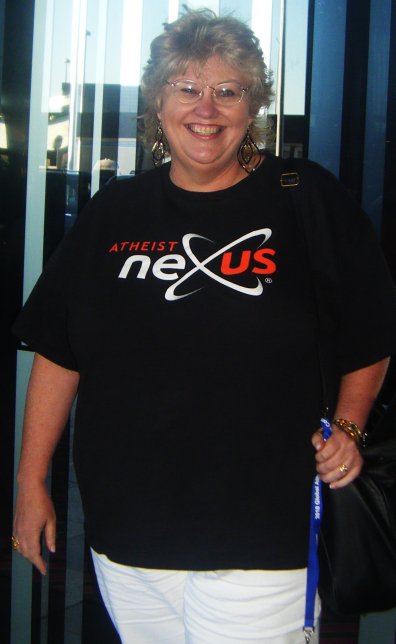 I clung on for a while but, as I read more, began to talk to atheists on the internet, and tested out the possibility of discarding the last vestiges of my sadly out-dated spiritual attire, I realized I’d reached a stage in my life where truth was more important to me than the comfort of delusion.
The white vinyl jacket, the six-inch wedges, the four-inch shoulder pads, the ridiculously expensive suits and the size 14 jeans have long since been banished from my wardrobe. Isn’t it right that the ideas and beliefs that no longer fit, that couldn’t stand up to the wear and tear of critical thought, and which, ultimately, proved to be bigger fashion faux-pas than a pair of Pucci hotpants, have also been discarded?





 We have known for some time that state schools, throughout Australia, have been breaching Education Department guidelines in respect to religious education (i.e. instruction) classes and that politicians and bureaucrats have shown little interest in policing this area.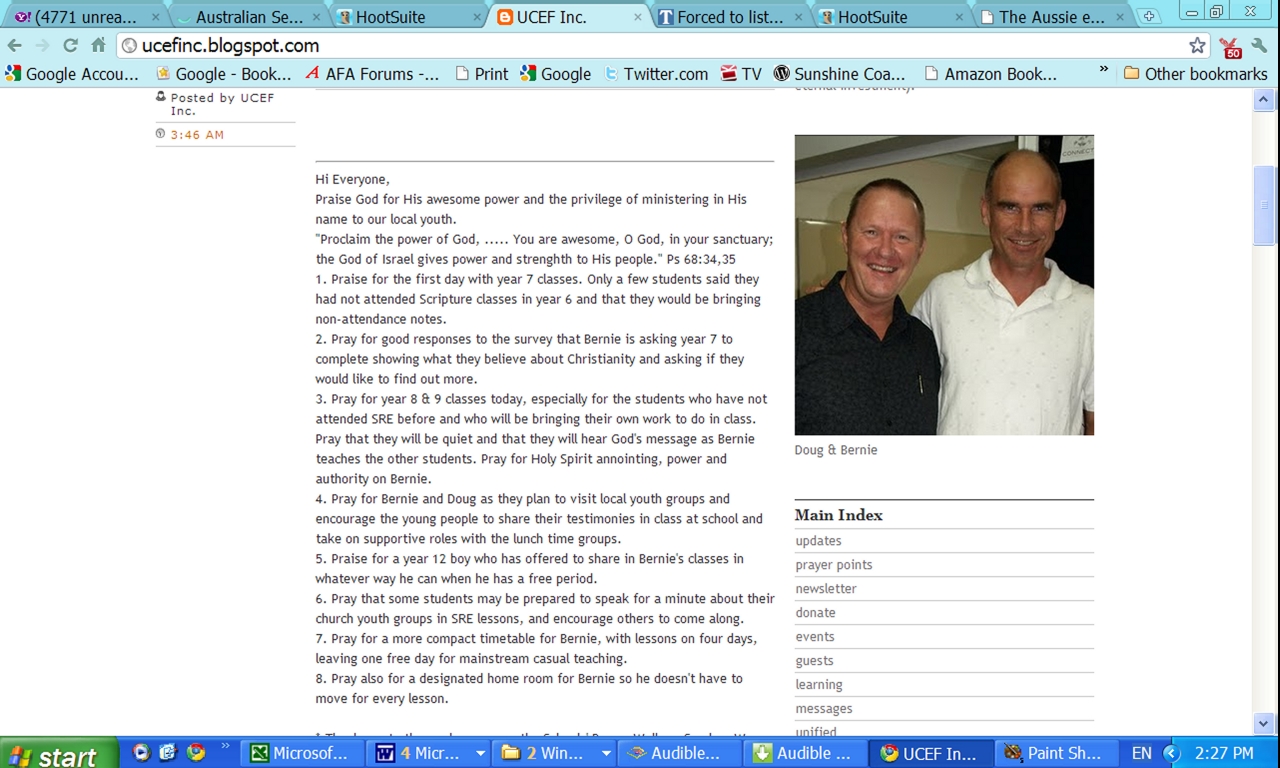
 Peter Kirkwood has reviewed The Australian Book of Atheism in today’s edition of The Australian. Here’s an extract:


 Gladly, the Cross-Eyed Bear
