A Case Against School Chaplaincy: Part Two – Russian Roulette

Australia’s national school chaplaincy program was introduced by the Howard government in October 2006 and continued and expanded by the Rudd Government.  Provided at enormous cost to Australian tax-payers, the result is that over 2,000 state schools currently employ chaplains, providing the chaplains and their churches with direct exposure to approximately 720,000 children (Overington, 2008).


My first article in this series argued that it is a pointless exercise, for all concerned, to place evangelical Christians into schools and then tell them they can’t promote their theistic beliefs.  This article will deal with another misleading claim of the National School Chaplaincy Program – that is, that chaplains do not counsel students.  In this article, I will argue that chaplains do counsel students and that this is tantamount to playing Russian roulette with children’s lives.

First, it is important to note that chaplains require no formal secular academic qualifications. Scripture Union, one of the major bodies contracted to supply chaplains to schools explains:

“Most Chaplains aren’t trained, qualified professional counsellors.  It would be a misrepresentation to describe them in that way.  Even if some Chaplains do have formal counselling qualifications, it would be sending the wrong message to stakeholders and the public about what Chaplains are and do.”

In fact, the Effectiveness of Chaplaincy report confirms that only 2.5% of school chaplains are qualified in counselling or psychology.

Of course, the government and the organizations which supply chaplains claim this isn’t a problem because chaplains are not permitted to offer ‘counselling’ to students.  Really?  I contend that this is a matter of semantics – and Scripture Union reveals why.

“There are legal ramifications that come into play when you use the terms ‘counsellor’ and ‘counselling’.

Obviously, there will be times when Chaplains will be involved in talking one-on-one with students, staff and/or parents about issues and problems that they’re facing, but Chaplains should be involved in nothing more intensive than high-level pastoral care.”

So, chaplains don’t provide counselling – they provide ‘high-level pastoral care’.  And in what areas is this ‘pastoral care’ put to use?  According to the Effectiveness of Chaplaincy Report (2009),  chaplains have been called in to help with children’s anger issues, grief and loss, bullying, peer pressure and self esteem as well as self harm and suicide. Even more concerning, according to the Rationalist Society of Australia, is anecdotal evidence suggesting that the more devout the chaplain, the less likely they are to refer students to professional services.

In another document, Access Ministries quotes a chaplain saying:  “At the moment…., in the last week I’ve got two Grade 5 kids on suicide watch.”

Scripture Union continues:

“The language used is important.  The term ‘counselling’ should be avoided.  ‘Pastoral Care’” or ‘pastoral conversations’ are much better terms to use when describing this element of a Chaplain’s role.  This is not intended to be ‘sneaky’ [really?] but rather to accurately describe and represent the Chaplain’s role.”

So, let’s get this straight.  Chaplains are not allowed to evangelise or counsel students.  Apparently, what they are allowed to do is to have ‘pastoral conversations’ during which they are prohibited from offering advice or offering prayer or religious faith as a solution.  So, what exactly do they do during these ‘pastoral conversations’?  Pat the student’s hand and mutter “There, there”?  Whistle Dixie?

As former senator, Lyn Allison says:

“I find it difficult to imagine a chaplain who is engaged with students and young people who have problems – and that’s where they will largely be used – to not be involved in counselling.”-

The Christian Research Association appears to agree, explaining that:

“Most school chaplains spend much of their time in pastoral work. They counsel young people who are referred to them, or those who come to them voluntarily”.

Note that in this quote the words ‘pastoral work’ and ‘counsel’ are used interchangeably.

Let’s be honest about what taxpayers are investing in with the National School Chaplaincy Program.  We are placing untrained, unqualified people with a religious agenda into our public schools to support and, yes, counsel, at risk kids.  Consider this job description by a chaplain who worked at Balwyn State High School :

“Teenage suicide, depression, grief associated with separation or divorce or death, questions of sexual identity, illness, abuse, physical disability, drug use and teenage pregnancy are issues which the school chaplain confronts day in day out.”

Later promoted to a supervisory role, she continues:

We as supervisors constantly worked with moving stories of chaplains supporting students who were pregnant and needed to make hard choices about whether or not to have the baby, with chaplains journeying with students who come out as gay, or who struggled with their own attitudes to homosexuality, chaplains ministering in a time of community grief after an accident had led to the death of one or more of their students, or a range of other pastoral situations.”

Nobody doubts these people are well-meaning, but I might be equally well meaning if I attempt to extract someone’s appendix with the intent of making the pain go away.  The fact remains that my total lack of training in medicine means there is every likelihood I’ll kill them instead.  Good intentions are no defence.

Experts agree that what is needed in schools are not chaplains, but trained counsellors.   Speaking on behalf of the NSW Teachers Federation, Angelo Gavrielatos said:

“At a time of ever increasing social pressures on children, what is needed is an enhancement of professional school counselling services. Currently the school counsellor to student ratio stands at about 1:1000 in NSW schools. This money for the National School Chaplaincy Program would be better spent on additional school counsellors to achieve a more manageable caseload.”

The Parents & Citizens Council agrees.  President, Elizabeth Singer, complains  that schools are being forced to turn to school chaplains because of inadequate funding and teacher training for crucial development programs.  She says:

”Funding has not been available in another form that they [schools] could use so they have had to turn to chaplains. … ‘We have received complaints from families that schools are having to rely on chaplains to meet the social and emotional needs of the students. In government schools there is a feeling that this should be delivered by secularly trained people.”

In a submission to the government, the Australian Psychological Society (APS) says: –

On a number of occasions since the establishment of the NSCP, the APS has been contacted by members who are concerned about chaplains who have been employed in schools to provide mental health counselling to students. This has occurred either instead of or in replacement of school psychologists.”

The APS complains:

  • That the government is supporting a scheme which allows unregistered and unqualified school chaplains to work outside their boundaries as spiritual and religious personnel;
  • That there is clear evidence that school chaplains are engaging in duties for which they are not qualified;
  • That there is clear evidence that church organisations and ministries are supporting school chaplains in their boundary violations;
  • That the NSCP promotes a combination of religious guidance and mental health service provision, which is in contrast to mainstream evidence-based service provision;
  • That the government is complicit in encouraging dangerous professional behaviour by funding school chaplains independently of other services carried out by professionals who are both qualified and registered.

Let me reiterate here:  teachers don’t want the scheme;  parents and citizens don’t want it; and the people most qualified to deal with our childrens’ mental health say the program is dangerous.

The upshot of this misguided policy is that school communities who would prefer to have financial assistance to employ a trained counsellor – or to extend a part-time counsellor’s hours to full-time – are prohibited from doing so.  And trained counselors who are qualified and willing to work as ‘chaplains’ but are not associated with a religious organization are also disqualified.

For example, I have been told that  Vermont secondary school in Tasmania declined to have a school chaplain because they wished to maintain a secular school.  Instead, they wanted to apply the government funding to a youth counsellor with no affiliation to a church.  This was denied. Surely this is religious discrimination?  As social worker, Tarnya, posted on an internet blog:

“I am a Social Worker and have completed a masters paper in spirituality in state schools. I have worked as a school counsellor for more than five years, yet under John Howard’s scheme I am ineligible to apply for the recently announced positions of chaplain as I do not have a Christian affiliation which is deemed suitable by Scripture Union (the employing body).”

Bioethicist and teacher, Chris Fotinopolous, explains the problem confronting schools:

“There is no doubt that mental illness places a strain on already stretched school welfare resources. According to the Australian Bureau of Statistics, in 2004-05, 7 per cent of children aged under 15 years were reported to have some form of mental or behavioural problem as a long-term health condition, with rates rising from very low levels among children aged under five years to 10 per cent of children aged 10-14 years.

But, because of the direction of funds to the NSCP, rather than qualified counselors, Fotinopolous says:

“… government schools are impelled to accept $20,000 a year for the implementation of a chaplaincy program not because they see a need for religious observance in schools, but rather as a means of securing desperately needed welfare assistance for students at risk. Considering these statistics, no school could be blamed for accepting federal funding for welfare assistance, but the Government does deserve criticism for attaching desperately needed funds to a church-led school welfare program.”

So, what is the harm?  What can happen when, instead of funding a full-time trained counsellor in a school, the government provides a part-time counselor and a full-time chaplain?

Let’s consider the case of fourteen year old Alex Wildman,  Alex, a student at Kadina State High School in Lismore, was the victim of long term, relentless bullying and physical abuse by his peers.  Yet, despite having spent a ‘significant’ amount of time with Alex over several months, the school chaplain admits that he “… never picked up that he [Alex] was being harassed.”  Notably, the school counsellor had no dealings with Alex during the sixth months he was at Kadina and the school acknowledges that “No real attempt was ever made to encourage Alex to see the school counsellor”.  Perhaps they believed, misguidedly, that with the chaplain working with the child, there was no need.

The extent of Alex’s problem only came to light when Alex was punched repeatedly in the face by a fellow student.  The chaplain’s response was to approach Alex on assembly the next day and ask if he was OK.  Alex replied, “ I’m fine … it’s all cool now…”  and, apparently, the chaplain took him at his word.

The next day Alex hanged himself.

Let me make it perfectly clear, I am, unequivocally not blaming the chaplain for this incident.  I do, however, blame the government that made this teenager’s first line of support a person who obviously had insufficient training to pick up on the signs of a child in danger.  The chaplain is as much a victim in this as anyone.  He was put in a position for which he was clearly unqualified.  He failed to see the signs that a trained counselor may have noticed.  He failed to ask the questions that might have encouraged Alex to share his concerns.

Of course, I can’t guarantee that if a full-time counsellor had been employed at the school, Alex would still be alive.  But it is sobering that, after examining the circumstances of Alex’s death, the coroner made particular note of the need for a full-time professionally trained counsellor at the school.

National School Chaplaincy is a dangerous programme which short-changes our children and plays Russian roulette with their lives.  Sure, chaplains are cheap in comparison to trained counsellors, youth workers and psychologists – but is this really an area where we should be skimping on cost?  I understand, absolutely, the claim that chaplains provide a valuable resource by being ‘out there’ interacting with the children rather than sequestering themselves in their offices.  But that is not an argument for school chaplaincy – it’s an argument to change the way counsellors work in schools.

In the next instalment of this series, I will argue that the group most at risk from this ill-advised scheme are teenagers who are, or think they may be, gay.

Chrys Stevenson

Update – 8 August 2010: The Prime Minister, Ms Gillard, will today announce an allocation of $222 million to boost the number of chaplains in schools by more than one-third, which would mean about 3700 schools will be covered under the voluntary scheme introduced by the Howard government.

First time comments on this blog are moderated, but will be approved as soon as possible.

Further Action

If you oppose the National School Chaplaincy scheme, please donate to the High Court Challenge against National School Chaplaincy.  A paypal facility is available on the website.

Ron Williams, a parent from Toowoomba, is bravely taking on the government and arguing against this scheme on constitutional grounds.  He has recently announced that high profile lawyer, Bret Walker SC will lead the legal team. Walker will be supported by Gerald Ng, Barrister, and the law firm, Horowitz and Bilinsky.

Note – money raised for the High Court Challenge goes into a trust for the payment of legal fees, not to Ron Williams and his family. For a small (or large) investment, this is a chance to be a part of Australian history.

Gladly’s Book Recommendations

Gladly’s favourite book store for online purchases is Embiggen Books.  If you’ve found this article interesting you may enjoy this further reading:

What Should We Believe? by Dorothy Rowe

Similar Articles

Jesus weeps for Gillard the hypocrite, Ben Sandilands, The Stump

A Case Against School Chaplaincy – Part One: A Fox in the Hen-House

This is Part One of a three-part series of articles. See also:

Part Two:  Russian Roulette

Part Three: Gay Teens at Risk from School Chaplaincy

“Don’t set a fox to guard the hen-house.”

You can put a silk hat on a pig, but it’s still a pig.”

“A leopard can’t change his spots.”

“Beware the wolf in sheep’s clothing.”

“If it looks like a duck, and quacks like a duck, we have at least to consider the possibility that we have a small aquatic bird of the family Anatidae on our hands.” – Douglas Adams

Australia’s national school chaplaincy program was introduced by the Howard government in October 2006 and was continued and expanded by the Rudd Government.  Provided at enormous cost to Australian tax-payers, the result is that over 2,000 state schools currently employ chaplains, providing the chaplains and their churches with direct exposure to approximately 720,000 children in state schools. (Overington, 2008).

A key plank of the program is that chaplains are not permitted to evangelise.*  It is passing strange, then, that the major bodies contracted by the government to supply chaplains to schools are evangelical – and expect their chaplains to conform to that religious tradition.

To me, the fundamental flaw in the national school chaplaincy program is that the government is specifically hiring evangelical Christians to go into state schools – and then telling them not to evangelise.  It’s like hiring a fox to look after the hen-house under strict instructions it’s not to eat the chickens:  the directive is neither fair to the chickens nor the fox.

Let’s consider, as a case study, the Scripture Union, a major supplier of chaplains to the nation’s schools.  Scripture Union Australia’s aims, mission statement and working principles are all strongly centred on evangelism.  Further, chaplains employed by the Scripture Union are required to adhere to its core principles and beliefs.  The Scripture Union, for example, believes – and expects its chaplains to believe – that:

“…  the Old and New Testament Scriptures are God-breathed, since their writers spoke from God as they were moved by the Holy Spirit; hence are fully trustworthy in all that they affirm; and are our highest authority for faith and life.” (Scripture Union – Aims & Beliefs)

Given this commitment to the literal truth of the Bible, one can only assume that they consider the call to evangelise as a holy commandment.  Growth Groups, an interdenominational group in the UK explains this divine imperative:

“The call to evangelise is clear from Scripture. In Matthew 28:18-20 Jesus gives His disciples the “Great Commission”.  In Acts 1:8, He tells them that they will be His “witnesses” (Acts 1:8) and the remainder of the book of Acts tells the story of how they spread the gospel to the ends of the earth.”

“We acknowledge the commission of Christ to proclaim the Good News to all people, making them disciples, and teaching them to obey him.” (Growth Groups)

Of course, Tim Mander, CEO of Scripture Union Queensland, and spokesperson for SU Australia,  insists that all chaplains work under Education Department guidelines.  Mander tells us, reassuringly, that:

“One aspect [of the school chaplaincy program] is that the chaplain cannot proselytise or evangelise and we respect and adhere to that.” (Percy, 2008)

Curiously, this directly contradicts a directive from a Scripture Union International policy paper which says, in part:

“We believe that our mandate is to bring children and young people into the life of established churches by programs that serve them in environments in which they feel comfortable.”

“We believe that, in the case of families that are not Christian, the evangelism of the whole family rather than of children in isolation is still our objective. However, if this cannot immediately be realised, we believe that God still calls us to evangelise children themselves.” (Scripture Union International, 2005)

While the Scripture Union says they resist approaches that treat children as ‘targets’ of evangelism – how can this be reconciled with their stated mandate to evangelise?

The truth is that they can’t and don’t reconcile these conflicting directives.  It is clear from reading anything written by the Scripture Union that their entire raison d’être is to be a recruiting agency for Jesus.  This is their primary purpose in our state schools and there should be no mistake about it.

Of course the chaplains’ missionary zeal is circumscribed, somewhat, by the government’s guidelines –  but only while they are dealing with the children within the confines of the school grounds.  That’s why there is an all-out effort to encourage the children to participate in out of school activities where they are removed from the scrutiny of parents and teachers and the ‘grooming’ process can be continued.

“The good news is that God is doing some incredible work through the ministries of SU Queensland. School chaplaincy, camps and missions are exposing thousands of young people and children to the good news of Jesus every year.” (SU News, June 2006)

“In Australia, SU operates in every state and territory and mobilises around thousands of volunteers each year to engage young people and families in holiday programs at beaches and in urban or rural townships, camps, secondary and primary schools, through sports, recreation, outdoor education and school chaplaincy.

SU’s ministry brings us into contact with hundreds of thousands of children, young people and families per year making SU one of the largest mission movements to children and youth in the world. But what drives us is a desire to see lives transformed. We are serious about making a difference.” (Scripture Union Australia – About SUA)

“With urgency. We intentionally make opportunities to present life-giving messages that invite children to respond positively to Jesus. Our approach is urgent because children will, by their nature and because of the world in which they live, turn away from God unless they are evangelised and nurtured.” (Scripture Union International, 2005)

According to a 2006 Scripture Union newsletter:

“Last year alone, over 2500 kids went on SU Queensland camps where many committed their lives to Jesus for the first time.”

Don’t tell me that those children – many of whom are now recruited through SU’s chaplaincy programme – weren’t ‘targets’ for evangelism.

Of course, it is up to parents whether to allow their children to be involved in these out of school activities.  But, as Ron Williams of the Australian Secular Lobby explains:

“Chaplains go on excursions and on school camps, so if you want your children to have no exposure to the chaplain, you’ve ‘volunteered’ for them not to go to the museum or the bush camp.” (Williams in Potts, 2010)

SU’s mission is clear.  Groom the children within the schools, win their friendship and the trust of their parents and then invite them to a fun adventure camp.  Get the unchurched and non-Christian kids to put pressure on their parents to let them attend.  Once you have the children in your care, and beyond the jurisdiction of the Education Department and their parents, work on them to ‘give their lives to Jesus’.

Now, some may take exception to the use of the word ‘grooming’.  After all, isn’t that what pedophiles do? Yes it is – and I use the word deliberately.

While I am not suggesting that chaplains (in general) are grooming children for anything more than religious conversion, it is impossible not to see the similarities between the two approaches.

In his article, “Child Molesters: A Behavioral Analysis”, former FBI agent Kenneth V. Lanning identifies the stages involved in a pedophile’s grooming process (Stang, 2008):

  • The first stage is to identify a child who is vulnerable in some way – often the same kind of ‘at-risk’ child that may be ‘targeted’ by a chaplain.  One of the best ways to do this is for the pedophile to spend a lot of time in places like ‘your child’s school and playground’ – exactly the place where the chaplain identifies children who may be open to conversion.
  • The second stage is to win the trust of the child and his parents in order to gather as much information as possible about the intended victim.  Similarly,  we have the kindly chaplain listening to the child’s problems, playing sport with them in the playground, maybe visiting the parents to discuss the child’s welfare.   We also have the use of the intimate and familiar term ‘Chappy’.
  • In the third step, once the pedophile knows a little about his victim, he steps into that child’s life to fill a need.  For example, a lonely child might receive extra time and attention, and a child who feels unloved might receive unconditional affection – exactly the kind of attention provided by a chaplain.
  • The fourth step in the grooming process is to lower the child’s inhibitions about sexual matters.  Of course, the chaplain (generally!) doesn’t do this, but taking a child on a camp where all the ‘cool’ counsellors pray publicly and give testimonies about how Jesus made them happy and successful and confident may certainly lower a child’s inhibitions about following a religion.
  • The fifth stage for a pedophile is the overt sexual abuse of the child, often resulting in marked changes in personality and behaviour.  Again, the correlation with chaplaincy is the successful religious conversion of the child  – an event specifically designed to result in marked changes in personality and behaviour.  Indeed, a stated aim of the evangelical Christian is to ‘change lives’.  And what else can we expect when a child is finally convinced to accept the premise that they are a sinner whose only chance at redemption is to live in the humble service, and in accordance with the moral (or immoral) precepts, of a supernatural deity?

In light of the above, consider the following video from SU Australia.  There is no denying that, in many respects, it is a ‘good news’ story,  and I am absolutely, unequivocally not implying that the chaplain or any of the camp counsellors are pedophiles. The correlation here is the process which is employed.   This process becomes very obvious in “Jarred’s Story”:

The evangelistic agenda is carefully avoided in the Jarred video, but for more insight into the SU Connect camps mentioned in the story, consider this:

“Keanu Schubert is 16 and lives in one of Brisbane’s headline suburbs. Now in Year 11, Keanu came to Connect in Year Nine – “pretty much a mess”. “There was not a lot of good stuff happening,” said Keanu. “I was close to doing things no one should think about.” One the first expedition Keanu made friends among boys he described as his school enemies. Part of his transformation included hearing about Jesus and becoming a disciple. He’s now connected to a number of church youth groups in the Springwood area.” (Journey Online – Queensland Uniting Church, 2008)

Further, training literature from SU Connect provides advice on how to engage children into talking about the Bible by using movies such as “The Matrix” or by talking about football. (Knowle Parish Church – Leaders Resources)

Make no mistake – religious conscription is at the very heart of everything Scripture Union does.  My issue is not that the children are being helped, but that they are being helped at a price by people with an agenda.  Indeed, sounding very much like a fox who’s been given the keys to the hen-house, SU’s CEO, Tim Mander admits:

“To have a full-time Christian presence in government schools in this ever-increasing secular world is an unbelievable privilege. Here is the church’s opportunity to make a connection with the one place through which every young person must attend: our schools.”

You can almost hear him salivating at the prospect of all those young, unsaved souls.

Now, with all this talk of foxes in hen-houses and wolves in sheep’s clothing and pigs in top hats, I must call a pause here to say, perversely, that I don’t think that the chaplains, themselves, are bad people.  In general, I believe, they are kind, sincere, enthusiastic, loving people with a genuine desire to help the kids in their care.  I also don’t dispute the fact that, in providing a friendly ear and some much needed attention for at-risk kids, they may fulfill an important role.  I don’t question, at all, the value of having someone in the school who has the time to play sport and ‘hang out’ with the kids and listen to their problems.  I don’t question that taking ‘at risk’ kids on adventure camps does wonders for their self-confidence and discipline.  What I question is why religion is brought into this process.  Why are evangelistic Christians, (often with no formal qualifications), who have an agenda which clearly goes beyond friendship and support, providing these services?  If our children need counseling and advice from adult mentors, surely these should be qualified people who have no agenda other than to assist the children in their care. If school counselors are less effective than chaplains because they’re not out in the playground with the kids – get them out in the playground!

State schools should provide a religion-neutral environment for children with parents of all faiths and no faith.  It is not sufficient to say that the Christian chaplain is ‘non-denominational’.  The act of placing an evangelical Christian chaplain into a school and telling them not to evangelise is unfair to both the chaplain and the children.  It places the chaplain in the position where they have to answer to two masters. When ‘God’ is telling you to spread the gospel and that children who are not ‘saved’ will burn in hell for eternity, and the Education Department is telling you that you mustn’t ‘target’ children for conversion – which ‘master’ do you think a good, evangelical Christian will listen to?  If you sincerely believe that, without conversion, a young person you care for will suffer eternally, how could you not find ways to defy government protocols or at least find ways to circumvent them?  And, indeed, this is exactly what chaplains do.  As we have seen, even if they have to take care what they do and say within the school, they use their position ‘strategically’ (SU’s own word) in order to entice the children into out-of-school activities where they, or other Christian agencies they work with,  are not constrained by Education Department policy.

For Christians reading this article, consider how you would feel if, instead of placing Christian chaplains in state schools, the government decided to employ Muslim counsellors whose role was to get close to the children, identify those ‘at risk’ and then encourage them to go to Islamic adventure camp where they were encouraged as part of a ‘long term programme’ to convert to Islam and accept the Koran as the true word of God.  Would you be arguing then that there is ‘no harm’ in bringing religion into state schools?

Chaplains are not evil, but they have no place in state schools.  You cannot place an evangelistic Christian into a state school and expect them not to create opportunities to evangelise.  They are compelled by their religious beliefs to do so.  Chaplains should not be put into that position and parents should not have their beliefs (or lack of belief) undermined by someone within the school whose primary aim is to entice their children into adopting a particular narrow, fundamentalist, literalist, Christian ideology.

It’s not fair to put a fox in a hen-house and tell him he’s not to eat the chickens while he’s in there.  You cannot expect him not to follow his innate compulsion to eat chickens.  Even if you happen to find a fox with remarkable self-control, a clever fox will simply invite the chickens to step outside – perhaps for a ‘really fun’ adventure camp –  and eat them then.  He is then able to claim, quite honestly, that he complied absolutely with the directive not to eat the chickens in the hen-house.  The fox is not evil.  You can’t blame the fox for doing what a fox does.  The blame lies squarely on whoever decided that it was a good idea to put a fox in a hen-house and direct him not to act like a fox.

Chrys Stevenson

This is Part One of a three-part series of articles. See also:

Part Two: Russian Roulette

Part Three: Gay Teens at Risk from School Chaplaincy


Update

8 August 2010: The Prime Minister, Ms Gillard, will today announce an allocation of $222 million to boost the number of chaplains in schools by more than one-third, which would mean about 3700 schools will be covered under the voluntary scheme introduced by the Howard government.

Clarification from Australian Secular Lobby

*”A key plank of the program is that chaplains are not permitted to evangelise.”

Although this is generally true, Hugh Wilson of the Australian Secular Lobby provides the following clarification:

It depends which programme you are talking about. DEEWR prohibit proselytising, but are silent on evangelising, but EQ prohibit both, so a NSCP chaplain in an EQ school cannot do either. The ASL discussed with DEEWR what they meant by ‘proselytise’, because the word is not defined by them. Within the private school section of DEEWR , there is a vague description of ‘proselytise’, and that comes out closer to EQs evangelise.  The new policy is here and says, in part:

“instruct volunteer and/or paid chaplain that s/he is not to evangelise or proselytise at any time in the delivery of chaplaincy program”

The words are defined here:

Evangelise: Engagement and dialogue with a student/s with intent to attract to a particular faith group.

Proselytise: To solicit a student for a decision to change belief system.

First-time comments on this blog are moderated but will be approved and published as soon as possible.


Further Action

Yes!  You can do something.  If you believe that the National School Chaplaincy Program is contrary to Australia’s secular principles and that chaplains (however well-intentioned) should not be placed into state schools, please support the High Court Challenge to the National School Chaplaincy Program being mounted by Ron Williams .

NSCP federally-funded state school chaplains across Queensland may: conduct Christian prayers on all-school assembly; at significant school ceremonies; hold lunchtime prayer/Bible study sessions and engage with students in the classroom, playground, school excursions, school camps and sport. Chaplains oversee and conduct Religious Instruction classes and on-campus church-designed and run programs including Hillsong ‘Shine’ which connect children with evangelistic off-campus clubs, programs and camps.

Contact with concerned parents in every Australian State and Territory reveals that occurences of the federally-funded National School Chaplaincy Program being utilised as a Christian evangelic ministry are common within the nation’s state schools.

After years of correspondence and meetings with state education and DEEWR executives as well as personal meetings with two Education Ministers and their Directors General, in 2009, a frustrated Mr. Williams sought advice regarding a possible High Court challenge to the constitutional legality of the Commonwealth providing treasury funds to the National School Chaplaincy Program. In February 2010, Horowitz & Bilinsky accepted the case.

This matter concerns more people than the Williams family from Queensland. It concerns all Australians, of all faiths and none, who support the secular ‘wall of separation’ concept concerning church and state. This ‘wall of separation’ is required to safeguard our multicultural, multi-faith  and non-faith liberal democracy that has become the hallmark of the civilised 21st century nation Australia rightfully claims to be.

Mr. Williams has established a trust account for the purpose of accepting donations to defray the considerable costs related to this s.116 ‘wall of separation’ constitutional challenge. Mr. Williams has instructed his solicitors that all funds deposited to the account are only to be applied for costs and disbursements associated with the High Court proceedings.

Considerable financial support from the broader Australian community will be required by Mr. Williams in order to meet his expected, and unexpected, legal costs. Whatever your faith position might be, this is a significant legal exercise aimed at ensuring Australia really is a secular nation-state, as our forebears clearly intended it to be.

Please secure a stake in your nation’s secular future by donating as much as you feel comfortably able to.”

Please note that funds donated go directly into a solicitors’ trust fund to be applied only to legal costs.  The money does not go to Ron Williams personally.

You could also write to or email your local Federal Labor candidate and/or the Prime Minister, Julia Gillard with your objections to the National School Chaplaincy Program and noting that the extension of this program will be a consideration in your decision on who to vote for at the forthcoming election.

Gladly’s Book Recommendations

Gladly’s favourite book store for online purchases is Embiggen Books.  If you’ve found this article interesting you may enjoy this further reading:

What Should We Believe? by Dorothy Rowe

Similar Articles

Jesus weeps for Gillard the hypocrite, Ben Sandilands, The Stump

The Secret Life of Us

A recent Facebook post referred to overweight people as ‘fat lazy slobs’.  It wasn’t directed at me, personally, but I admit to taking offence.  As a larger than average person I was outraged.

I thought, “You know nothing about me, and yet you think it’s perfectly acceptable to make judgments about me and my lifestyle based on my size.”

As it happens, I am not lazy, I am definitely not a slob and I don’t spend my days lying on the couch watching Days of Our Lives while whacking back litres of Coke and chowing down on chips and chocolate.

There is a whole life story and medical history that lies behind my weight which is no-one’s business but mine and I certainly wasn’t about to share it with some stranger on Facebook.  But it got me thinking – how often do we judge (or worse, condemn)  people on face value without really considering that everyone has a ‘back story’?  Indeed, those back stories can often turn our first impressions upside down, revealing the danger of judging people based on very little knowledge.  The truth is that people are very rarely exactly as they seem.

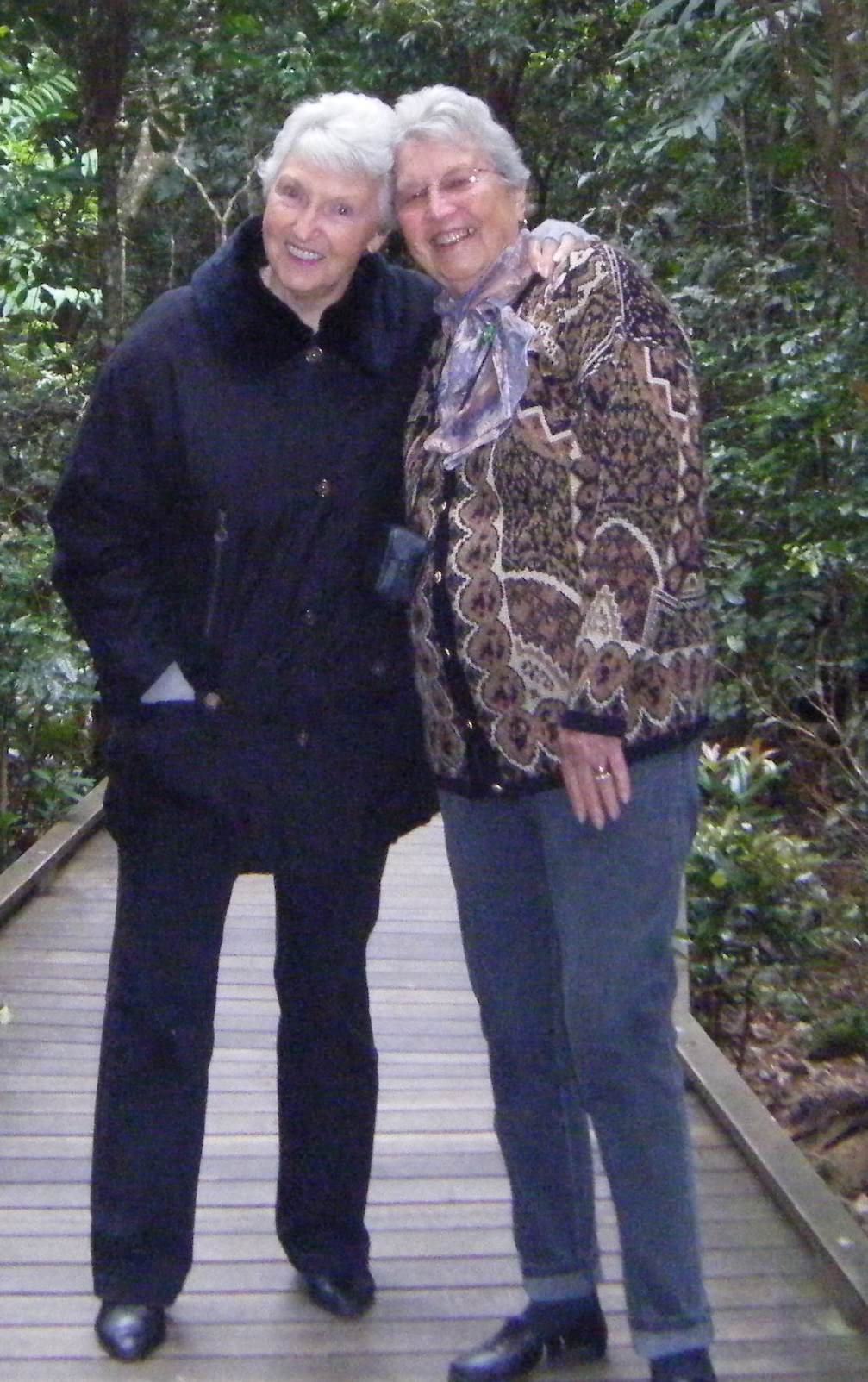
My mother met her best friend, Joan, on their first day at primary school.  Today, they are eighty-six, still friends, and they still walk hand in hand down the street as they did as teenagers during the war.

We love her dearly, but Joan can appear rather grand.  She lives in an expensive, art-filled, inner-city apartment, having returned to Australia after many years living on Central Park, New York as the wife of an eminent university professor.  She speaks casually of world travels, United Nations luncheons and fundraisers at the Museum of Modern Art.

Recently, I mentioned that I was looking for a rug for my study.

“An oriental?” asked Joan.

“Well, that kind of thing …” I said vaguely (thinking I might pick up something at a Rugs a Million sale for around $150).

“Well do take care, dear” she warned, “some of the orientals nowadays are [shock!] machine made!”

I had to curb my mirth as I told her I very much doubted I’d be able to purchase a hand made oriental rug on my meager budget.

My point here, is that anyone speaking casually to Joan may dismiss her as a wealthy, elderly socialite who has never known anything but luxury.  They would be wrong.  Joan’s husband was an eminent anthropologist and she was a vital contributor to his fieldwork amongst the Walpiri people of Central Australia and the Enga tribe of Papua New Guinea.  She knows what it is to ‘rough it’.  She has patched up Aborigines wounded by axe fights, she has grubbed for yams in New Guinea, she has slept in a yurt in Kazakhstan and lived in a village in Andalucia.  She might appear to be a ‘lady who lunches’, but she is so, so much more.

Many years ago, I was a member of a social club which met once a month for lunch.  It was an eclectic bunch and one never quite knew who would turn up, but it made for some interesting conversations.  One day we were joined by a very large, very scary looking bikie (biker for my American friends).  He strode in, wearing the obligatory leather vest with his club ‘colours’ emblazoned on the back, an impressive “Vietnam Vet” belt buckle, long grey hair tied in a pony tail and an intimidating face full of whiskers.  Despite first appearances he turned out to be a gentle, articulate and highly intelligent man with an incredible back story.

Zev was an Israeli, seconded to the Australian Army during the Vietnam war, suffering horrific experiences including being ordered to fire on what turned out to be their own troops.  After Vietnam, Zev settled in Australia, but, like many vets, struggled with post traumatic stress syndrome.  Zev, it turned out,  was also a keen Bible scholar and, as an Israeli, spoke and read Hebrew.  He grinned as he told us how much he enjoyed the occasional visits from Jehovah’s Witnesses.

“Surprisingly, the sign on the door that says, “Big, ugly, hairy bikie lives here,” doesn’t deter them,” said Zev.

But when I open the door and they actually see the big, ugly, hairy bikie you can see I make them a bit nervous.”

They’re so used to being turned away, I reckon they think they’re safe, but I say, “Oh hello!  Oh? You want to talk about the Bible?  How fascinatingDo come in!  Sit down!  Make yourself at home!”

And then they start quoting from the Bible, and I go and get my big Bible off the shelf and I say, “Your Bible says that?  Really?  That’s strange because that’s not what my Bible says!” and I begin to read to them, chapter and verse …. in Hebrew.”

“As I see their eyes glazing over, I say, “Oh, you don’t speak Hebrew?  How very strange?  I would have thought if you really wanted to understand the Bible you would at least have learned the language it was written in!”

“By that time, they’re inching forward in their chairs muttering about having to get going and I say, “Oh don’t go!  Please stay!  We’re having such an interesting conversation!”

How easy it would be to dismiss a big, ugly, hairy bikie as one of society’s rejects.  Why is it a surprise to find a Hebrew speaking, Bible literate, intellectual war-hero hiding behind all those whiskers?

Zev now works tirelessly as a lobbyist for better conditions for Vietnam Vets.  Next time you see a bikie and are tempted to think of the stereotypical drugs, alcohol and bikie wars, remember that everyone has a back story and you don’t know theirs.

Finally, a story from very close to home.  Recently we hired a handyman to do some gardening and landscaping chores around the house.  A very tall, self-effacing, quietly spoken chap, Gavin* worked so diligently and efficiently and for such a fair price we kept finding stuff for him to do.  Over several cups of coffee we found that Gavin, too, was much more than he seemed.  How easy to underestimate someone who does gardening and odd-jobs for a living.  How easy to think they’re ‘just a normal bloke’, hardworking, but with a rather pedestrian life-style and outlook.  So, we were mildly surprised to hear our willing worker say quietly, “Oh, by the way, I’m  in the local paper this week – but you probably won’t recognize me.”

And so began a story which revealed so much more about the value of friendship and love and laughter than we could ever have imagined would come from our lanky, rather dour, handyman.

Some years ago, Gavin’s nephew’s wife had begun to earn some much needed money by making teddy-bears.  Having something of an entrepreneurial mind and a kind heart, Gavin decided on a scheme to promote the business.  He invested thousands of dollars of his own money into the idea and, when it was realized, he was keen to show it off to a friend.  Arriving at his friend’s house, he was told he was out, so he revealed all to the friend’s wife who said, “Brilliant!  He’ll be home soon.  Let’s surprise him!  You go and get set up in the bedroom and when he comes home you can come out and show him your idea.”

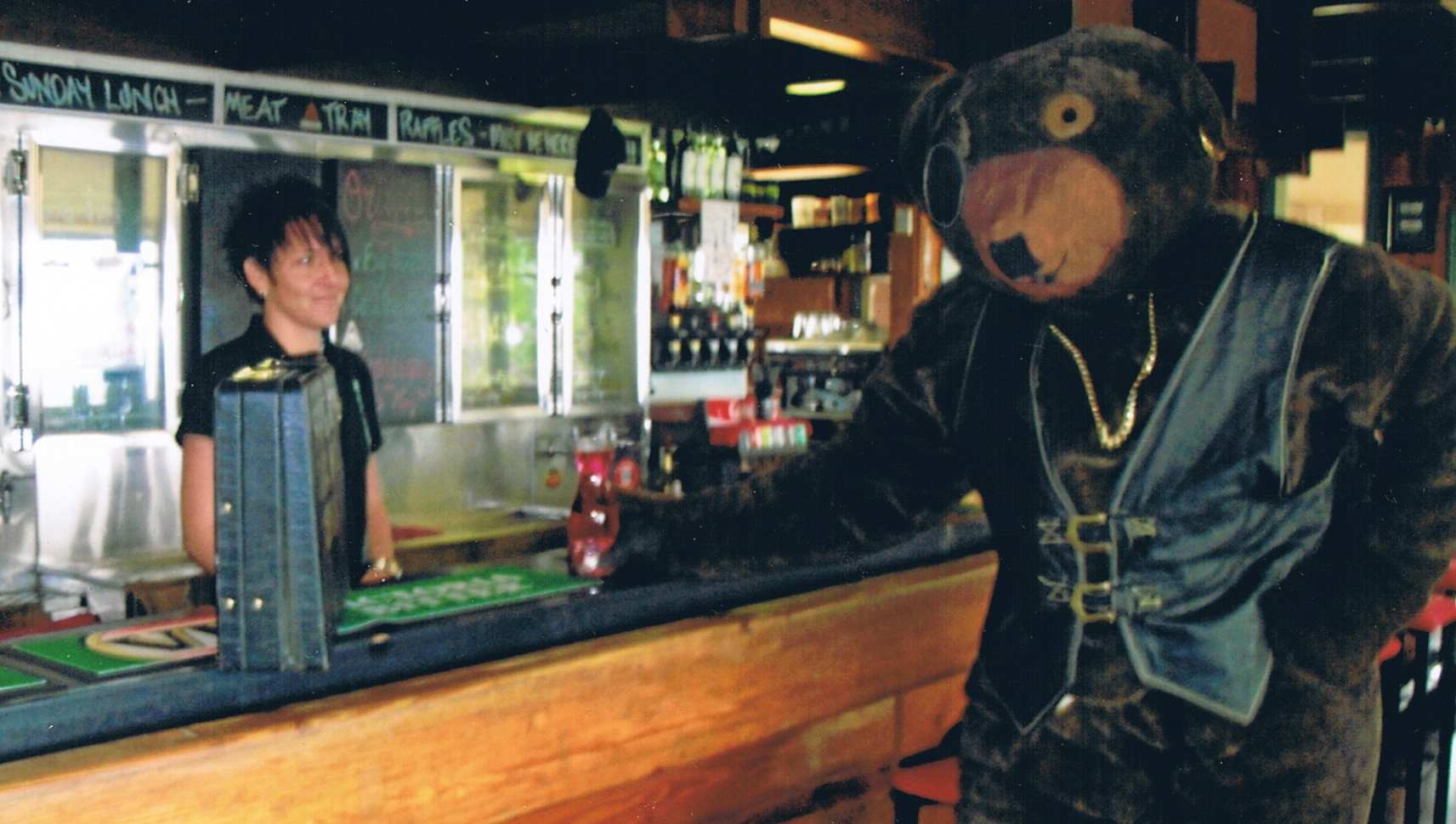
So, at length, the friend comes home, the wife stays out of sight, and Gavin steps out into the living room, transformed into a 6’8” bear with a wooden leg and an eye patch.  His poor friend was so discombobulated by the sight of this beast in his living room his reflexes took over and he delivered a thunking right hook to the bear’s face!

“Of course,” says Gavin, laconically, “the head is so heavily padded it didn’t hurt a bit, and I reckon I could have taken him, even with the bear suit on, but of course, I didn’t.”

The story of Gavin’s bear being decked by his mate became one of those iconic stories that are retold and laughed about for years.  These are the moments that add depth and character to our friendships.

But time moves on and, eventually, Gavin moved to Queensland, taking up work as a handyman and gardener while he cared for his elderly mother.  When he heard that his mate, back in Adelaide, had terminal cancer, he was struck by the question we are all faced with at some stage in our lives, “What can I do to make a difference?”

The first thing he did was jump on a plane and go to see him.  During his visits they talked about Queensland and the little town where we live and his mate said he’d love to see it – but, of course, Gavin knew that simply wasn’t going to happen.  Gavin returned home, glad he had visited, but still convinced there must be something more he could do.

And so he conceived of the idea that, if his mate couldn’t come to visit him, he’d send him some photos of our village.  And then, remembering their history with the bear, Gavin decided on a plan.  Co-opting the support of some locals as guides and photographers, Gavin morphed into Secret Agent 008 ¾ Super Sleuth Incognito – the 6’ 8” bear – and set out on a tour of the village.  He visited the pharmacy, the library, the coffee shop, the post office, the park, the pub and the supermarket – meeting the locals and posing for photos all the while.  And then, when he was finished, he sent the photos off to his mate.

They were met with great hilarity and, as each new visitor came – undoubtedly with their own concerns about what to say to a dying man – the photos came out, broke the ice and eased the conversation.  The photos provided a catalyst for laughter and conversation and the effort involved in taking them spoke more about the depth of the friendship than two Aussie blokes could express in words.  A week or so after the photos arrived, a mutual friend rang Gavin and said simply, “Mate, you did a good thing.”

And so, we have a fat lady who is emphatically not a lazy slob, a wealthy matron who has roughed it in the deserts of Australia and the jungles of New Guinea, a bikie who is a Hebrew-speaking Bible scholar and a gardener who also happens to be a 6’8” bear.  None of us, I’d venture to say, is exactly as we seem.

Wouldn’t it be wise – indeed rational –  if we reserved our judgments, condemnations and dismissals of people based on first impressions and accepted that looks really can be deceiving.  Surely we need to look no further than ourselves to know that if there is a ‘secret life of us’ there is also, very probably, a secret life behind  just about everyone we meet.

Chrys Stevenson

* Not his real name.  ‘Gavin’ prefers the bear to ‘speak’ for himself and prefers that his ‘owner’ remains anonymous.  More photos of Secret Agent 008 3/4 Super Sleuth Incognito can be seen here.

Gladly’s Book Recommendations

Gladly reminds me that we happen to know a rather diminutive and very scholarly looking bookshop proprietor whose ‘back story’ includes working as an exotic dancer and cycling 20,000km across Australia for charity. His partner, currently playing the role of a slightly harrassed and terminally tired mother of a one-year-old happens to have an incredibly impressive profile on IMDB as a film editor, with credits including Baz Luhrman’s Moulin Rouge and Nim’s Island (starring Jodie Foster). They’d both be very grateful if you’d buy some books from them so that, 15 years from now when they’re luxuriating on their 60′ yacht in the French Riviera they can say, “Don’t hate us because we’re rich – we used to be impoverished bookstore owners once, you know!”

For more unexpected tales of fascinating people, try Embiggen Books‘ biography section.

Dear Julia

Dear Julia

Congratulations on becoming Australia’s first female Prime Minister.

I wish I could greet your ascension to the leadership with the same elation I felt when Kevin Rudd won the 2007 election.  Sadly, Rudd taught me not to expect too much of politicians.  Indeed, I started out feeling like a kid who’d got a bike for Christmas, only to find out it had two flat tyres, no steering, and a bell that didn’t so much ring as babble incoherently in Mandarin.

Kevin Rudd came in promising to be one thing, and delivered another.  He was all wrapping and no present.  You haven’t had time to promise anything substantial so, at this stage, I’m not expecting much.  But, mustering a little optimism and pretending for a moment that I’m a small kid writing to Santa, here’s my wish list for your Prime Ministership:

  • The kids next door in the USA and France have this neat thing called the separation of church and state.  I know you’re probably not going to get us a real shop bought, constitutionally guaranteed separation, but do you reckon you could run the government ‘as if’ we had one?
  • A lot of us kids are sick of being bullied by Jim Wallace of the Australian Christian Lobby.  Just because he used to lead the SAS he thinks he can tell us all what to do – whether we’re in his gang or not.  I think he must have been stealing Kevin’s lunch money because when Jim said, “Jump!” Kevin said, “How high?”  As you appear to have bigger balls than Kevin, could you please tell Jim he doesn’t represent the views of the majority of Australians and that his nasty, divisive, discriminatory views are no longer welcome in the ALP?
  • Can you please get rid of school chaplains?  If kids need counseling they should have the same access as adults do to trained professionals, not evangelists who are in the school grounds recruiting for Jesus.  If parents want their kids to have access to religious counseling, maybe they should start taking the family to church instead of sleeping in on Sundays like the other 93% of the population.  Remember that separation of church and state thing?  Let’s keep our schools secular.
  • Would you mind very much withdrawing funding from Exclusive Brethren schools which isolate children from the broader community, teach girls to be submissive and discourage young people from going to university?  As an independent woman with the benefit of a university education, how can you countenance spending tax-payers’ money on such schools?  Exclusive Brethren girls and boys don’t choose their religion – they’re born into it.  There is no freedom of religion when you are not allowed to know there’s a choice!
  • Perhaps it’s too much to ask, but if a law is worth having, surely it should apply to everyone.  If everyone else is required by law to pay taxes, why not churches?  If everyone else is required not to discriminate on the basis of gender, sexual orientation or religion, why do we allow exemptions for religious institutions?  Fair’s fair, Julia.  Let the religious institutions claim exemptions for their charitable work, but not ‘as of right’.  And there’s an advantage to this – it means the government won’t be financing harmful cults like Scientology, the Christian Fellowship Churches or the Exclusive Brethren.  Where their stockings were once stuffed full of tax-payers’ dollars, they’ll wake up to find, like other naughty children, all they have is a few bits of coal. Win!
  • A letter to Santa really isn’t complete without a thought for those less fortunate than ourselves.  Julia, would you please stop the tradition of making political capital out of treating asylum seekers like criminal scum?  Instead of ‘talking tough’ and locking these poor people and their families up behind razor wire indefinitely, how about trying to educate the Australian public about their plight?  Maybe you could use some of the money you’re saving by taking down the mining tax ads?
  • And finally, Julia, if I promise to be very, very good and vote for you at the next election, would you please boot out Senator Conroy and his ugly plans for an internet filter.  We’re not in China or Iran and, as much as we all want children protected from the seedier side of the internet, we all know this filter is not the way to do it.  One of your smarter elves, Senator Kate Lundy, knows about this.  Give her a hearing.  Better still, give her Conroy’s job.

Signing off with not much hope ….

Chrys Stevenson

Comments on this blog are moderated but will be approved as soon as possible.


Heroic or Quixotic? The High Court Challenge against Australia’s National School Chaplaincy Program

Recently, Toowoomba resident, Ron Williams, announced that he is launching a High Court Challenge against the government’s National School Chaplaincy Program on the basis that it is unconstitutional.  Is this move heroic or quixotic – and, does it really matter? **


** Update 1/1/2011  A Writ of Summons and Statement of Claim was issued out of the High Court of Australia on Tuesday December 20, 2010.  A date for the hearing is expected to be set after the High Court resumes on 31 January.  For more details on the specifics of the writ and/or to make a donation towards legal costs please visit: High Court Challenge

In 2006, former Labor NSW premier Bob Carr slammed the Howard government’s plan to put chaplains into state schools as “profoundly wrong” and “really frightening”. “It abandons the principal of the separation of church and state.  Taxpayers should not be asked to fund religious promotion. That should be left to members of churches to fund themselves,” Mr Carr told The Daily Telegraph.

But, while our political leaders tend to give lip service to the principle of church/state separation, they know full well that, since the defeat of the Defence of Government Schools High Court Challenge in 1981, the Australian Constitution provides no barrier to politicians pork-barreling in favour of religious institutions in exchange for votes.  In the case of the school chaplaincy program, the cost to Australian tax-payers will top $207 million.

Carr’s opinion on the government funding the National School Chaplaincy Program echoes that of Edmund Barton, Australia’s first Prime Minister and one of the authors of the Australian Constitution.  In the debates leading up to Australian Federation in 1901, Barton’s view on using tax-payers’ money to fund religion was unequivocal:

“I cannot support for a moment any system of education which in the name of denominationalism or under any other name, draws funds from the coffers of the State manifestly for the propagation of creeds and dogmas widely divergent.  Taxpayers ought not to be called upon to support a system of that kind. It ought not to be compulsory upon any man to support that which he believes to be untrue, but that is inevitable under a system which subsidises what to different minds must appear as truth and error in the various and discordant dogmas and beliefs.  …

If, as tax-payers, we are asked to support religion we say, “No; you must leave that to our consciences as individuals, and not impose it upon us as tax-payers.” That is really the opinion which the people have expressed with regard to the teaching of religion to the adult population, and I say it is inconsistent to deal with the teaching of youth on any other principle at variance with it.”

Barton was speaking here, principally, about state funding for religious schools, but I think we can fairly extrapolate from his comments what his attitude towards the National School Chaplaincy Program would be. Curiously, at the time, Barton would have felt no compulsion to push for secular education in Australian public schools – it was already in place.  Between 1872 and 1897, each of the Australian colonies introduced Education Acts which guaranteed “free, compulsory and secular” education in government funded schools and ceased (in most instances) to provide tax-payers’ money to religious schools.  Let me make this clear.  Australia moved into Federation with an already clearly established secular public school system.

There is no doubt that our founding fathers intended that Australia should have a wall of separation between church and state.  Australia’s first draft Constitution was written by Tasmanian attorney-general Andrew Inglis Clark in 1891 and eighty-six of his ninety-six draft clauses remain in the modern Australian Constitution. Clark traveled to America in 1890 to undertake research and his draft drew heavily on the United States Constitution.  The people Clark chose to consult with on his visit are significant.  One was Moncure Conway, formerly a Unitarian but, by then, an atheist and freethinker.  Another was Justice Oliver Wendell Holmes – an agnostic.  Neither is likely to have counseled Clark against a Constitutional separation of church and state!

We must view the intent of the Australian Constitution in its international historical context.  Secular education was established in France between 1881 and 1882 and further strengthened in 1886. Contemporaneously, between 1872 and 1893, after years of bitter disputes between religious denominations over who should control the public education system, every Australian state passed an Education Act removing state aid to Church schools and guaranteeing ‘free, compulsory and secular education’ (Queensland’s secular education was rescinded in 1910 and has never been reinstated).

At the same time that Australia was moving towards Federation, France was also involved in debates leading to the institution of their 1905 law which established the principle of laïcité – the separation of church and state. Unambiguously, the French law states “The Republic neither recognizes, nor salaries, nor subsidizes any religion”.  The drafting of our Constitution must be seen within an historical context in which the American Constitution and the move towards a French secular state would have been highly influential on contemporary ideas of state-making.

Accordingly, Clark’s draft Constitution, submitted to the 1891 Constitutional Convention, included the following clause:

46. The Federal Parliament shall not make any law for the establishment or support of any religion, or for the purposes of giving any preferential recognition to any religion, or for prohibiting the free exercise of any religion.

This clause specifically sought to appeal to those who did not want an established church and those who had no religion. Despite attempts by religious delegates to water down the separation of church and state at the 1896 convention, delegates voted firmly in favour of a secular state, as they had done in 1891. There were further debates on this issue at the 1897 convention  with both Protestants and Catholics seeking to minimize secularization.  Defending the separation of church and state, Edmund Barton said:

“The whole mode of government, the whole province of the state is secular. The whole business that is transacted by any community, however deeply Christian, unless it has an established church, unless religion is interwoven expressly and professedly in all its actions – is secular business as distinguished from religious business.”

The historical record shows clearly that, despite numerous proposals and heavy lobbying against it, the various constitutional conventions maintained strong majority support for a strict separation of church and state. The separation of church and state was finally enshrined into the Australian Constitution at the 1898 Convention.  While a compromise with the churches was reached with the invocation to ‘Almighty God’ in the Constitution’s preamble,  Henry Bournes Higgins, a Victorian barrister, pushed for the inclusion of the clause which now appears in our Constitution as Section 116:

“The commonwealth shall not make any law prohibiting the free exercise of any religion, or for the establishment of any religion, or for imposing any religious observance, and no religious test shall be required as a qualification for any office or public trust under the Commonwealth.”

Again, in the context of contemporary debates, it is clear that Higgins’ aim was to support the Seventh Day Adventists’ argument against the Council of Churches’ push for secularization to be minimized.  The Seventh Day Adventists argued that:

Each [church and state] has its particular sphere and … the realm of one is in no sense the realm of the other…[W]e are opposed to anything and everything tending towards a union of religion and the civil power.

Fast forward now to 1963 when Prime Minister, Robert Menzies, determined that the only way to win the Catholic vote was to give in to their lobbying and promise limited financial assistance for Catholic Schools.  While support for private schools was initiated by Menzies and subsequent Liberal coalition governments, it was Prime Minister Gough Whitlam’s Labor government which began to directly fund private schools – again as a means of winning over the Catholic vote.  By blurring the lines between state/church separation, this provided the wedge which has ultimately led to the de-secularization of our state schools.

In 1973, the Whitlam Government, with the support of the Coalition parties, institutionalized government funding for private schools.  Bob Hawke’s Labor government continued and expanded the practice which was further expanded when the Howard’s Liberal coalition came to power in 1996.  It is now being further exploited by the Rudd Labor Government.  Edmund Barton, Andrew Inglis-Clarke and Henry Bournes-Higgins must be spinning in their graves!

Our founding fathers framed our Constitution and fought against pressure from the churches to make Australia a modern, secular nation in which freedom of religion was protected by being set apart from the workings of the state.  Anyone reading the views of those involved in the process of drafting and defending the Constitution must fairly conclude that this was their intention. However, because of the defeat of the 1981 Defence of Government Schools challenge against government funding of religious schools, the flood-gates were opened to allow state funding of all kinds of religious activities of a kind that would never be allowed in America or France.  This was clearly never the intention of those who framed our Constitution nor the conventions which routinely voted in favour of a secular state.

The seeds of what is now the National School Chaplaincy Program were sown deep in Queensland’s bible belt.  The original scheme was initiated at a state level by the Queensland Labor Government in the lead-up to the 2006 state election.  Toowoomba is a hot-bed of Christian fundamentalism and, at the time, Premier Beattie needed his candidate, Kerry Shine, to defeat self-declared moral crusader, Lyle Shelton.  That Beattie chose to announce funding for school chaplains in this particular electorate shows clearly that it was conceived as a $10 million carrot to induce Toowoomba’s religious right to elect Labor candidate, Shine.

In the same year, similarly motivated by the Christian vote, John Howard and his education minister, Julie Bishop, launched a $90 million plan to support chaplains in state schools.  This later ballooned to $165 million. During the ALP’s electoral campaign in 2007  it also announced that it would not only continue to honour Howard’s commitment to the National School Chaplaincy Program, but expand it at a further cost of a $42.8 million.  Importantly, the Rudd Government said that secular counselors may be supported, but only if a religious counselor was not available.  This is a clear case of discrimination based on religious belief.

Constitutional lawyer, Stephen McLeish,  suggests that the National School Chaplaincy Program breaches Section 116 of the Constitution in several ways, primarily by funding a program that directly promotes religion and the religious over the non-religious, and which privileges the Christian religion above minority religions.  According to the lobby group, Stop the National Schools Chaplaincy Programme, the scheme also breaches agreements incorporated into Australian Law through the operation of the Human Rights and Equal Opportunity Commission Act 1986.  In short, Howard and Rudd cheerfully ignored our constitution and our international commitments to human and civil rights along with their own publicly stated support of church/state separation in order to purchase the Christian right votes with hundreds of millions of our tax dollars.

For those of us who value secularism, it is clear that something must be done.  But what?  Every successive government, it seems, is intent on tearing down another brick in the wall of state/church separation.  Should this remain unchallenged? There are some who argue that nothing can be done.  Indeed, there are some who argue that another High Court challenge, if lost, will make it even harder to argue for church/state separation in this country.  But does that mean that such a challenge should never be made?

There are some who say that a High Court challenge is doomed to fail and that a winnable case cannot be made.  And yet, there are others who say that the National School Chaplaincy Program (NSCP) violates the Australian Constitution in a way that funding religious schools does not, and so the fact that the Defence of Government Schools case was lost does not mean that a case based on the NSCP will be argued, or lost, on the same basis.

Some say that public opinion must precipitate legal change and there is no such popular push, at this stage, for Constitutional change or reinterpretation.  But how many Australians actually realize that Australia has no legal guarantee of church/state separation?  And what will bring it to their attention and engage their interest in this omission?  A high profile court case with the attendant media coverage is a sure-fire way of raising public consciousness about this matter.  And, even if the case is lost, politicians will be forced to admit openly that Australia has no separation of church and state.  Perhaps this is what is needed to precipitate a popular push for Section 116 to be reworded.

Ron Williams is a musician, a video producer, a university student, a husband and a father of six.  Together with his friend, Hugh Wilson, Ron formed the Australian Secular Lobby in 2006 after finding (to his horror) the Queensland Education Act provided no guarantee of a secular education for his children. Ron attracted international media attention in 2008 when he lodged a complaint with the Anti-Discrimination Commission after his five year old daughter, Kathleen came home from school crying about the animals that were soon to drown in the ‘rain that God made’.  On investigation, he discovered, that despite his express wish that Kathleen receive no religious instruction, she had been exposed in her classroom to a movie and a craft project based on the story of Noah’s ark and that her classroom boasted a bookshelf full of children’s biblical titles.

Ron also withdrew his two oldest children from their school when it employed a chaplain.

Ron thinks that secular education in public schools is something worth fighting for and he has spent the last four years doing just that.  Now, he has decided to take on the government with a High Court challenge against the National School Chaplaincy Program.  Despite the naysayers who believe such a case cannot be won, Ron has an experienced and reputable team of lawyers and legal academics supporting him and the case will be argued by a high profile barrister (appointed, but yet to be named).  Who among us would have the courage to take such a step to defend a principle we believe in against such trenchant opposition?

Imagine yourself, with virtually no financial resources, challenging a government with boundless access to taxpayers’ money and the best legal minds in the land.  Of course, those of a religious bent might take comfort from the tale of David and Goliath.  (Those of us who eschew religion, might look instead to the triumph of Daryl Kerrigan in the movie, The Castle.) The odds of winning might be remote, but the little guy can defeat the big guy with guts and determination.  There’s a chance you might win and everything will be OK. Sure, but what if you knew that even if you win, the court may not award you costs, so even in victory, you might still be sending yourself and your family into a financial black hole.  How strongly would you need to feel about an issue in order to take that risk?

Now, let me ask you another question.  While you may not be willing, or able, to take such a risk, how far would you be prepared to go to support someone who is?  If you can’t even rouse yourself to send them a cheque for the price of a meal at a mid-priced restaurant, then you, I fear, are one of the ‘silent majority’ who are prepared to ‘do nothing’.

I wonder how many of us who espouse passionate convictions about social and political issues would actually be willing to risk everything in order to stand up for them?  And, if we balk at stepping off the precipice for our principles, are we at least committed enough to chip in for a parachute for someone who is willing to do it for us?

Whether Ron wins or loses and regardless of whether you accept the logic that Ron would not risk his family’s future on an unwinnable case, I think his cause deserves the financial support of every single Australian who believes in the principle of the separation of church and state.  The question is, how highly do you value it, and what are you prepared to sacrifice to see this case proceed to court?

Whether Ron Williams is heroic or quixotic remains to be seen, but, does it really matter?  Win or lose his quest will gain much needed exposure for the lack of a formal separation of church and state in this country.  Either way, I think Ron deserves our encouragement and practical assistance.  Sometimes windmills just have to be tilted and the very least we can do is chip in for a horse for a knight brave enough (and eccentric enough?) to do it.

Donations can be made by PayPal (and other means) on the High Court Challenge website.  Please note that all funds donated go directly towards legal costs and not to Ron, personally.

Chrys Stevenson

Further Action:

Visit the High Court Challenge website and donate as much as you can manage.

Important Sites:

High Court Challenge

Australian Secular Lobby

Stop the National Schools Chaplaincy Program

Let’s Get Secular Back in the Queensland Education Act

Defence of Government Schools High Court Case

Gladly’s Book Recommendations

Gladly agrees with David Nicholls, writing in the Sydney Morning Herald:

“If children in state schools need counselling, surely funding should go towards providing qualified counsellors, not those who bring only their blue card and religious bias to the table. What will be next? Will Medicare favour faith-healers, over doctors on the basis that they’re “more economical” and “just as effective”? If not, why are our children any less deserving of unbiased, professionally accredited counsellors?”

If you’re interested in this subject, you might enjoy the following books from Gladly’s favourite bookstore – Embiggen Books.

Realising Secularism: Australia and New Zealand by Max Wallace

The Australian Constitution by John Williams

God Under Howard: The Rise of the Religious Right in Australian Politics by Marion Maddox

Atheist in Wonderland

This article first appeared in the April-June 2010 issue of Secular Nation Magazine, a publication of Atheist Alliance International. It also appears on the Sunshine Coast Atheists website.


It’s a Sunday evening in Melbourne, Australia. The Rise of Atheism Global Atheist Convention has just concluded and I’m  sitting in the bar at the Hilton Hotel having an animated discussion about how to build on the momentum of this amazing  event.

Sunshine Coast Atheists at Global Atheist Convention

My drinking buddies are my friend Warren Bonett, the owner of a science and philosophy bookshop in my home state of Queensland; Julie and Mark, a couple whose income from the adult industry is threatened by the Christian lobby; former  Catholic schoolgirls Vicki and Tracey; Tanya Levin, author of a best-selling book about her life in and outside of Hillsong Church; and Jane Caro, a writer, social commentator and well-known television panellist.

Suddenly, Jane makes a smart-ass comment — I can’t remember what it was, blame the chardonnay — and before I  know it we launch simultaneously into a loud rendition of Janis Joplin’s, “Oh Lord, won’t you buy me, a Mercedes Benz …”

Surreal! I feel like I’ve just tumbled into an atheist Wonderland. Until the Convention, Jane was just a face on a television screen and Tanya was the name on the cover of a well-thumbed book. Now, I’m drinking and singing with them in a bar while we plot the next step for atheism in Australia.

That sums up the Global Atheist Convention experience for me. It’s about meeting like-minded people, discussing important subjects, mixing as equals with professors, celebrities and authors, looking beyond the Convention to the future and, of course, drinking and laughing hysterically.

There is another surreal moment in the same bar, just before the Convention begins. It’s early evening and atheists beginning to wander in for a drink, prior to attending the launch of Russell Blackford’s and Udo Schuklenk’s 50 Voices of  Disbelief. As each person arrives we introduce ourselves, often giving both our real names and our Internet monikers and big hugs all round as we discover the 3D versions of people we’ve already bonded with online. Perhaps an hour into our drinking session a familiar face appears.

“Hi, I’m PZ Myers!” he says, hand outstretched.

There’s no need for an introduction. There’s no mistaking that hirsute but cherubic face.

“We know who you are!” says Warren with a huge grin.

PZ is supposed to be meeting some Pharyngulites in the bar, but there’s no sign of them.

“Can you give me a name?” I ask. “Perhaps I have their number in my phone.”

PZ looks a tad sheepish and admits the only name he has is Bride of Shrek. Regrettably, although I have Darwin’s Bulldog, the Irreverent Mr Black, Sean the Blogonaut and the indomitable Felch Grogan in my contacts list, Bride of Shrek is a notable omission.

We wait with PZ as long as we can, but the Blackford book launch is in a neighboring suburb and we’re going to be late. I muster our herd of cats into taxis, but, as we step into our cab, Warren pauses momentarily, nods his head and says, “We’re so cool, we just walked out on PZ Myers!”

At the book launch I get my first introduction to the philosopher A.C. (Anthony) Grayling, a distinguished-looking scholar with a mane of silver hair and a razor sharp wit delivered with a mellifluous British accent. The combined effect is devastatingly charismatic.

I had met Russell Blackford earlier in the day, after conversing for several months on the Internet. He is a quietly-spoken but passionate atheist whose slight reserve and thoughtful manner belie the sometimes scathing tone of his blog, Metamagician and the Hellfire Club.

After the book launch, a rag-tag crowd of atheists meanders along Lygon Street and boards a Melbourne tram to one of the waterholes designated for the rare unscheduled moments of the Convention. A trip in a Melbourne tram, I find, is akin to standing inside a tin can and being shaken vigorously from side to side until the lid is removed and you are unceremoniously tumbled out, dazed and discombobulated, into the middle of the road. It is, in short, a religious experience.

We walk the short distance to Federation Square, an amazing piece of public post-modern architecture. After an obligatory beer at an outdoor table, we split up into smaller groups to dine at whichever nearby restaurant grabs our interest.

Although the Convention doesn’t start officially until Friday night, there are a host of events programmed during the day. At the bloggers’ breakfast, PZ Myers is encouraged to add a little Australian flavor to his communion wafer by spreading it with Vegemite.

Later in the day, local students, led by young rising star Jason Ball, launch the new Australian Freethought University Alliance. Meanwhile, older atheists, representing Australia’s diverse local atheist groups, meet at a nearby pub to discuss the formation of a national atheist network. As one of the convenors of that meeting I’m delighted to see so many groups represented and by the unanimous decision to begin work immediately on a project-based, goal-oriented national atheist alliance.

The goodwill generated by meeting in person achieved in a couple of hours what may have taken months on the Internet.

After such a busy time in the lead-up to the Convention, it’s rather a relief to frock up for the cocktail party and official launch on Friday night. I happily leave the running around to the hard-working, black-shirted volunteers while I drink champagne and devour generous helpings of hors d’oeuvres.

At last we are seated for the formal opening. David Nicholls, the Convention Committee chairman and president of the Atheist Foundation of Australia, gives a rousing opening speech in which he invites us to enjoy being “part of the majority” for a change. Comedian Sue-Ann Post, a self-confessed six foot lesbian, ex-Mormon, diabetic, comedian and writer, performs a deeply textured stand-up routine that transcends humour with frustration, anger, vulnerability, sadness and even a measure of forgiveness. Throughout, Post’s incredible intellect shines a penetrating light on the absurdity and tragedy of the religious experience.

Columnist and broadcaster Catherine Deveny follows with a tour-de-force excerpt from her one-woman stage show, “God is Bullshit: That’s the Good News.” In a frenetic dialogue in which she takes on the parts of a “cultural Catholic” and her atheist friend, Deveny powers through all the familiar arguments from both sides of the religious debate. “It’s my life, it’s my belief, fuck off!” she rages against the rational arguments of her atheist opponent as he methodically strips her of the remnants of her Catholicism. Again, the comedy is multi-layered and speaks directly to the experiences of many in the audience.

On Saturday morning, the Convention begins in earnest. It’s a revelation (if you’ll excuse the word) to see the cavernous expanse of the Melbourne Convention Centre filled with a sea of atheists! We’ve done what everyone told us was impossible — we have united and shown ourselves as a force to be reckoned with.

But I enter the Convention hall with some trepidation. The first presentation is from Australia’s elder statesman of atheism, radio broadcaster Phillip Adams. Adams, father of the modern Australian film industry, is a towering figure in Australian public life and an outspoken atheist. He has insisted on being the first speaker and his recent public utterances suggest that his sympathies lie more with the polite old-school atheism of Paul Kurtz than the brash and confrontational style of PZ Myers. The crowd is ripe for revolution and I fear Adams has brought a fire hose.

Adams’ speech, however, is tempered and fair. He acknowledges the need for us to be pro-active on issues concerning the separation of church and state, but warns against over-estimating our importance. Religious edifices will crumble, he says, because of internal, not external, forces.

One of the highlights of the Convention is the women’s panel, comprising four strong, articulate and passionate Australian atheist women: bioethicist Leslie Cannold. author and social worker Tanya Levin, secular education advocate and television commentator Jane Caro, and former Australian senator Lyn Allison. Levin, a refugee from Hillsong Church, points out that the Hillsong Women’s Convention is also on this weekend.

“I know which one I’d rather be at!” she says, to hoots and cheers from the audience.

“I’m finally getting to hang out with the grown-ups!” she adds with a grin.

A strong message from the women’s panel is that feminism often leads to atheism. An exemplar of that process is Taslima Nasrin, the Bangladeshi feminist and human rights activist who is exiled from her country and is the subject of five fatwas. Taslima brings the audience to tears as she speaks of the price she has paid for speaking out against the treatment of  women in Islam.

In a story filled with pathos, Taslima recounts her childhood doubts about the existence of Allah. Her mother tells her that if she says anything against Allah, her tongue will fall off. Young Taslima retreats to the privacy of the bathroom to the theory.

“Allah is a son of a bitch!” she says, and checks her tongue in the mirror. “Allah is a dog!” she says. Her tongue stays firmly in place and she has used it ever since to fight against injustice, superstition and inequality.

We must fight for the right to offend, says Taslima — without that right, freedom does not exist.

PZ Myers gives an entertaining and uncompromising presentation on the irreconcilable incompatibility of religion and science — a common theme for Convention speakers. Striding onto the stage after a screening of his starring role in Mr. Deity and the Science Advisor, PZ reminds the audience, “I am the only speaker who has video proof that I have the ear of God.”

“We shouldn’t criticize religion because it’s evil,” says PZ, “but because it’s wrong and makes you stupid.”

For me, the “star” of the Convention is British philosopher A.C. Grayling. His presentation is clear, entertaining and incisive. Speaking of the relationship between religion and science, he criticizes religion for making unquestioning faith a virtue and the Templeton Foundation for attempting to give religion respectability. Religion and science are not complementary, he insists, but he concedes that they share a common ancestor: Ignorance.

It is not Grayling’s presentation that turns me into an adoring fan, but his accessibility and kindness. At the Convention dinner on Saturday night, a friend confides that he would love Grayling to critique a chapter he’s written for Warren Bonnet’s forthcoming anthology of Australian atheism. Grayling is at the dinner, but my friend doesn’t want to impose. I’d met Grayling briefly the day before — just long enough to determine that he was approachable — so I offer to act as an intermediary.  Gathering my courage I approach his table and tentatively touch his arm. Grayling is warm and gracious. He’d be delighted to read the article and will be happy to provide feedback. Later, I encourage my friend to introduce himself. He mentions to Grayling how much he reminds  him of his late father. On hearing that my friend’s mother is also at the dinner,  Grayling asks for an introduction. What an absolute gentleman.

Warren Bonett and AC Grayling

At the end of the Convention, I introduce Warren to Grayling. Warren explains that he owns a science and philosophy bookshop which stocks all of Grayling’s books.

“Oh, I think I’ll be in your area for a writer’s festival next year. I’ll have a new book out by then,” says Grayling. “Perhaps I could do a book signing at your store?”

I don’t know if Grayling realizes what an incredible boost this spur-of-the-moment offer gave to a young, struggling bookstore proprietor, but I hope he might read this and know it was the cause of much post-convention rejoicing.

As the famous quote goes, “There are a million stories in the naked city….”  On the first day of the Convention I sit next to 87-year-old Beryl.

“I couldn’t miss this!” she says, “It’s history!”

In a pub, I meet Gold, an intimidating six-foot plus New Zealander with a shaved head, pierced ear and huge gothic, silver buckled boots. Gold turns out to be a warm-hearted, good-natured but passionate atheist who’s literally spent his last cent to fly over for the Convention.  Despite being penniless, he offers to help us set up a website for our new atheist alliance.

Patrick and Grace from the Charlotte Atheists and Agnostics of North Carolina are here too — after meeting online they’re spending their honeymoon at the Convention. We adopt them as honorary Aussies.

I sit next to April for the Dawkins’ presentation. “I’ve just retired and I’ve got time to spare,” she says, “Tell me how I can get involved!”

The Convention ends and we atheists disperse geographically, but the Internet knows no borders. In no time, Facebook is buzzing as new friends reconnect and bloggers and their readers relive and dissect the presentations of some of the world’s greatest thinkers. Australian atheism has come of age, networks have been forged, community has been strengthened, and there is a new air of urgency, enthusiasm, and commitment. Cats can be herded. Minorities can make a difference. A movement has begun.

Chrys Stevenson

Chrys Stevenson is an atheist activist from Queensland, Australia. A retired marketing executive, she attended university as a mature-age student, earning a first class honors degree in cultural studies, a bachelors degree with majors in history, literature and sociology and the University medal for academic excellence. Chrys is a founding member of her local Sunshine Coast Atheists group and sits on the Atheist Nexus international advisory board. She has recently completed a chapter on the history of atheism inAustralia for Warren Bonett’s soon-to-be-published anthology on Australian atheism.

We Didn’t Start the Fire

This blog post originally appeared on the Sunshine Coast Atheists website.

This Easter, many of Australia’s church leaders abandoned their traditional Easter messages to issue dire warnings about the imminent onslaught of the heathen hoards.  Last month’s Global Atheist Convention attracted 2,500 people and a  torrent of publicity and it is clear that atheism is a dragon these holier-than-thou heroes are eager to slay.

Ironically, Australia’s atheist dragon was happily asleep in its cave until the persistent political posturing of religious institutions poked and prodded it into a fiery response.  In effect, Australia’s clergy are oiling up their rusty armour and mounting their sway-backed nags to battle a monster of their own creation.

It seems that that while Cardinal Pell, Archbishop Jensen, Bishop Fisher, Reverend Moyes and theologian, Scott Stephens are ardent supporters of freedom of religion, they’re not so big on freedom from religion.  For years now, Australian churches have been quietly insinuating their way into our political and educational institutions.  The now (presumably defunct) Lyons Forum became an influential conservative Christian faction within the Howard Government.  Meanwhile, Prime Minister Howard and Deputy PM Costello happily kowtowed to the prejudices of the religious right in return for the bloc votes of the mega-churches.  The new Liberal Party leader, Tony Abbott has boasted publicly that the eight Catholics in the Howard cabinet were influential in stemming the tide of secular humanism through that Government’s decisions to overturn the Northern Territory’s euthanasia law, ban gay marriage, stop the ACT heroin trial and try to reduce abortion numbers through [Christian] pregnancy support counselling.  For Abbott, the [Catholic driven] DLP is alive and well and living inside the Liberal/National Coalition.

The Christian agenda is transparent.  The Australian Christian Lobby openly admits their mission is to ensure that Christian principles and ethics influence the way Australians are governed.  Similarly, the National Alliance of Christian Leaders argue that Christian moral values and ideals must become the prevailing standard of the culture.  The Family First Party, heavily weighted with Pentecostals, wields its influence in the Australian Senate and the Legislative Councils of New South Wales and South Australia.  Even the Exclusive Brethren cult has privileged access to our parliamentarians through accredited lobbyists – thanks, in part, to the sponsorship of Reverend Moyes.

The insidious reach of the religious right seems even to have penetrated the Australian Labor Party – once the bastion of Australian secularism.  Despite Rudd branding the Exclusive Brethren a dangerous cult, his government has ploughed millions of tax-payers dollars into funding schools which isolate the children of the cultists from the wider community.  More millions have gone into expanding Howard’s ill-conceived school chaplaincy scheme which installs largely unqualified evangelists into a state school system which is, supposedly, secular.  While Prime Minister Rudd happily attended the Australian Christian Lobby’s conference in November, he failed even to respond to invitations to attend the Global Atheist Convention in March – does the ALP now represent only Christian Australians?

Economically, Australians buckle under high state, federal and local property taxes as they carry the burden for the billions of dollars not paid by churches.  The Catholic Church, for example, earns more than $15 billion dollars a year in revenue from various profit-making ventures but pays not a skerrick of tax.  It owns more than $100 billion worth of property but pays no rates.  The ordinary punters, ‘working families’ as the Prime Minister is so fond of saying, pick up the slack.  We are not just talking about exemptions for charities here – the Catholic Church has a vast financial empire including private schools, aged-care homes and hostels, hospitals, superannuation funds, insurance companies, a multi-storey carpark and a vineyard.  Profits from these enterprises are not taxed and there is no requirement for the church to show how the profits are disbursed.  Similarly, Hillsong Church rakes in over $40 million a year – untaxed.  How much of that goes to actual charitable causes and how much goes towards proselytizing and Pastor Brian Houston’s property holdings on Bondi Beach?  No-one knows.

Less than 7.5% of Australians attend Church on a regular basis (Zuckerman, 2005).  Probably close to 50% or more have no real interest in religion beyond claiming a nominal affiliation with the church into which they were baptized on the quinquennial census form.  And yet, we forego billions of tax dollars to support institutions which are intent on infiltrating our political and education systems and imposing their particular religious values on to the rest of us – whether we like it or not.

And what are these ‘Christian values’ religious lobbyists wish to promote?  At least 80% of Australians believe the terminally ill should be free to choose a medically assisted death while the Catholic Church prides itself on having vetoed that right through its political influence.  Jim Wallace from the Australian Christian Lobby would like to see women stripped of their reproductive rights by outlawing abortion.  Tony Abbott argues that Jesus would have turned away boat people.  Churches consistently seek exemptions from anti-discrimination laws, so that they may continue to discriminate against their fellow Australians on the basis of their gender, sexual orientation, religion or marital status.  Polls consistently show that Australians are vehemently opposed to compulsory internet filtering while, under the influence of the Australian Christian Lobby, the Labor Party stubbornly persists with a policy which has earned international condemnation.

But it is we atheists who are now accused of being ‘morally bankrupt’.  Yes, we godless infidels who argue for freedom of speech, freedom from religion as well as freedom of religion, equality – regardless of gender, sexual orientation or religious affiliation (or lack thereof), the right of children to grow up without religious indoctrination and the right of women and the terminally ill to have dominion over their own bodies – we are accused of having no values.

Little wonder that 2,500 people attended the recent Global Atheist Convention and that membership in Australia’s many atheist organizations is booming.  Little wonder that atheists, once content to sleep in quietly on Sundays, have been prodded into action and are now standing up and shouting, “No more!”  Little wonder that atheists and secularists are uniting and mobilizing politically in order to fight back against the incipient influence of an unrepresentative conservative religious minority.

We have seen the long-term damage caused to America’s political, legal and education systems by a politicized religious right: a supreme court stacked with conservative Christian judges; an evangelical President who defied the UN to take his (and our) nation to war based on his conviction that ‘Gog and Magog’ were at work in the Middle East; court cases over the teaching of creationism in public schools; and a population increasingly riven by sectarian differences.  Is that what we want for Australia?

Australia’s religious institutions have pushed their luck too far.  They have taken advantage of Australians’ political apathy to push their agendas and their values on to a largely secular public while relying on us to fund the assault on our freedoms through billions of dollars in tax exemptions!  They have poked and prodded and intruded upon our supposedly secular government and education systems, assuming that the apathetic atheist dragon would merely raise one sleepy eyelid and return to its rest.

They were wrong.  They have pushed us too far.  Secular and non-religious Australians are beginning to speak out and fight back and, for that, we are accused of being ‘morally bankrupt’, communistic, and akin to Nazis.  These outrageous insults are the last refuge of those who can see their empires crumbling around them.  Australian atheism and secularism is growing apace because the churches have overstepped the mark.  Public opinion is rising against the churches.  The dragon they have awoken will not be defeated by the ineffectual huffing and puffing of the clergy.  A fire has been started, and it is spreading fast.  The dragon is awake and the churches have only themselves to blame.

Chrys Stevenson

Reference:

Zuckerman, Phil (2005), Atheism: Contemporary Rates and Patterns, Cambridge University Press


Left Right Out by Labor

I was just 14 years old when Whitlam’s Labor Government stormed into office in 1972, but I still remember the feeling of excitement and anticipation that ‘something big’ had just happened and that Australia would never be the same again.

Once in office, Whitlam set to implementing his policies with iron resolve and an almost unseemly haste. Well may we question the fiscal responsibility of the Whitlam government but we still live with the benefits of their brave, take no prisoners reforms: multiculturalism, Medicare, free university education and the first moves towards Aboriginal reconciliation to name just a few.

I felt the same sense of breathless anticipation when Rudd was elected. He was young, energetic, ambitious and seemed intent on sweeping aside the crushing conservatism of the Howard years, just as Whitlam had done thirty-five years before. He started boldly with an apology to the Stolen Generation – surely this foreshadowed a commitment to other social justice issues? He followed with the 2020 summit, giving ordinary Australians input into building a vision for Australia’s future. We dared to hope for an inclusive, representative government that would actually listen to what the ordinary citizens of Australia really wanted.

Sold a Pup

Do you know the feeling when you see a trailer for a movie and think ‘that’s going to be amazing’, but when you actually see the film you realize the only good bits were in the preview and even they don’t move the story along much? That’s how I feel about the Rudd government. We were sold a pup. Up front we got a big, glossy, exciting bells-and-whistles wind-up, but the whole thing just turned out to be a disappointing flop that failed for want of good direction.

Rudd may have patiently listened to your views at the 2020 summit but he has since rejected all of your silly ideas and just gone on his own merry, conservative, non-consultative way.  He may have apologised to the Stolen Generation, but what has he done for indigenous people since?

The Rudd government is not the reformist government we expected.  Rudd is not the alternative to Howard we were promised.  Rudd is just Howard in a blonde wig.  He has sold out the Labor left.  Indeed, there are even some of us who considered ourselves more centrists than lefties – and even we are left feeling that the political rug has been pulled out from under our feet.

The overwhelming feeling of those who have been hung out to dry by a party many have supported all their lives is anger, betrayal and dismay.

Prior to his election, Rudd claimed to be a Christian socialist. He now claims he has never been a socialist. (I’m just waiting for the day he concedes he’s never been a Christian either!) Citing Bonhoeffer as his inspiration, Rudd had us believing that his was a religionless Christianity steeped in a commitment to social justice rather than religious dogma. We expected a liberal Christian – what we got was a new best friend for the arch-conservative extreme right-wing religious nutters at the Australian Christian Lobby.

The Exclusive Brethren and Other Cults

Prior to his election, Rudd denounced the Exclusive Brethren as a ‘dangerous cult’.  After his election Rudd’s government continued to provide millions of dollars to the cult enabling them to keep their children isolated from the general population and actively dissuade them from pursuing tertiary studies.  Further, Labor has refused to support the inquiry into the tax status of Scientology proposed by Senator Nick Xenophon, frightened that it may open a Pandora’s Box regarding the tax-exempt status of more mainstream  religious institutions.  Neatly brushing the issue aside, Senator Ludwig said that the government preferred to wait for the results of the Henry Tax Review – the recommendations of which have since been substantially rejected.

Bill of Rights

In more sleight of hand, Rudd agreed to a public inquiry into an Australian Bill of Rights. Ignoring the blatant conflict of interest, he appointed Father Frank Brennan to head the inquiry, despite the Catholic Church’s official opposition to the concept. Reflecting the strength of feeling encountered in the public consultations, Brennan’s National Human Rights Consultation committee recommended the adoption of a Human Rights Act but Rudd’s government refused to accept the recommendation of its own inquiry. Adding salt to the wound, the Liberal Party controlled Menzies Research Centre claimed the defeat of the Bill of Rights as ‘a significant victory for the Menzies Research Centre and the Coalition’. Just remind me, who is Rudd supposed to be representing – the Labor party, the majority of Australians or the Liberal conservatives?

Asylum Seekers

With a self-confessed Christian socialist in charge, we may well have hoped that the Rudd Government would foster a kinder, more understanding public response to refugees rather than pandering to ill-informed populist scare-mongering. Perhaps they might launch an education campaign to explain why asylum seekers are neither ‘illegal’ nor ‘queue jumpers’. But no. Rudd’s approach to refugees has ceded to the same conservative populism which fed Howard’s policies. In fact, more and more, the Rudd solution leans towards the Howard government’s inhumane position of indefinite mandatory detention.

Gay Marriage

And so to homosexuals. In his article, “Faith in Politics”, Rudd said: “I see very little evidence that this pre-occupation with sexual morality is consistent with the spirit and content of the Gospels. For example, there is no evidence of Jesus of Nazareth expressly preaching against homosexuality.” But, when Rudd’s liberal views on homosexuality were put to the test, he folded. Rather than support the ACT’s move to allow gay marriage as a positive reform, Rudd’s government overturned it.

Climate Change

On climate change Rudd came out with all guns blazing. Climate change, he said, striking a statesmanlike pose, is ‘the great moral and economic challenge of our time’. His government’s Emissions Trading Scheme, he assured us, was one of the ‘most important structural reforms to our economy in a generation’. When getting the ETS through became too hard, however, Rudd did a Scarlett O’Hara – “Oh, fiddle-dee-dee, I’ll think about that tomorrow” – and stuck his climate change reforms in a drawer marked 2013. I have a vision of Rudd in a Scarlett O’Hara bonnet, driving his carriage out of town lickety-split as Atlanta … er …  Australia burns behind him.

Internet Censorship

The Rudd government’s $43 billion National Broadband Network is already being criticized as an outdated white elephant – even before the scheme has been introduced. Further, Senator Stephen Conroy, Rudd’s Minister for Communications is pushing a hugely unpopular, $125.8 million mandatory internet filter which will put Australians’ freedom of information on par with countries like China and Iran – and, if the IT experts are correct, substantially slow internet speeds. And it’s not just a few computer geeks grumbling about the assault on Australians’ freedom. In January, US Secretary of State Hillary Clinton said that internet freedom was central to American foreign policy and that the US would actively resist efforts by governments seeking to censor the internet. Subsequently, the Obama government has raised its concerns about the plan with the Australian Government while child protection agencies have noted that the filter will have no effect whatsoever in protecting children from sexual predators or abuse.

Many rank and file Labor voters are astounded that a Labor government would even consider a policy that undermines Australians’ basic freedoms and dismayed to find that Rudd and Conroy are working, hand in glove, with the right-wing Australian Christian Lobby on the implementation of the scheme. In fact, in December it was revealed that the results of Conroy’s internet filtering trial had been shared exclusively with the Australian Christian Lobby – leaving other stakeholders out in the cold.

One has to ask what backroom deals have been done between the Rudd Government, Conroy, Family First Party Senator Fielding and the Australian Christian Lobby to make Labor ignore the advice of IT experts and child welfare agencies and risk the ire, not only of the vast majority of internet users but the American government? Is the Labor government selling us out to the right-wing conservatives for 30 pieces of electoral silver?

National School Chaplaincy Program

And then we have the National School Chaplaincy Program (NSCP). This ridiculous scheme was instituted by the Howard Government. According to the Australian Secular Lobby, even the Coalition never intended it as a long-term policy. But, to the dismay of Labor voters, it has not only been continued, but expanded under Rudd. I am sure I’m not the only one who shudders to think what the evangelical chaplains provided by the Scripture Union are telling young people who confide in them about same-sex attraction, pre-marital sex, or unwanted pregnancies. If our children need support and advice within the school system surely this should come from qualified, unbiased counselors – not from largely unqualified people with a clear religious agenda? The NSCP is yet more evidence that Rudd has sold out the Labor party to the conservative right.

As the Australian Secular Lobby rightly says:

“The question for ordinary tax-paying Australians must be, “Do we elect politicians to make decisions in the openness of parliament and in the full glare of the media, or are we happy to have secretive evangelical groups undertaking ‘quiet work’ to determine what is, or is not, in Australia’s ‘national interest’?”

Left Right Out

In the Sunday Age today, national political reporter, Josh Gordon writes:

“Understandably, the left today might be feeling a tad disillusioned and disenfranchised … One prominent Labor backbencher said there was a growing perception that Rudd had sacrificed the aspirations of traditional rank-and-file supporters in a Howard-esque pitch to swinging voters.
”We are getting quite a lot of emails which are critical of the positions that have been taken about carbon trading and asylum seekers,” the MP said. ”If you show up at ALP branch meetings you do see a certain amount of frowns and folded arms and so on. I think there is some concern among the leadership base about those things.”

The MP is right and I have some inside information that an internal Labor Party poll shows that Rudd’s overt religiosity and pandering to the religious right is a matter of considerable concern within the party. Traditional Labor voters are disillusioned, disenfranchised, angry and betrayed. Rudd has left the left right out. He promised a Labor government and delivered a Liberal conservative government in all but name.

Further, Rudd’s efforts to woo the ‘moral majority’ for Labor doesn’t seem to be doing him much good. This week’s Newspoll results show the Rudd government trailing the Coalition on a two-party basis (49-51 per cent) with an 11-point drop in the PM’s satisfaction rating to 39 per cent. Fifty per cent of voters, it appears, are dissatisfied with Rudd’s performance. Seems those votes the Australian Christian Lobby promised you just weren’t worth the price, Kev!

A vote for the Greens may well be a vote for Labor – for now – but the Greens are gaining in strength, attracting a broader base and, at the next election, it is highly likely that Labor’s left will desert in large numbers. Rudd and his cronies would do well to look at the UK election results in which the Liberal Democrats now hold the balance of power and will largely determine who leads the country. The left may be disenfranchised, Kevin, but we don’t necessarily need you to win.

Chrys Stevenson

First-time comments on this blog are moderated but will be approved and published as soon as possible.

Read Also

Abbott’s Contrasting Role Revealed in Black and White by Leslie Cannold for a similar analysis of the Opposition leader.

Sources

The Legacy of the Whitlam Government – Modia Minotaur – Friday, November 11, 2005

Are Asylum Seekers Illegal? – Asylum Seeker Project – Hotham Mission

Politics and religion: crossed paths – David Marr, Sydney Morning Herald, 25 December 2009

A matter of church and state, Amanda Davey, Mosman Daily, 5 April 2010

Faith in Politics, Kevin Rudd, The Monthly, October 2006

Rudd’s dangerous climate retreat, Paul Kelly, The Australian, 29 April 2010

US reveals concerns over Conroy’s net filter plan, Paul Colgan, The Punch, 29 March 2010

Conroy will be censoring people, not the internet, Nina Funnell, Sydney Morning Herald, 17 December 2009

Rudd praises ‘quiet work’ of evangelicals: evangelicals undermine Liberal Party and ‘national interest’, Australian Secular Lobby

Figures prove hard for PM to swallow, Michelle Grattan – The Age, 5 May 2010

Policies Overboard, Josh Gordon – Sunday Age, 9 May 2010

Further Action

1. Consider supporting the Australian Greens at the next election – particularly in the Senate. It is not a ‘wasted’ vote, if your Green candidate fails to win, your full vote will go to your next preference. You do not have to preference according to the Green’s ‘how to vote’ card – you may choose your preferences according to your own wishes. If Labor only wins because of Green’s preferences that sends a strong message to them about where their support is coming from.

2. Write to your local Federal Labor representative stating your dissatisfaction at the direction the Rudd Labor Government has taken.

3. Donate to the High Court Challenge which seeks to expose the government’s National School Chaplaincy Scheme as unconstitutional. (Paypal now available.)

4. Electronic Frontiers provides a list of ten things you can do to stop Conroy’s internet censorship scheme.

5. Write to Senator Nick Xenophon stating your support for an inquiry into Scientology and other similar organizations.
Senator.Xenophon@aph.gov.au
Level 2, 31 Ebenezer Place, Adelaide 5000

6. Collect signatures on a petition for Equal Marriage Rights in Australia

7.  Join the Facebook Group Kevin Rudd’s Lies and Broken Promises and invite your friends to join.

Gladly’s Book Recommendations

Gladly reckons his crossed eyes make him lean towards the left. He wonders if Kevin’s lurch toward the right and apparent short-sightedness might be corrected with a visit to a good optometrist. If you liked this article you might be interested in reading further from Gladly’s favourite online bookstore, Embiggen Books.

A Certain Grandeur: Gough Whitlam’s Life in Politics by Graham Freudenberg
It’s Time Again: Whitlam and Modern Labor by Colleen Lewis and Jenny Hocking
Dear Mr Rudd: Ideas for a Better Australia by Robert Manne
Exit Right: The Unravelling of John Howard by Judy Brett
God Under Howard: The Rise of the Religious Right in Australian Politics by Marion Maddox
Beautiful Lies: Australia from Menzies to Howard by Tony Griffiths
Behind the Exclusive Brethen by Michael Bachelard
The Statute of Liberty: How Australians can take back their human rights by Geoffrey Robertson
The Purple Economy: Supernatural Charities, Tax and the State by Max Wallace
Realizing Secularism: Australia and New Zealand by Max Wallace
Scorcher: The Dirty Politics of Climate Change by Clive Hamilton

The Brisbane Christian Fellowship – A Government Sponsored Cult

Men never do evil so completely and cheerfully as when they do it from a religious conviction.

Blaise Pascal French mathematician, physicist (1623 – 1662)

For it is humility – the complete abasement of our own assessments and thought processes – that opens the way to freedom.

Tim Maurice,  Highlands Christian Fellowship  – June 2008

You may choose to look the other way but you can never again say you did not know.

William Wilberforce, 1789

Helen Pomery is a typical, upper-middle class woman – the absolute epitome of a well-to-do doctor’s wife. Tonight, well-dressed, immaculately made-up and hair carefully coiffed she stands in front of an audience of seventy people in the meeting room of a slightly shabby Brisbane pub.

“I was married for 30 years,” she explains. “My husband was a doctor – a gynaecologist and an obstetrician.  I was his practice manager.  I can’t prove it to you, but we had a normal, happy marriage.  We had three children.  We had a close and loving family.  My husband was a good man.”

Helen’s nightmare began after they moved from South Australia to Maryborough in the 1990s and began attending a normal looking church, full of normal looking, middle-class people.  Some time after, the couple moved to Brisbane after Helen’s husband expressed a wish to become more involved in his leadership work with the church – which is based at Samford, in Brisbane, but has satellite churches throughout the country.

“There were no alarm bells,” says Helen. “The church presents so well – it doesn’t look like a cult.  No-one knowingly joins a cult.”

What Helen wasn’t told when she innocently joined the Brisbane Christian Fellowship (BCF) was that her husband would be persuaded to transfer his loyalty from his family to the church hierarchy and that she would be required to submit, unquestioningly, to him.  If this chain of command was not honoured, they were told, their entire family would suffer eternal damnation.  The responsibility of keeping his family under the submission of the Church falls to the husband.  Helen was not to know when she joined the BCF, beguiled by smiling, welcoming people and ‘wonderful music’, that the Church leaders would later subject her family to an ‘acid test’, setting husband against wife and parent against child, to ensure that their loyalty lay, not with each other, but with the Church and its supreme leader, Vic Hall.

“The dynamic wears you down,” Helen explains. “They screw with your mind.  They practice poisoning in small doses.”

During her 15 years with the BCF, Helen was forced to submit, without question, to her husband and the male elders of the church and she was punished arbitrarily when they deemed that she was not ‘on board’.  She was routinely instructed to produce written confessions to trumped up charges of disloyalty and threatened with various forms of exclusion if she did not comply.  She was told that she must not think for herself.  The Church, she says, calls for the ‘complete abasement of thought processes’.  Her role in the ‘divinely appointed’ order was to act only under the instructions of her husband, and his, to act only under the instructions of Vic Hall and the other church elders.

The BCF teaches that ‘an unsubmitted woman walks into insanity and then she walks into death’.  Worn down, psychologically abused, and on the brink of suicide, Helen wrote in her journal,  “The men want me to come to an end of myself – do they want me dead?”

“My life at that time was sheer survival,” she says.  But what was the price of self-preservation?  To fail to submit, she was told, was to condemn her entire family to eternal damnation.  Meekly invalidating herself, giving up her free will, her intelligence, her autonomy was, she was led to believe, the ultimate act of selfless love.

Cruelly, her misery was exacerbated by the fact that, “The more I was victimised, the more my husband was esteemed.”

Helen’s second daughter was the first to be excommunicated from the BCF and estranged from the family.  At 26 years old she wanted to date a man from outside the church.  Her father, in concert with Hall and the church elders, refused his permission.  She insisted on being free to make her own decision, and was evicted.  Helen was told she was to have no further contact with her daughter – ever.

“It’s not like coping with a loved-one’s death,” says Helen, who lost her father at around the same time.  “Death is normal.”

“To be asked to treat my daughter ‘as if’ she were dead, but knowing that she wasn’t, was torture – nobody understands the horror of being trapped inside a cult.”

Now Helen’s marriage is over.  She was evicted from her family home and left destitute and alone for the ‘sin’ of phoning her daughter to tell her she loved her.  When Helen confessed to her ‘crime’, she was given seven days to leave the house, excommunicated from her church, and prevented from seeing, or having contact with her two children and three grandchildren still trapped inside the cult.

As her husband informed her of this decision, he assured her, “I have never loved you more than I love you now.”

“He meant it,” Helen explains.  “He was convinced that the only way to save his family was to force us to submit.”  The church rules by fear.  Fear is the ultimate tool of control.

It has taken nine years, a stint in a USA deprogramming centre and long-term, on-going psychological counselling for Helen to reach the point where she is tonight – standing up and telling her story to a room full of strangers.

Helen now works with the Queensland Cult Information and Family Support network.  Since meeting with other cult survivors she has realized that her story is not unique.

“We have all lived through the same nightmare,” she says. “The names of the victims, the institutions and their ideologies may differ but they all operate the same way.”

And there are thousands of victims here in Australia.  At the recent Cult Information and Family Support (CIFS) conference, survivors from more than twenty different cults were represented.  Not all cults are religious, but many are.  And what should outrage ordinary Australians is that our government supports this abuse through tax exemptions and grants.

Indeed, the BCF is widely known as an abusive cult.  It has long since been exposed by its victims, on television, in a book, and on an internet forum where survivors tell their stories.  According to Helen, the BCF offers no charitable or welfare services or any other kind of community benefit.  And yet, their multi-million dollar income and property holdings are untaxed, simply because they are a ‘religious institution’ and, in accordance with a four hundred year old law, the state deems that the ‘advancement of religion’ is a charitable act in, and of, itself.  Further, our government supplies the BCF with grants to operate a ‘Bible School’ which reportedly runs only four ‘classes’ a year – has any government officer asked what is taught at this ‘institution’ or do they just blithely hand the money over, no questions asked?

And, what is the response of our esteemed politicians to this blatant abuse of tax-payer’s largesse, not to mention the psychological abuse of women and children within the cult?  They tell Helen they can’t get involved because they have to honour the ‘separation of church and state’ and people’s ‘freedom of religion’.

As Helen says, “Nobody chooses to join a cult.”  It is not a free choice.  The people who join such organizations are the victims of a ‘bait and switch’.  They may enter the ‘shop front’ of their own free will, but they don’t know that, ultimately,  their ‘free will’ is the price of admission.  Being drawn into a cult and being kept there by coercive persuasion and mind-control techniques has nothing to do with ‘freedom of religion’ – it is state-sponsored slavery, abuse and imprisonment.

The fact that our politicians turn a blind-eye to this abuse and pretend that there is nothing they can do is both despicable and inexcusable.

The French Government, does not subsidise any religion, either with grants or exemptions, so that they are not implicated in allowing religious cults to fleece their members, tax-free.  The British Government has recently introduced a ‘public benefit’ test for religious institutions seeking tax exemptions.  Why is this not being done in Australia?

Further, in 2001, the French Government instituted laws to guard against cultic abuse.  The French anti-cult law established the new crime of mental manipulation, defined as any activity or activities undertaken with the goal or the effect to create or to exploit the state of mental or physical dependence of people who are participating in the group’s activities and to infringe upon their human rights and fundamental liberties; to exert repeated pressures in order to create or exploit this state of dependence and to drive the person, against their will or not, to act (or abstain from acting) in a way which is heavily prejudicial to them.  Importantly, the French law allows for the criminal culpability and dissolution of a corporation or association whose members or leaders have been found engaging in such activities.

If such laws and protections can be enacted in other Western countries, they can be enacted here.  The defence that the state must allow ‘freedom of religion’ is a smokescreen for cowardice.  These religious institutions are about money and power – not religion – and religious institutions which actively seek to deny freedom of will and action to their adherents should not be protected by laws enacted to safeguard such freedoms.

Currently, the Australian federal and state governments not only fail to protect the interests of cult victims, they negligently enable cults like the BCF, the Exclusive Brethren and Scientology through tax-exemptions and grants.

In her quest to have the BCF’s abuses stopped, Helen Pomery has written letters to all politicians – state, federal and senators – three or four times, with minimal response.  Not only are they not interested in taking action, they seem intent on preventing action from being taken!  Just last month, Senator Nick Xenophon’s request for a Senate inquiry into the tax status of the Church of Scientology, following numerous claims of cultic abuse, was defeated by both major parties.    Xenophon has since vowed to continue his campaign and return to the Senate with a re-worded motion which may include a push for police to take criminal action against cults and allow for the prosecution of cult leaders whose actions cause psychological harm to their adherents.

Recently, a small glimmer of hope has been offered by Queensland Senator Sue Boyce, who would not support a ‘public benefit’ test for religious organizations but has forwarded a letter to the Federal Attorney-General, Robert McClelland, asking him to consider introducing legislation against psychological abuse.  CIFS Queensland has drafted a petition [downloadable here as a word document] aiming to persuade the Attorney-General that such legislation would receive popular support.

Generally, however, our politicians remain apathetic to and disinterested in the fate of Australians innocently entrapped in abusive cults.  Helen despairs that despite the personal testimonies of hundreds of people, the CIFS is still only achieving small, incremental changes.  But she will keep fighting – for herself, her family, and for the many others who have suffered as she has.  As Helen says, “I bear witness to the reality and the power of coercive persuasion and mind control, because I live with its impact every day of my life.”

Chrys Stevenson

Comments on this post are moderated but will be approved and published as soon as possible.

For an account of what cult survivors go through, please read Helen and David’s stories on this blog or on the campaign website – David’s Story;Helen’s Story.

Support for Victims and Survivors of the BCF & Similar Cults

2023 update: There is a new group, the Olive Leaf Networkhttps://oliveleaf.network/ – to support people leaving closed cults like BCF. You can read more about them in this article – https://www.rnz.co.nz/news/national/486996/former-exclusive-brethren-church-member-sets-up-support-network-to-help-other-leavers

Streetcar Foruma place for people who have left or are looking to leave EB or RFI type organisations and need support. With nearly 100 families from CF Groups around the Country, what is being said can no longer be ignored. If you chose to leave a CF you will have a voice and support here.

Cult Information and Family Supporta network for  families, friends, former members and concerned individuals working together towards a common goal, to provide support and develop awareness for those affected by high demand groups or cultic relationships

Similar Stories:

Please read David Lowe’s moving story about his experience with the BCF.  Here is a short extract:

…I really can’t believe how BCF has changed and affected my life. I lived under these controlling abusive men for 35 years of my married life and suffered irreparable damage to my home, my family, my heart and my whole being. Often I wake up in the night crying and I have been dreaming of my children. I am sick of having pain in my heart all the time. I have often felt like there’s a black hole that’s going to suck me in. In the aftermath of BCF they are still trying to kill me. I oscillate from feeling frustrated to being exhausted by the unbearable pain in my heart and mind. There is no time or place where you are free of the pain because our children are part of our very being. I have phoned my children on their birthdays and at Christmas and they will not talk to me.

I hold the elders accountable for violating the sanctity of our home and for poisoning my close, loving family relationships in an evil and perverted manner without any qualms or conscience. I spoke up on the ‘Four Corners’ programme last year because I have recovered enough to know that my story and my voice is important in this struggle against this evil dictatorship that holds so many innocent people captive by it’s corrupt doctrine and obsessive control.

How can a church do this to people and get away with it?

————

The God of Broken Hearts – Four Corners, 2008

You can view investigative journalist, Chris Masters’, Four Corners report on the Brisbane Christian Fellowship, featuring stories from several victims of the BCF.  Or you can read a transcript of the program.  Helen tells her story to Chris Masters here.

Further Action

1. Send a link to this story to your local, state and federal political representatives and ask if they have taken any action whatsoever to support people in Helen’s situation and, if not, why not?

2.  Disseminate Helen’s and David’s stories as widely as possible – either by writing about them yourself or linking to this page.  If you are writing about this subject, please link to the Streetcar forum and CIFS so that people within the BCF (or similar organizations), or planning to join it, can read the truth and seek support.

3.  Write to Nick Xenophon and support his efforts to make cults legally accountable for their actions.

Senator.Xenophon@aph.gov.au

Senator Nick Xenophon, Level 2, 31 Ebenezer Place, Adelaide 5000

4.  If you are willing to collect signatures for the petition to the Attorney-General, please download this petition form and return the signed form/s to:  CIFS, PO Box 4002, St Lucia South  Q  4067.

You may also wish to print up Senator Sue Boyce’s letter to the Attorney General as supporting information for your signatories. (Please note, the letter has two pages, click the thumbnail under the first page for page two, or see here.)

5. Write to your political representatives (state, federal and senate) asking them to:

a) support any future motions regarding an inquiry into organizations like Scientology, the Exclusive Brethren and the BCF

b) support a ‘public benefit’ test for religious exemptions or, ideally

c) call for the removal of all ‘as of right’ exemptions for religious institutions.

Gladly’s Book Recommendations

Gladly gets madder than a bear with a sore head at injustice and political cowardice.  If you feel the same way, you might like to read these books:

Apostles of Fear: A Church Cult Exposed by Morag Zwartz (includes Helen’s story) – available soon from Embiggen Books

Behind the Exclusive Brethren by Michael Bachelard

People In Glass Houses: An Insider’s Story Of Life In and Out Of Hillsong by Tanya Levin

The Cult Files: The inside stories of the world’s most intriguing cults and alternative new religions by Chris Mikul

God Under Howard: The rise of the religious right in Australian politics by Marion Maddox

Jesus Freaks: A True Story of Murder and Madness On the Evangelical Edge by John Lattin

The Purple Economy by Max Wallace

Why People Believe Weird Things by Michael Shermer

In Which We Speak of Militant Atheists, Australian History, Girlie Magazines and the Christian Pot Calling the Atheist Kettle Black

Australian Christian Lobby spokesman, Jim Wallace, shares his views (below) about the Global Atheist Convention held in Melbourne in March 2010.

I claim a right of reply.

“2,500 for an international conference … is not incredible … the national conference for these atheists some two years ago only had about 19 people there.”

Hmmm – from 19 people to 2,500 in just two years.  I’m not sure that a meeting of 19 people can be claimed as a ‘conference’ but still,  if Jim’s right, a 13,000 percent increase in just two years seems a rather remarkable rate of growth to me. Consider, the first Hillsong Conference had only 150 people and took 20 years to build to 30,000.  So, 2,500 as a starting point for future atheist conventions augurs well for the future.

“… what came out of this [the Global Atheist Convention] was a new militant atheism.”

Militant, eh?  Militant as in lobbying the government to deny basic human rights to Australian citizens?  Militant as in trenchantly opposing freedom of information?  Militant as in trying to force your values on people who don’t share them through government legislation?  Militant as in denying the rights of our elderly people to choose to die with dignity (meaning that many of them hang themselves instead)?  Yep – that’s militant, Jim but – oops, sorry – that’s the Australian Christian Lobby isn’t it?  Not the atheists.

“… this [the growth of atheism] is going to threaten our Christian heritage.”

Sorry to break this to you, Jim, but Australia doesn’t have a Christian heritage – it has a secular heritage (which, admittedly, you and your mate Mr Rudd are doing a fine job of destroying).

The convicts who came to Australia in 1788 despised the clergy for their corruption and their alignment with the status quo.  (Plus ça change, plus c’est la même chose, eh?)  The early governors were so disinterested in religion that after waiting for years for the government to build him a church, the first chaplain finally paid for one out of his own pocket.  When the prisoners were forced to attend, they burned it down.

The bushmen immortalised by Banjo Paterson and Henry Lawson were practical atheists.  History records that travelling outback preachers were the subject of disdain – there are even stories about them being paid to go away.

The Chartists, whose British movement inspired the Eureka Stockade, were largely atheists.  The founding fathers of Australian Federation fought for a secular nation – not a Christian one.  While people like Alfred Deakin, Sir Samuel Griffith and Andrew Inglis-Clarke toiled hard to draft a secular Constitution, church leaders busied themselves by bickering over who should have precedence at the Federation ceremonies.

Many of our finest Prime Ministers and political leaders have been atheists. For example, we owe our national health system and the beginning of a more respectful attitude towards Aborigines to atheist, Gough Whitlam, and his largely atheist cabinet. (You might recall, Jim, it was your Christian missionaries who stole children from Aboriginal parents causing untold misery for thousands.)

Today, Australia is one of the most secular nations in the world with less than 8% of its population regularly attending a place of worship.

“… Richard Dawkins was worried about the decline of the church and what might replace it.”

You’re clutching at straws, Jim.  I don’t recall who mentioned this at the Convention – I doubt it was Dawkins.  But, whoever said it, the context of the remark was simply that many of the people rejecting the church in their droves are turning to new age ‘woo’ which has no more evidence than religion – but is probably a damn site less harmful. Your implication that Dawkins was afraid that what might replace religion may be much worse is deliberately misleading.  After all, I haven’t noticed too many psychics or astrologers blowing up abortion clinics, being involved in long-term institutional child-abuse, or starting bloody protracted holy wars.

“… the West’s wealth [in comparison to non-Christian countries] … we say, is the blessing of God, because it’s maintained its Christian heritage.”

Really, Jim?  So it isn’t hundreds of years of Western imperialism, the bloody invasion of foreign countries, the exploitation of their resources and cheap labour, control of global markets and the bully-boy tactics of Western governments that has made the West wealthy, but God?  Geez, you learn something every day.  It must be nice, Jim, to feel so smugly deserving while your ‘loving God’ condemns children in third-world countries to starve to death because their countries aren’t Christian.

But there are more important things to worry about than starving children, aren’t there, Jim? Let’s worry, instead, about well-fed Western children glimpsing a bit of bum or boob in girlie magazines. Far more important!

“We’ve all gone into petrol stations and the like and we’ve seen these [pornographic] magazines which are there … at very low level … even a child’s level … they should be only sold in adult stores.”

Interesting point.  You have to be 17 years old to drive a car, why would a small child be in a petrol station without a parent or adult present?  If your point is that children should be better supervised, I’m right with you, Jim.  But, tell me, just how many unattended 6-10 year olds have you noticed loitering around your local petrol station?

Actually, if you want to start protecting children from dangerous and unsuitable literature, may I suggest you start with your own holy book which contains some of the most ghastly, bloodthirsty, unjust violence ever described, reportedly perpetrated by, or at the instructions of, the God you want innocent children to worship.

This is the book which commands that children who curse their parents should be put to death  (Leviticus 20:9), which describes (with no condemnation) how Lot’s daughters got him drunk and had sex with him (Genesis 19:30-38), which tells of how Elisha, beloved of God, cursed some children who were teasing him for being bald and how the Lord sent two bears from the woods to maul forty-two of the children (Kings 2:22-24). I could go on, but really, it’s not just unsuitable literature for children, it’s pretty sickening for adults too.

The truth is, Jim, I find the literature that you tout offensive and dangerous, violent, racist, homophobic and sexist.  It’s certainly literature I wouldn’t want children exposed to – but you don’t see we ‘militant atheists’ campaigning to ban the Bible, do you?

“… the Australian Christian Lobby has been very much against the growing sexualisation of children in our society …”

Jim, perhaps you should take a closer look at some of those magazines. There are photos of naked, consenting adults in there, not naked children. It’s highly dishonest of you to conflate the availability of adult magazines to adults and the sexualisation of children.  They are two, completely separate issues.

Or rather, why don’t you just give up this obsession you have with girlie magazines and take another look at your Bible – which actually has some diamonds among the dross.  Here’s a useful passage for you:

“And why beholdest thou the mote that is in thy brother’s eye, but considerest not the beam that is in thine own eye?” (Matthew 7:3)

Chrys Stevenson

See Also:  ACL must stand up against “militant atheism” by Sean the Blogonaut

We have to oppose this Atheist Movement – Jim Wallace, by Distroman, Distro’s Blog

Further Action:

1. Learn more about the Australian Christian Lobby and let others know it is not a community lobby group.

The Australian Christian Lobby likes people to think that it is a community lobby group, but this is not the case. In fact, the ACL is is a privately owned, legally secretive, company, which has ‘supporters’, not ‘members’. It is the private board of the ACL which makes decisions about what issues they will lobby on – they do not have a democratic structure in which members can vote and directors are invited on to the board by the board itself – they are not elected by any membership. Read more here.

2. Write to the Prime Minister and tell him you object to the Australian Christian Lobby’s undue influence on the Labor Government and let him know it will effect your vote at the next election.

Prime Minister
PO Box 6022
House of Representatives
Parliament House
Canberra ACT 2600

Email

2. Join a group which opposes the ACL’s aims to de-secularise the Australian government and impose Christian values and prejudices on all Australians – regardless of their own beliefs. These may include an atheist, rationalist, freethought, humanist, secular or even a skeptics group.

3. When you see the ACL campaigning against the rights of Australians to freedom from religion, write a letter to the relevant politician and/or a letter to the editor of the newspaper you read the article in. Make your voice heard.

Gladly’s Book Recommendations

Gladly is a gentle, atheist bear who acts according to his own conscience, not the directions of a violent and capricious deity.  Gladly would not even consider mauling a child because they called some old guy ‘baldie’.

If this post has given you ‘paws’ for thought, Gladly thinks you might enjoy the following further reading:

Evil Bible

The Skeptics Annotated Bible

A Secular Age by Charles Taylor

American Fascists: The Christian Right and the War on America by Chris Hedges

Holy Hatreds: Religious Conflicts of the 90s by James A Haught

Beyond Belief:  Skepticism, Science and the Paranormal, by Martin Bridgstock

Australian Legend by Russell Ward, Oxford University Press

Convicts, clergymen and churches : attitudes of convicts and ex-convicts towards the churches and clergy in New South Wales from 1788-1851, by Allan Grocott, Sydney University Press, Sydney, NSW.

Religion books, secular books, and history books are all available online from Embiggen Books, Australia.